Voice Notes for Family Caregivers: The Load You Don't Have to Carry in Your Head
By Jim Breese ·
The logistics take over
Nobody warns you that caring for a parent turns into a logistics job. One caregiver on AgingCare's caregiver forum described it exactly: what overwhelmed her most was not the emotional weight but "doctor visits, insurance, bills, coordinating care, and figuring out the future." Another caregiver on the same thread put it more bluntly: you are not only caring for a parent, you are now managing a small business as a result.
That is not an exaggeration. Appointments multiply. Medications change. Insurance calls need follow-up calls. Every piece of it lives in your head until you write it down somewhere, and most caregivers do not have a spare hour a day to build a filing system.
Your voice is the fastest tool you already own. You do not need a new app, a course, or a system overhaul to start using it. You need one habit: talk it out the moment it happens, before it blurs into the next thing on the list.
The voice note nobody else is telling you about
Every guide to recording for caregiving covers recording someone else: the doctor, the nurse, your parent. None of them mention the one recording that needs no one's permission at all: your own recap, said out loud, to no audience but yourself.
When you are the only voice on a recording, consent law does not apply. There is no one else's conversation to protect. You can walk to the car after an appointment, hit record, and say what the doctor told you while it is still sharp in your memory. That is not a workaround. It is simply talking to yourself, which has never required anyone's sign-off.
The National Institute on Aging already endorses this instinct, just with a pen instead of a phone. Its guidance for caregivers taking a loved one to a doctor's appointment says plainly: "Bring your list of questions, starting with the most important ones, and take notes on what the doctor recommends. Writing things down will help both you and the older person remember what the doctor said, and you can share the information with other caregivers later."
A federal health agency is telling you to capture the visit in your own words and pass it along. A spoken debrief does the same job, faster, and it survives even when your hands are full of a walker, a purse, and a pharmacy bag.
That same NIA guidance also notes that most doctor's offices keep a consent form on file, sometimes called a HIPAA release or a HIPAA waiver, that lets a provider talk to you directly about your parent's care. Getting that signed early, before you need it in a hurry, is worth doing alongside a medical power of attorney, which carries more weight if a provider ever pushes back.
The doctor-visit workflow: before and after
The workflow has two halves, and neither one requires recording anyone but yourself. Before the visit, write or dictate your questions, starting with the ones that matter most, and bring the full medication list so nothing gets left out when the doctor asks. NIA's guidance backs this up directly: a written list keeps you from freezing when it is finally your turn to ask.
After the visit, before you start the car, say out loud what you just heard: what changed, what to watch for, when the next appointment is. Two minutes, spoken while it is fresh, beats trying to reconstruct it from memory that night.
This matters more than it sounds like it should. A Dartmouth Institute review of 33 studies, published in JAMA, found that 71 percent of patients who recorded a visit listened to the recording again, and 68 percent shared it with a caregiver. Most of the time, a caregiver is the intended audience for what happened in that room anyway. Your own debrief just skips the step where someone else has to record first, and it costs you nothing more than two minutes in a parked car.
One of the review's authors, Glyn Elwyn, put the bigger trend simply: "Health care overall is moving toward greater transparency and patient recordings are going to become more common." Whether your parent's doctor ever gets recorded directly or not, the habit of writing or saying down what was said is only going to matter more, not less.
Can you record the doctor's visit itself?
Sometimes you want the whole conversation, not just your recap of it, especially when the news is complicated or your parent has trouble retaining it. That is where consent law comes in, and it varies by state in ways that change over time, so a fixed list in a blog post is already out of date the day it publishes. Justia keeps a fifty-state survey of recording consent law that is worth checking for where you actually live, since even states that look similar on paper handle edge cases differently.
The one rule that holds everywhere, in every state, is this: ask first. Even in a state where the law would allow you to record without saying anything, ask the doctor and your parent before you press record. Most doctors are willing once they understand why: you want an accurate record of the plan, not a gotcha. Asking also protects the relationship, which matters more than any recording does, and it mirrors the same ask-first habit worth using before recording any phone call with a sibling or an insurance rep, where consent law works the same way.
What to capture as you go
Caregiving generates more than doctor visits. A running voice journal at the end of the day, turned into a dated, organized note instead of a pile of audio files, becomes the place you can search later for "when did the cough start" instead of trying to remember. Symptom changes are worth capturing in your own words, in the moment, rather than trying to reconstruct a timeline from memory during the next appointment.
The logistics themselves become a task list. Refills to pick up, forms to sign, calls to return, questions for the next visit: talking through what needs doing turns the ramble into a list you can actually work from. This is organizing what you said, not a reminder system you can rely on to alert you; you still own the follow-through.
Two nuances worth a sentence each. If your parent lives in a facility, ask administration about their recording policy before you record any conversation there; policies vary by facility and are not something to guess at. And if your parent has dementia or cannot meaningfully consent, the decision to record someone else's conversation is generally one for whoever holds healthcare power of attorney or legal guardianship, not for you alone. None of this is legal advice: consent and guardianship rules vary by state, so check the law where you live, or ask a lawyer if the situation is complicated.
The guardrails, stated plainly
Your caregiving notes are yours. You are not building a medical record, and nothing here should be treated as one. If a symptom or a change worries you, that is a conversation for the doctor, not something to diagnose or manage from a voice app.
This also means being honest about what any consumer app, including InstantOwl, is not. It is not HIPAA-certified medical software, and it is not a substitute for any tool built for clinical documentation that signs a business associate agreement with a provider. It is a place for your own notes about your own caregiving, the same way a notebook would be.
A few purpose-built tools sit in this space too, and each is honest about its own boundaries. Voice Memos is free and already on your phone, though it will not organize anything for you. Elderella builds a full family elder-care hub with photo-based medication tracking on top of voice notes, useful if you want one app for the whole care team.
Caregiver Notes turns voice into shareable reports for $9.99 a month, and states its own limits clearly: it "is not a covered entity under HIPAA and is not subject to HIPAA regulations," and describes itself as "an organizational tool, not a medical device," one that "does not provide medical advice." That is the right posture for any tool in this category, including ours.
Where InstantOwl fits
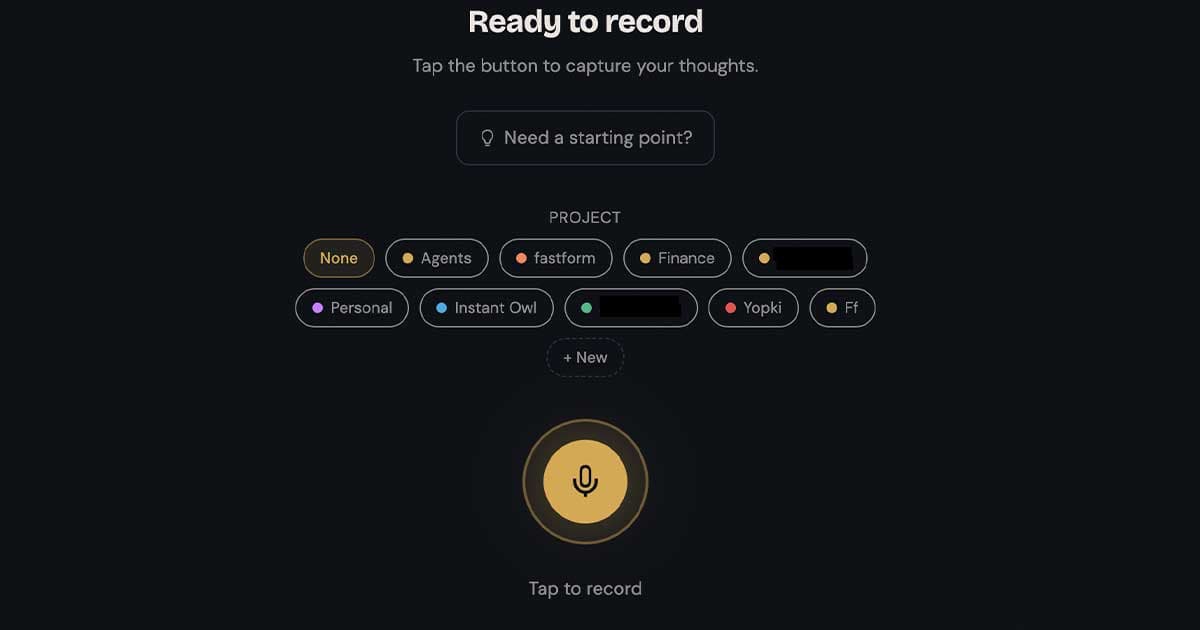
Full disclosure: InstantOwl is our product, and this is our blog. We are not a care-team platform or a med-reminder system, and we are not trying to be. We are built for the ramble: the two-minute car debrief after a doctor's visit, the end-of-day recap, the voice note you would otherwise have to hold in your head until you find a pen.
One recording turns into organized notes and a task list instead of a wall of transcript you have to sort through yourself. Ask a question across everything you have recorded, like what the cardiologist said about the last medication change, and get an answer pulled from your own notes instead of scrolling back through weeks of recordings. It is the same consent-free debrief logic that works after a phone call, applied to any conversation you were part of: you talk, we organize, no one else's permission required.
InstantOwl is currently free to use. It runs in the browser on your phone, no app store required, and buffers your recording locally if the signal drops in a hospital basement or a parking garage, syncing once you are back online. For a caregiver managing the small business that caring for a parent has become, that is one less thing to carry in your head.
Frequently asked questions
How do I write caregiver notes?
The simplest habit is a short voice debrief right after anything that matters: a doctor's visit, a call with a sibling, a hard afternoon. Say what happened in your own words while it is fresh, then let it become an organized note instead of leaving it as a raw recording you have to relisten to.
Can I record my parent's doctor visit?
Recording someone else's conversation is governed by state consent law, which varies and changes, so check Justia's fifty-state survey for where you live rather than relying on a list in a blog post, and ask the doctor and your parent before you press record even in a state that would technically allow it without asking.
How do I share caregiving notes with siblings or other family?
Turn your voice note into a written summary right after you record it, then copy, download, or export it as a PDF or Word document and send it to the family group chat or email thread, so everyone gets the same accurate version instead of a secondhand retelling.
Do I have to record every doctor's visit to remember what was said?
No. The National Institute on Aging's own advice for caregivers is to bring a list of questions and take notes during the visit, not to record it, and a quick spoken recap in the car afterward captures the same information without needing anyone's consent at all.

Written by
Jim BreeseJim Breese is the founder of InstantOwl. He's spent 15 years building companies, from an Airbnb host community he founded and exited to growth leadership at venture-backed SaaS startups. He built InstantOwl because his best ideas kept arriving mid-walk, out of order, and half-finished.
Stop losing good ideas.
InstantOwl turns a rambling voice note into a clean, organized document in moments. Just talk. We'll organize it.
 Try InstantOwl free