Medical Dictation Software: The Four Layers, Real Pricing, and the BAA Test
By Jim Breese · · Updated

What is medical dictation software?
Medical dictation software is not one category. It splits into four distinct layers (all built on what dictation now means: talking to software instead of a typist), and most buyer's guides blur them together, which is how a busy clinician ends up comparing a $49-a-month app to a developer tool that has no interface at all.
Layer one: ambient AI scribes. These listen to the actual patient visit and draft a clinical note from the conversation, with no dictation required. Dragon Copilot, Microsoft's newer ambient assistant, and DeepScribe are the two named in this space. DeepScribe uses custom, demo-gated pricing, per the vendor listicle that ranks for this search; we did not independently verify a specific rate this session.
Layer two: dictation into the EHR. The clinician still talks, but the software types the words directly into the electronic health record in real time. Dragon Medical One and VoiceboxMD both sit here. VoiceboxMD lists $49 to $79 a month, per its own product page, and includes a Business Associate Agreement on every plan.
VoiceboxMD also lists integrations with Epic, Cerner, athenahealth, Practice Fusion, eClinicalWorks, and MEDITECH, plus any system that accepts typed text, per its own site. It claims 99% accuracy on medical terminology, drug names, and ICD-10 and CPT codes. That number is the vendor's own claim, not a figure we tested.
Layer three: developer APIs. Amazon Transcribe Medical is not something a clinician opens. It is infrastructure other companies build dictation apps and ambient scribes on top of, per AWS's own product page. It is HIPAA-eligible and stateless, meaning it stores neither the audio nor the resulting text.
AWS names eight medical specialties the service supports: primary care, cardiology, neurology, obstetrics and gynecology, pediatrics, oncology, radiology, and urology, per its product page. That specificity is a sign it was built for clinical use, not adapted from a general transcription tool.
Layer four: hardware plus workflow. Philips sells SpeechMike microphones and Pocket Memo recorders alongside software that routes a dictation to a transcriptionist and back into the patient file, per Philips's healthcare page. This is the older delegation model: the doctor talks, a person types.
Philips claims this approach is up to seven times quicker than typing directly, per its own page. Its SpeechMike hardware adds speaker separation, a hygienic surface, and on some models a barcode scanner for linking a dictation to the correct patient file. Philips offers both on-premise and cloud hosting for the surrounding workflow software.
Knowing which layer a tool sits in matters more than any single feature list, because the four layers are priced, sold, and secured in completely different ways.
What happened to Dragon Medical?
Dragon Medical did not disappear. Consumer Dragon products have been discontinued, but Dragon Medical is a separate, still-active product line, now fully under Microsoft rather than Nuance.
Nuance's own healthcare page now redirects to Microsoft's health solutions site, and the standalone dragon.nuance.com site displays only a brand-transition message: "Nuance is now Microsoft." The old Nuance product store no longer exists.
Microsoft's current healthcare pages name three live products: Dragon Copilot, described as an AI clinical assistant; Dragon Medical One, described as advanced speech recognition; and PowerMic Mobile, a smartphone dictation accessory. Dragon Medical One is still sold as "additional licenses" through a contact-sales process, per Microsoft's own product page.
Microsoft is actively pushing existing Dragon Medical One customers toward Dragon Copilot as the newer, ambient successor. Microsoft publishes no price for either product on its own site. A $99-a-month, one-year figure for Dragon Medical One circulates online, but it appears only in a third-party vendor listicle (Lindy's), never on a Microsoft or Nuance page we could find. Treat that number as reseller-cited, not Microsoft's stated price.
Microsoft's health solutions page no longer names DAX Copilot on its own; that earlier ambient-scribe product has been folded into the Dragon Copilot brand, per Microsoft's own site. PowerMic Mobile, the third product Microsoft still names, turns a clinician's smartphone into a dictation microphone paired with Dragon Medical One, rather than a standalone tool.
For a clinician asking "is Dragon still around," the honest answer has two parts. Consumer Dragon is gone. Dragon Medical, the clinical product, is not gone; it has simply changed owners and branding, and Microsoft would clearly rather sell a new Dragon Copilot license than an old Dragon Medical One one. Anyone stranded by the consumer retirement, including clinicians who used Dragon for non-clinical writing, can find the replacement paths in our Dragon alternatives guide.
The BAA test
The real HIPAA checklist item for medical dictation is a signed Business Associate Agreement, not a marketed accuracy percentage. A BAA is the contract that lets a vendor legally handle protected health information on a covered clinician's behalf.
VoiceboxMD includes a BAA on every plan at no extra cost, per its pricing page. Amazon Transcribe Medical is HIPAA-eligible, which means the developer building on top of it still has to execute a BAA with AWS and build the surrounding app compliantly; the eligibility label alone does not make an end product compliant.
Philips's healthcare page describes an on-premise storage option and says "medical data is secure," but does not explicitly claim HIPAA compliance on that page. Consumer dictation apps, the kind built for personal notes rather than clinical documentation, do not offer a BAA at all.
That single question, does this vendor sign a BAA, sorts the market faster than any spec sheet. If the answer is no, the tool cannot legally touch a patient's name, diagnosis, or visit notes, no matter how accurate its transcription is.
Handling protected health information without a signed BAA is a HIPAA violation regardless of how carefully the recording is stored. That is why every layer-two and layer-three vendor above treats a BAA as central to its pitch, and why Philips's on-premise option exists at all: keeping the data off a third party's servers narrows what a BAA has to cover in the first place.
What does it cost?
Real pricing exists for exactly two of the four layers, and it is worth stating plainly rather than estimating the rest.
VoiceboxMD publishes $49 a month for its base plan and $79 a month for its Power plan, which adds an AI medical scribe feature, with a 7-day free trial and no contract, per its own site.
Amazon Transcribe Medical charges per minute of audio, with no license fee. AWS's own pricing example works out to $0.075 a minute, or $4.50 an hour, and a 15-minute physician conversation costs $1.125 by that math. The first 60 minutes each month are free for a developer's first 12 months.
Dragon Medical One and Philips's dictation and hardware products both publish no price. Both route buyers to a sales conversation instead. DeepScribe follows the same pattern, per the listicle that ranks for this search: custom, demo-required pricing with no public number.
If a vendor's page shows no price, that is itself useful information: it usually signals per-seat or per-organization contract pricing negotiated through sales, rather than a simple monthly plan a clinician can sign up for alone.
VoiceboxMD backs its published price with a 7-day free trial and no long-term contract, per its own pricing page, which is a meaningfully lower-commitment offer than the contact-sales process every other clinical-grade tool in this list uses.
A note on ranking listicles
The page currently ranking for "best medical speech-to-text" is a vendor's own list, and it says so plainly if you read past the headings. It names its own product first, calls it "the one I'd actually recommend," and repeats "How Can [this vendor] Help?" sections throughout the other four entries.
That is not necessarily dishonest, but it is not neutral either, and a clinician comparing tools deserves to know which recommendations are marketing and which are independently verified. The listicle in question ranks five tools in this order: itself first, then DeepScribe, Dragon Medical One, Amazon Transcribe Medical, and Notta, a general transcription app not built for clinical documentation at all; where Notta actually earns its place is a general-purpose question our Notta vs Otter breakdown answers with verified numbers.
That same listicle is the source of the $99-a-month Dragon Medical One figure mentioned above, a number we could not confirm on any Microsoft or Nuance page. The safest habit: check every price and claim against the vendor's own official pricing page before deciding, rather than trusting a single ranked list, especially one written by a competitor.
A note for non-clinical notes
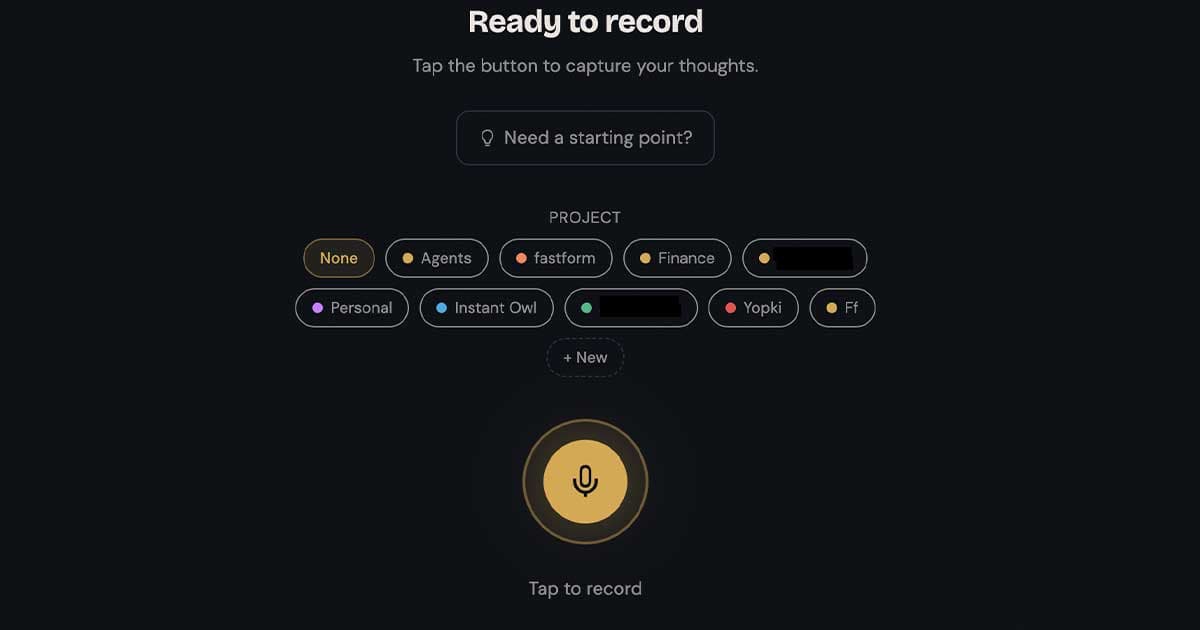
Full disclosure: InstantOwl is our product, and this is our blog. InstantOwl is not HIPAA-certified medical software, and nothing above changes that. It does not belong on this list, and it is not a substitute for any tool that signs a BAA.
The one narrow case worth naming: a clinician's own non-patient thinking, a lecture idea between patients, a personal to-do, a reflection with no patient information in it at all, can be captured in a general voice tool, a split our guides to voice notes for nurses and for therapists each walk through in detail. InstantOwl is one option for that, currently free to use. The moment a recording includes anything about a patient, that use case ends, and the BAA-backed tools above are the only correct choice.
Related reading
- Dictation software: the broader consumer dictation landscape, including what happened to consumer Dragon.
- Transcription services: for audio that already exists and needs to become text, the human-versus-AI price comparison.
Frequently asked questions
What do doctors use for dictation?
Doctors use one of four kinds of tools: ambient AI scribes that draft the note from the visit conversation (Dragon Copilot, DeepScribe), dictation software that types directly into the EHR (Dragon Medical One, VoiceboxMD), developer APIs that vendors build on (Amazon Transcribe Medical), or dictation hardware paired with a transcriptionist workflow (Philips SpeechMike and SpeechLive).
Is Dragon Medical still available?
Yes. Dragon Medical One is a live, separately sold product line under Microsoft, still available by license through a contact-sales process. Nuance's consumer branding has been retired, and Microsoft is actively migrating Dragon Medical One customers to Dragon Copilot, its newer ambient AI assistant, but Dragon Medical One itself has not been discontinued.
What is the cheapest HIPAA-compliant dictation?
Among tools with a published price, VoiceboxMD is the cheapest at $49 a month, with a Business Associate Agreement included on every plan. Amazon Transcribe Medical costs less per minute, about $0.075, but it is a developer API for building an app, not a dictation tool a clinician opens and uses directly.
Can I use a regular dictation app for medical notes?
Not for anything containing patient information. A regular consumer dictation app has no Business Associate Agreement, which is the standard HIPAA requires for handling protected health information. A regular app is fine only for a clinician's own non-patient notes, like a personal to-do or a lecture idea.

Written by
Jim BreeseJim Breese is the founder of InstantOwl. He's spent 15 years building companies, from an Airbnb host community he founded and exited to growth leadership at venture-backed SaaS startups. He built InstantOwl because his best ideas kept arriving mid-walk, out of order, and half-finished.
Stop losing good ideas.
InstantOwl turns a rambling voice note into a clean, organized document in moments. Just talk. We'll organize it.
 Try InstantOwl free