Voice Memos: The Complete Guide (iPhone and Android)
By Jim Breese · · Updated
What is Voice Memos?
Voice Memos is Apple's free, built-in recording app, included on every iPhone in the Utilities folder. It exists for one job: hit record, capture whatever you are saying or hearing, and stop when you are done. Recording pauses and resumes mid-take, and you can drag the waveform to scrub to any point, per Apple's support guide.
Every Voice Memos recording syncs automatically across your devices. As long as Voice Memos is turned on in your iCloud settings, a memo recorded on your iPhone shows up on your iPad and Mac under the same Apple Account, per Apple. There is no separate upload step, no export, nothing to remember to do.
Two features solve real recording problems. Voice Isolation, available from Control Center, filters out background noise while you talk. Wide Spectrum does the opposite and keeps ambient sound in the recording, though it is not available on every iPhone model. Newer iPhones record in Spatial Audio by default, and you can switch to Mono or Stereo in Settings > Apps > Voice Memos > Recording Mode, per Apple's guide.
One gotcha catches people off guard. Voice Memos stops recording the moment another app on your phone starts playing audio, according to Apple. A podcast starting, a notification sound, even the wrong tap, and the recording ends right there, mid-thought, with no warning banner to tell you it happened.
On iPhone 12 or later, Voice Memos also transcribes what you said, in English and nine other languages including Spanish, Portuguese, Italian, French, German, and Japanese, per Apple's transcription guide. Search works across both memo titles and the words inside a transcript, and tapping a result jumps playback to that exact moment. The app itself is rated 4.8 stars from about 1 million App Store ratings, a volume of reviews no competing recorder comes close to.
How do you use Voice Memos on iPhone?
Open Voice Memos, tap the red record button, and tap it again to stop, per Apple's support guide. That is the entire core loop. A finished recording saves under the name New Recording, or under your location's name if Location Services is turned on for the app.
A few details make the basics work better. Move the phone closer to or farther from what you are recording to adjust the input level. Tap pause mid-recording, then Resume to keep going in the same file instead of starting a new one. Swipe up from the top of the waveform to see recording details, and watch for the orange dot that appears whenever the microphone is active, per Apple.
Voice Memos also edits after the fact. Per its own App Store listing, the app supports trim and replace: cut a section out of a recording, or re-record over part of it instead of starting the whole thing over. Playback includes adjustable speed and a skip-silence option, so a long, rambling memo can be reviewed faster than it was recorded, per the same listing.
What Voice Memos does not do is organize for you beyond a title. A recording is named after a place, or left as New Recording 14, and nothing sorts it into a project, pulls a task out of it, or notices that three memos this week were about the same idea. That gap is the real story later in this guide.
What about Android?
Apple does not make Voice Memos for Android, so the closest widely used answer is a third-party app. The one that actually holds broad daily use is Voice Recorder & Voice Memos by Simple Design Ltd., rated 4.8 stars from 266,000 reviews with more than 10 million installs on the Play Store, last updated July 13, 2026. It is free, with ads and in-app purchases.
The app ships five recording modes: Meetings & Lectures, Music & Raw Sound, Standard, Live Transcribe (real-time speech to text in multiple languages), and Internal Recording, which captures the phone's own internal audio and stores it locally only. It also backs up to Google Drive, suppresses background noise, runs from a widget or notification, and records in the background. Call recording is explicitly not supported, per its own Play Store listing.
The honest caveats come straight from its own top-voted 2026 reviews. One from February 8 reports losing recordings entirely after an app update, with 37 people marking it helpful; the developer's reply points affected users to a specific storage folder to check manually. Another from February 19, with 29 helpful votes, describes a persistent crackling noise on nearly every recording regardless of mode. A May 28 review reports that trimming a recording distorts the frequency balance, drowning the subject under background noise.
If you own a Pixel phone, Google's own Recorder app is the stronger built-in option, with real-time transcription starting on Pixel 3 and AI-generated summaries on Pixel 8 and later, per Google's Pixel support documentation. It just is not available outside Pixel hardware, which is why the third-party app above is the more realistic answer for most Android phones.
What do people actually use voice memos for?
People use voice memos to catch a thought before it disappears, usually while their hands are busy elsewhere. Recurring examples straight from real users of voice-memo apps: brainstorming an idea out loud, building a to-do or grocery list while driving, walking, or cooking, and recording interviews to transcribe later, per one Android voice-memo app's own pitched use cases.
Daily journaling is another common pattern. It needs no more setup than opening the app and talking, which is exactly why people default to it over typing a page before bed. Personal recall is the other major use: people record a memo the way they would jot a sticky note, meaning to store a memory or an idea and come back to it later, a use case one voice-memo tool's own marketing page names directly.
A Reddit thread of iPhone users comparing transcription tools shows a related pattern: people accumulate a real backlog, not just one-off memos. One searcher put it plainly: "I have a whole bunch of voice memos that I would like to transcribe into text format." Several replies described transcribing an hour-long interview or a 90-minute memo "filled with technical language," evidence that voice memos are not just quick ten-second reminders for a lot of people. They are long recordings that pile up faster than anyone gets around to dealing with them.
The pile problem: what happens after you record
The pile problem is what happens after you have recorded fifty voice memos: a list of files named New Recording 12 through New Recording 61, or a string of location names that mean nothing three weeks later. Voice Memos gives you a transcript and a search bar on iPhone 12 or later, but neither one sorts a memo into a project, pulls a task out of it, or tells you which of forty recordings was actually about the dentist appointment.
This is the same wall the Reddit searcher above ran into. He did not just want a transcript for its own sake; he wanted his backlog turned into something usable, and the top community answer he got pointed to a third-party app, not a native fix. Our guide to transcribing voice memos covers exactly how to work through a backlog like his, and what each option actually costs.
Even the use-case pages built around voice memos run into this same gap. A free browser tool built entirely around the "personal recall" use case still leaves you with a pile of separately titled clips at separate links, with no structure connecting any of them. A transcript, or a shareable link, is not the same thing as an organized note. Our guide to voice notes covers the difference between sending a voice message and keeping one for yourself, and the keeping half runs into this exact wall every time.
Where InstantOwl fits
Full disclosure: InstantOwl is our product, and this guide is published on its blog. If all you want is a plain recorder app, say so plainly: Apple's Voice Memos is free, built into every iPhone, and rated 4.8 stars from about 1 million ratings. There is no reason to replace it for plain recording.
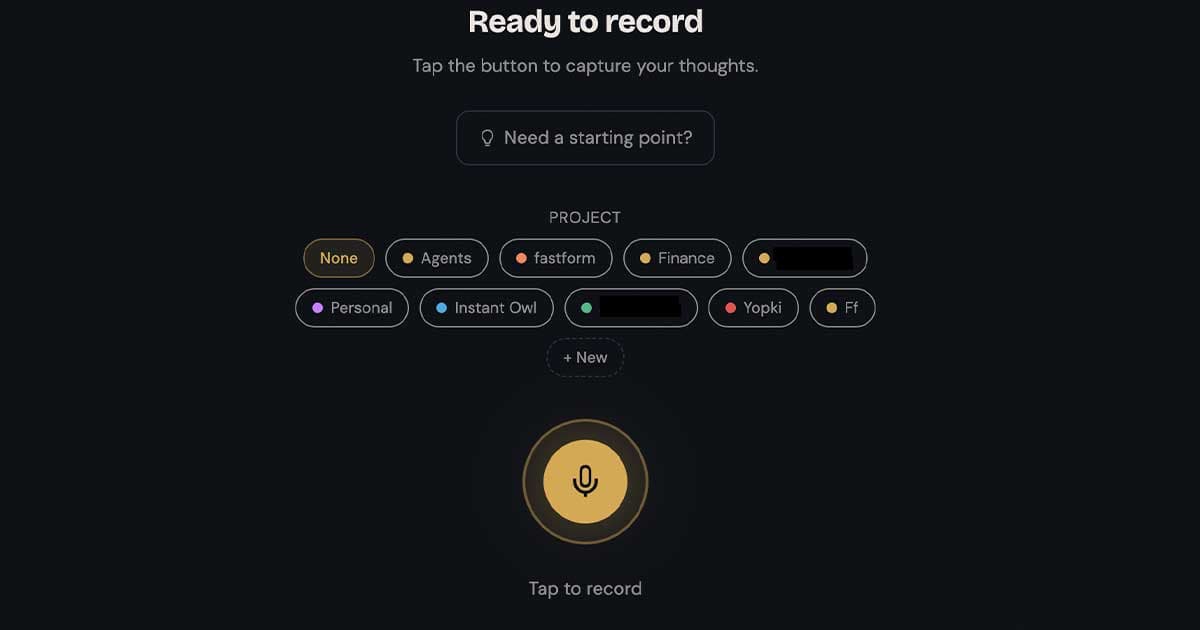
InstantOwl solves a different problem, the one this guide has been building toward: the pile. Instead of recording into Voice Memos and sorting the mess out later, you talk into InstantOwl and the organization happens as part of capture. One recording comes back titled and sorted into the right project, with any tasks pulled out on their own, instead of landing as one more untitled file next to forty others.
That matters most for the person recording daily, not occasionally: an idea in the car, a reminder walking into a store, a thought at your desk that would otherwise turn into memo number sixty-two. InstantOwl is currently free to use. If you want a wider look at how the options compare, job by job, our roundup of voice notes apps covers plain recorders, meeting tools, and cleanup apps side by side.
Related reading
- Voice notes: how to send them, keep them, and actually use them: the difference between a voice note you send and a voice memo you keep.
- The best voice notes apps in 2026: plain recorders, meeting tools, and organized capture, compared by job.
- How to transcribe voice memos: what your options actually cost once the backlog builds up.
Frequently asked questions
Where are voice memos stored on iPhone?
Recordings live in the Voice Memos app itself and sync through iCloud. As long as Voice Memos is turned on in your iCloud settings, a memo recorded on your iPhone appears automatically on your iPad and Mac under the same Apple Account, per Apple's support guide.
Does Android have Voice Memos?
Apple does not make a Voice Memos app for Android. The closest widely used equivalent is Voice Recorder & Voice Memos by Simple Design Ltd., rated 4.8 stars from 266,000 reviews with more than 10 million installs, though it is ad supported. Pixel owners have a stronger built in option in Google's own Recorder app.
Can Voice Memos transcribe recordings?
Yes. On iPhone 12 or later, Voice Memos transcribes recordings automatically in English and nine other languages, including Spanish, French, German, and Japanese, per Apple's support guide. You can search by the words inside a transcript, not just a memo's title.
Why does Voice Memos stop recording by itself?
Voice Memos stops recording the moment another app on your iPhone starts playing audio, according to Apple's support guide. A podcast starting or a notification sound is enough to end the recording mid-take, so it helps to close anything that might play sound before you start.

Written by
Jim BreeseJim Breese is the founder of InstantOwl. He's spent 15 years building companies, from an Airbnb host community he founded and exited to growth leadership at venture-backed SaaS startups. He built InstantOwl because his best ideas kept arriving mid-walk, out of order, and half-finished.
Stop losing good ideas.
InstantOwl turns a rambling voice note into a clean, organized document in moments. Just talk. We'll organize it.
 Try InstantOwl free