Hands-Free Note Taking: For Driving, Walking, and Full Hands
By Jim Breese · · Updated
How do you take notes when your hands are busy?
When your hands are busy, typing is not an option, so capture has to be voice-first. Three situations come up constantly: driving, walking, and cooking or working with your hands full. Each needs a different setup, and the one that matters most to get right, because the stakes are highest, is driving.
The mistake most people make is figuring out their hands-free method mid-task: fumbling with an app while merging onto a highway, or trying to unlock a phone with wet hands over a cutting board. The fix is deciding your method for each situation ahead of time, so capture is a single motion when the moment hits.
The cost of skipping this is not abstract. An idea that shows up while your hands are full and passes without being said out loud does not usually come back later in the same shape, if it comes back at all. That is the whole reason a hands-free method is worth setting up before you need it rather than improvising in the moment.
Is it safe to take hands-free notes while driving?
Only hands-free, and this comes before anything else in this post. Use CarPlay or Android Auto voice recording, a wake-phrase assistant, or start recording before you pull out of the driveway. Keep both hands on the wheel and your eyes on the road the entire time.
Never unlock your phone, open an app, or type while the car is moving. If your car or phone is not set up for hands-free recording yet, the safe move is simple: park, record while stopped, then drive. A thirty-second delay costs nothing. A phone in your hand at a stoplight is not worth it.
Once hands-free recording is set up, the note-taking becomes part of the drive itself instead of a separate task competing with it. A wake-phrase assistant or a CarPlay-integrated recording app both work for this; what matters is that the recording starts without your hands leaving the wheel.
If you have not set any of this up yet, that is fine. Park first, record while stopped, and set up the hands-free version before your next drive. Nobody gets this right on day one, and there is no penalty for taking the safe route until the fast route is actually ready.
What's the best way to capture notes while walking or cooking?
Walking is the easiest of the three: pull your phone from your pocket, hit record on a quick-launch app, and talk while you keep moving. A recorder pinned to your phone's lock screen or home screen removes the extra taps that turn a two-second capture into a fumble.
Cooking and other hands-dirty work call for a voice assistant instead of touching the phone at all. Saying something like "create a note" or "take a note" to your phone's assistant gets a quick line down without unlocking anything, though the exact phrasing your assistant expects can vary by device, so it is worth testing once before you rely on it mid-recipe.
Both situations are more forgiving than driving: if the first attempt fails, you can usually just try again a few steps later or after the pan is off the heat. That is exactly why driving gets the safety rule above and these do not.
The two scenarios share one requirement, though: whatever you use has to be reachable in a single motion. A recorder buried three menus deep loses to the moment every time, whether that moment is a sidewalk, a stovetop, or a shoot with a camera in both hands.
Why is hands-free capture still this hard?
Because most note apps assume you can look at a screen and tap through menus, and hands-free moments give you neither. Boone Ashworth put it plainly in a 2024 Wired roundup of note-taking apps: "So you pull out your phone and start swiping through your apps. But there's no good option for dictating your thoughts. All your apps are either too slow or too cumbersome to whip open in a pinch."
That friction is the whole reason hands-free capture needs its own toolkit rather than just using whatever note app you already have open. The apps built for typing are not built for a driver, a real estate agent dictating notes between showings, a nurse decompressing on the drive home from a shift, a dog walker, or someone with flour on both hands.
What's the best hands-free note-taking toolkit right now?
Start with what is already on your phone: your voice assistant. On iPhone, saying something like "create a note" or "take a note" to Siri starts a note without touching the screen. Habits worth knowing: the first line you say typically becomes the title, punctuation has to be spoken out loud to appear, and a few seconds of silence ends the note. It is fast, but it stays a flat, unorganized note.
For a dedicated hands-free lane, Just Press Record from Open Planet Software is the strongest single-purpose pick. It costs $6.99 one-time on the App Store today (v51.2, rated 4.3 stars from more than 1,500 ratings), and runs on iPhone, iPad, Mac, Apple Watch, and Apple Vision Pro. One-tap recording starts straight from an Apple Watch Complication or a Siri Shortcut, with recordings syncing to your iPhone through iCloud. If you would rather dictate straight into a text field on the watch instead of recording an audio file, our voice to text on Apple Watch guide covers the setup and the four reasons it stops working.
Background recording, no length limit, and transcription in 30+ languages come with it. One older ranking roundup still lists it at $4.99; that figure is outdated. What it will not do is organize your words: it transcribes, and you sort out the rest.
Your phone's built-in recorder still matters here too. We cover exactly how Voice Memos and its transcription work on iPhone, including the gotcha where a recording stops the moment another app plays audio, which is worth knowing before you trust it hands-free in the car.
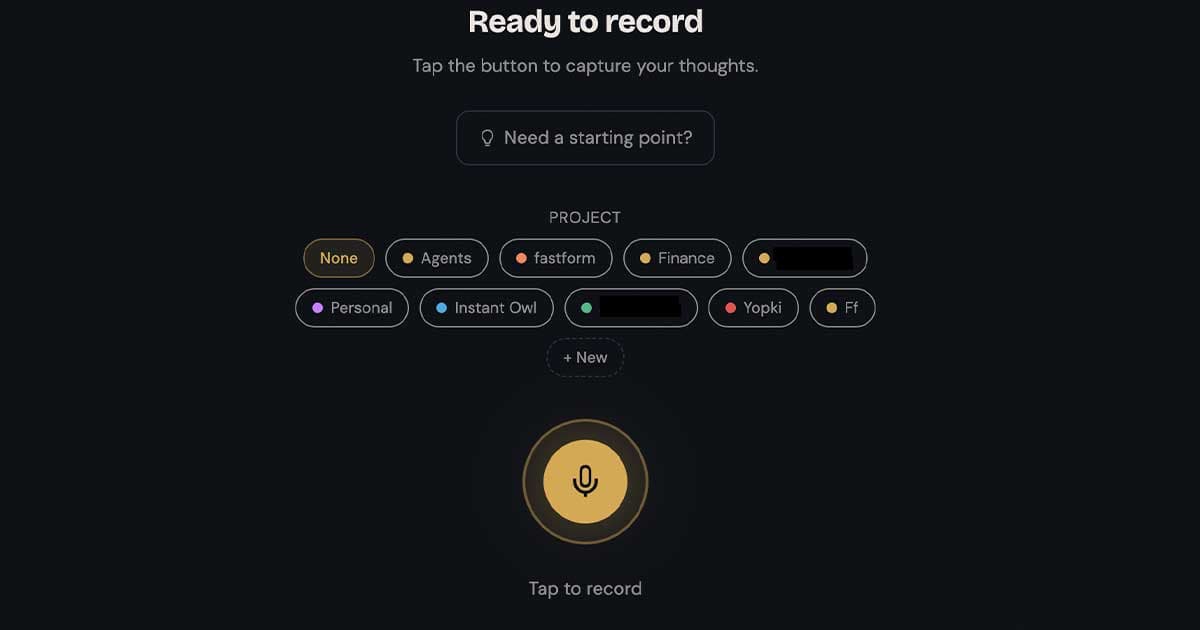
This is where InstantOwl fits, disclosed as our own product. It is not a watch app and it has no wake-word yet, so for driving specifically, start the recording before you move or trigger it through an assistant, then let InstantOwl organize the result afterward. A screen wake lock keeps the phone's screen from locking itself while a recording is running, and the recording buffers locally and syncs once you are back in range if a connection drops mid-walk.
Once you talk, InstantOwl turns the ramble into organized notes and tasks instead of leaving you with a flat transcript to sort by hand. InstantOwl is currently free to use.
Is the demand for hands-free note taking real?
Yes, and it shows up in the exact words drivers use to ask for it. In Evernote's own community forum, one driver described wanting to say a note out loud while listening to a podcast in the car, without touching the phone at all, and have it land directly in the right notebook.
Another forum member, one who replies with expert status on that board, could not point to a built-in way to do it. The workaround that reply described instead: record on an Apple Watch, let the phone transcribe it, then share the text into the note app by hand. That is a three-step workaround for something that should be one tap.
The same reply notes it gets messier on Android, where a third app is needed just to grab the spoken words and move them into the note at all. Whichever phone you carry, the request is the same one this post opened with: say it once, hands-free, and have it land somewhere useful.
How is this different from a general AI note-taking app?
This post is about the hands-busy moment: driving, walking, cooking, anything where looking at a screen or typing is not an option. That is a narrower problem than general AI note-taking, which is usually about turning a meeting or a long recording into a structured summary after the fact. If that broader comparison is what you need, our AI note-taker roundup covers it.
If you send voice notes to other people as often as you keep them for yourself, our guide to voice notes covers the etiquette and the send-versus-keep distinction. And if the moment that triggers your best ideas is oddly specific, like a shower thought or a string of scattered voice memos you never listen back to, those posts cover the adjacent capture-when-you-cannot-write problem directly.
The common thread across all of it: speaking is the fast part, and it always has been. What happens to your words after you stop talking is the part worth choosing carefully.
Frequently asked questions
How do I take notes hands free?
Use your phone's voice assistant to start a note, a dedicated recording app you can trigger without unlocking your phone, or a smartwatch's one-tap recorder. The method depends on the situation: driving needs a hands-free setup done before you move, walking and cooking are more forgiving.
How do I take notes hands free while driving safely?
Only hands-free, and set it up before you drive. Use CarPlay or Android Auto voice recording, a wake-phrase assistant, or start recording before you pull out of the driveway. Never unlock, hold, or type on your phone while the car is moving. If hands-free is not set up yet, park first, record, then drive.
What is the best hands-free note-taking app?
It depends on the job. Just Press Record is the strongest pick for one-tap Apple Watch recording at $6.99 one-time. InstantOwl is built for when the input is a rambling voice note and you want organized notes and tasks back, and is currently free to use.
Can I take hands-free notes on my Apple Watch?
Yes. Just Press Record supports one-tap recording directly from an Apple Watch Complication or a Siri Shortcut, with the recording syncing to your iPhone through iCloud. It costs $6.99 one-time on the App Store and transcribes in 30+ languages, but it does not organize what you said.

Written by
Jim BreeseJim Breese is the founder of InstantOwl. He's spent 15 years building companies, from an Airbnb host community he founded and exited to growth leadership at venture-backed SaaS startups. He built InstantOwl because his best ideas kept arriving mid-walk, out of order, and half-finished.
Stop losing good ideas.
InstantOwl turns a rambling voice note into a clean, organized document in moments. Just talk. We'll organize it.
 Try InstantOwl free