How to Capture Ideas While Driving (Without Taking Your Eyes Off Anything)
By Jim Breese ·
Is it safe to capture ideas while driving?
Only if you do it entirely hands-free, and even then, only in short bursts. The CDC defines distracted driving around three types of distraction: "Visual: taking your eyes off the road. Manual: taking your hands off the wheel. Cognitive: taking your mind off driving." A hands-free voice note solves the first two. It does not solve the third.
That third category is the one most driving-and-productivity advice skips. Talking through a complex idea while merging onto a highway takes your mind off driving even if your hands never leave the wheel and your eyes never leave the road. Hands-free is necessary. It is not, on its own, cognitively free.
The stakes are not abstract. The CDC reports that "nine people in the United States are killed every day in crashes that are reported to involve a distracted driver," attributing the figures to federal crash data. It also reports that "over 3,100 people were killed and about 424,000 were injured in crashes involving a distracted driver in 2019." Those numbers are the reason this post leads with safety instead of a list of apps.
The honest rule that follows from all three distraction types: capture short, capture hands-free, and treat anything longer than a sentence as a reason to pull over. The rest of this post shows you exactly how to set that up.
What's the law on voice notes while driving?
It depends on your state, and nobody should tell you otherwise without checking. Handheld phone rules and hands-free requirements are set state by state, not federally, so the same voice-note habit that is fine in one state can be a citation in another.
The Governors Highway Safety Association tracks this directly. As of its most recent update in October 2025, with laws last reviewed by state highway safety offices in June 2025, 33 states plus D.C., Puerto Rico, Guam, the Northern Mariana Islands, and the U.S. Virgin Islands ban all drivers from using a handheld cellphone while driving. 49 of those same jurisdictions ban text messaging outright for all drivers.
This is not legal advice, and this post is not a substitute for checking GHSA's page for your own state before you rely on any in-car capture method. The safest posture, regardless of what your state technically allows, is the same one CDC's cognitive-distraction category points to: hands-free, brief, and set up before you start driving, not while you are already moving.
Set your capture method up before you drive
The single biggest mistake in this whole topic is figuring out your method mid-drive. Fumbling with an app, hunting for a setting, or trying a voice command for the first time while merging onto a highway defeats the entire point of hands-free capture.
Do this in the driveway instead, before you back out. Confirm your steering wheel voice button or wake phrase actually launches your assistant. Say a test note out loud and check where it landed. If you plan to use an app instead of your phone's built-in assistant, open it once, parked, and confirm it starts recording without unlocking your screen.
Thirty seconds of setup in a parked car buys you a habit that works every time you need it later. Skipping that thirty seconds is how people end up glancing at a screen at 60 miles an hour trying to figure out why their note did not save.
How do you capture an idea with Siri in the car?
Siri has the most complete, officially documented in-car capture path of any option covered here. According to Apple's own guide to using Siri in your car, you activate it by pressing and holding the voice command button on your steering wheel, touching and holding the equivalent button on a CarPlay touchscreen, or saying "Hey Siri" in a supported vehicle.
Apple documents an actual capture example on that same page, not just an activation method: "Remind me to pack an umbrella when I get home." That is Apple itself showing a reminder being created from the steering wheel, which is a stronger guarantee than most driving-productivity advice can point to.
Apple also documents a hold-to-talk tip worth using: "Instead of waiting for Siri to notice that you've stopped talking, you can press and continue to hold the voice command button on the steering wheel while you speak, then release it when you finish." For older cars without CarPlay, Siri Eyes Free works the same way over a plain Bluetooth connection.
Apple's car-specific page documents reminders, not notes. Real drivers use Siri for notes too. In a forum thread about safe ways to capture ideas while driving, one driver described the exact problem this post is solving: "I often have thoughts or ideas when I'm in the car, but I have no easy way to capture them. I have an iPhone, but I don't want to fiddle with it while I'm driving."
The top-voted reply described a simple chain: "I just hit the siri button and asked her to take a note, then babbled some stuff and it made a note in the Notes app. All the text was pretty correct. If your car has CarPlay, you may be able to start Siri from your steering wheel!" A second reply confirmed the same chain end to end: hit the button, say "take a note," the text lands in Notes, and it syncs through iCloud so it is readable later from any computer, no unlocking required.
That thread is community-verified, not Apple-documented, for the note-taking case specifically. Treat it as a real, working habit, set up and tested once while parked before you lean on it at speed.
What about Android and Google Assistant in the car?
Android's official in-car documentation is narrower than most people assume, and it is worth knowing that before you build a habit around it. According to Google's Android Auto support page, you activate Assistant by saying "Hey Google," tapping the microphone, or pressing the voice command button on your steering wheel. The documented command categories are calls, messages, directions, and music.
Google's own guide to Assistant commands in the car lists the same narrow scope: navigation, car controls, media, and communication. Neither official page documents a note, reminder, or list command for in-car use. That is a real, sourced gap, not an oversight in this post.
"Hey Google, take a note" does work for a lot of Android drivers in practice, saving into Google Keep, but it is a general Assistant feature, not something Google's car-specific documentation promises. The same forum thread that covered Siri's Notes chain confirmed the Android version too, with two caveats worth setting up before you drive: "Assistant Responses on Lock Screen" needs to be turned on in your phone's settings first, and more than one commenter noted the place Assistant saves notes has changed over time, so it is worth confirming where yours land.
One more freshness note: Google states that Gemini is replacing Google Assistant on most mobile devices, with Assistant users being upgraded to Gemini through 2026, so the exact voice prompt that works for you may shift as that rollout reaches your phone.
The honest asymmetry, stated plainly: Siri's car documentation includes a reminder-capture example straight from Apple. Android's car documentation does not include a note-capture example from Google. Both platforms can capture a note hands-free in practice. Only one of them shows you the receipt.
When should you just pull over?
When the idea needs more than one breath to say. A hands-free voice note is built for a single sentence: "call the dentist," "check the Henderson quote," "look up that espresso machine." It is not built for working through a plan, a pitch, or anything with more than one moving part.
That distinction connects straight back to the CDC's cognitive-distraction category from the top of this post. A one-sentence capture barely registers as a mental load. A multi-step idea, worked out loud while merging lanes, is exactly the kind of distraction hands-free tools cannot fix, because the problem was never your hands.
The fix costs almost nothing: find a safe place to stop, park, finish the thought properly, and then get back on the road. A parked capture takes thirty seconds longer than a rushed one and loses nothing. The same instinct that makes you pull over for a phone call that actually matters applies here. If an idea is worth getting right, it is worth thirty seconds parked.
What do you do with the idea once you're at your destination?
You turn the raw capture into something usable, because a captured idea and an organized idea are two different things. Whatever method got the words down in the car, whether Siri's Notes chain, Google Assistant into Keep, or a recording you started before you pulled out of the driveway, what you have when you arrive is a rough, out-of-order ramble. That is fine. It was never supposed to be tidy at 60 miles an hour.
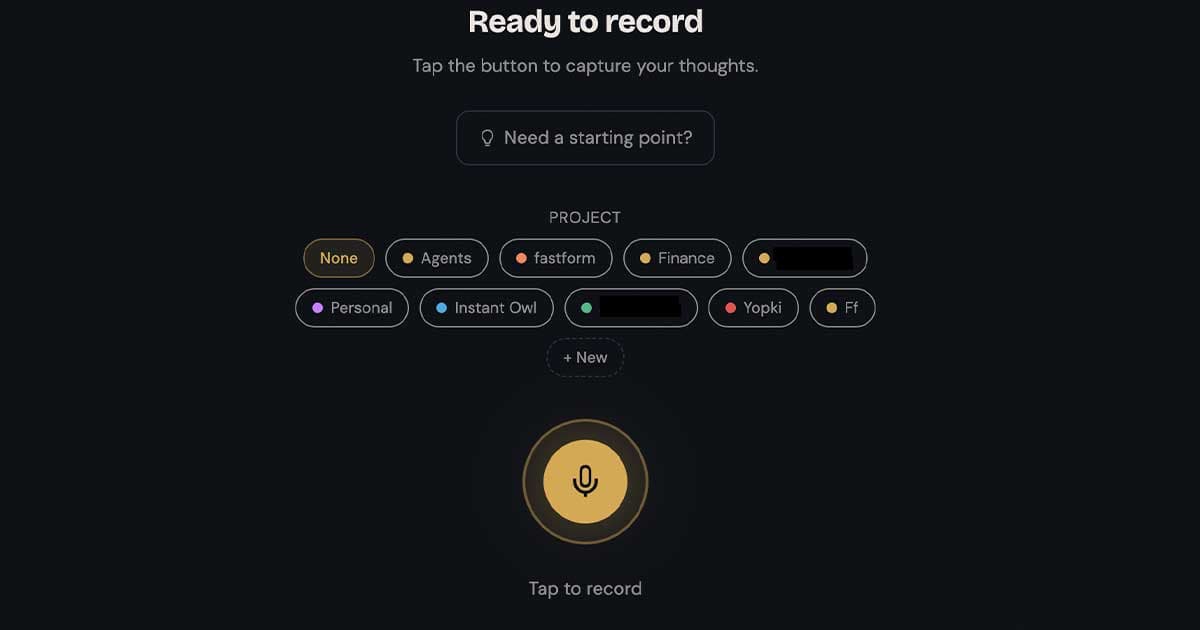
Full disclosure: InstantOwl is our product, and this blog belongs to it. InstantOwl does not have a wake word or a watch app, so the honest way it fits the driving scenario is either of two paths: start a recording before you pull out and let it run hands-free for the drive, or capture through Siri or Assistant in the moment and paste or upload the result into InstantOwl once you arrive.
A screen wake lock keeps the recording running while it is active, and if a connection drops mid-drive, the recording buffers locally and syncs once you are back in range.
Once InstantOwl has the raw capture, it turns the ramble into organized notes and tasks instead of leaving you with a flat transcript to sort through by hand. That same between-stops habit works well beyond a single commute; a similar drive-time debrief works for real estate agents recording between showings, for the same reason it works for a single idea on a single drive: capture it while it is fresh, organize it later. InstantOwl is currently free to use.
Related reading
- Hands-free note taking: the broader toolkit for driving, walking, and any moment your hands are full.
- How to capture ideas before they vanish: the full system behind fast capture, not just the driving scenario.
- Why you get your best ideas in the shower: the same capture-before-it-fades problem, in a completely different setting.
Frequently asked questions
What is the safest way to capture ideas while driving?
Set up hands-free capture before you drive, not while you are moving. Use CarPlay or Android Auto voice activation, a wake phrase like Hey Siri or Hey Google, or start a recording before you pull out of the driveway. Never unlock, hold, or type on your phone while the car is moving.
Is voice-to-text legal while driving?
It depends on your state. Handheld phone bans and hands-free requirements vary, so check your state's current law through the Governors Highway Safety Association rather than assuming. This is not legal advice; when in doubt, treat any phone interaction as something you do parked, not moving.
Is Siri or Google Assistant better for capturing notes in the car?
Siri has a documented advantage: Apple's own iPhone guide shows a reminder capture example activated from the steering wheel. Google's official Android Auto and Assistant-in-car pages document calls, messages, navigation, and music, but list no note or reminder commands, so a note habit on Android relies on general Assistant behavior, not a car-specific, documented feature.
What if the idea is too complicated to capture safely while driving?
Pull over. A hands-free voice note is built for a single sentence, not a structured plan. If an idea needs more than one breath to say, or you find yourself thinking instead of watching the road, find a safe place to stop, finish the thought, then get back on the road.

Written by
Jim BreeseJim Breese is the founder of InstantOwl. He's spent 15 years building companies, from an Airbnb host community he founded and exited to growth leadership at venture-backed SaaS startups. He built InstantOwl because his best ideas kept arriving mid-walk, out of order, and half-finished.
Stop losing good ideas.
InstantOwl turns a rambling voice note into a clean, organized document in moments. Just talk. We'll organize it.
 Try InstantOwl free