Voice Recorder Apps: Start With the One You Already Have
By Jim Breese · · Updated

What is the best voice recorder app?
For most people, the honest answer is the voice recorder already on their phone. Voice Memos on iPhone and Google's Recorder app on Pixel both record for free, show no ads, and can turn speech into searchable text without installing anything else. Neither one costs money or asks for a subscription.
That answer disappoints anyone hoping for a single downloadable pick, but the app store data backs it up. The most-installed dedicated recorder apps carry ads, in-app purchases, or both, and their own reviews document real reliability problems: lost recordings, apps that keep running after you close them, and features locked behind a monthly fee. A tool your phone already ships free rarely loses to one you have to pay to unlock.
The right next step depends on what you actually need. If you just want a clean recording with automatic transcription, start with the built-in and skip the rest of this list. If you need something the built-in cannot do, like recording internal audio or working from a phone without one, the third-party market has real options, just not always the top-ranked free ones.
Does your iPhone already have a voice recorder? Voice Memos, explained
Yes. Voice Memos ships on every iPhone, is free, and needs no setup beyond opening the app, tapping record, and tapping stop. It is rated 4.8 stars from roughly 1 million App Store ratings, a review volume no competing recorder app comes close to.
Recordings sync automatically across iPhone, iPad, and Mac through iCloud, as long as Voice Memos is turned on in iCloud settings, per Apple's support pages. On an iPhone 12 or later, Voice Memos also transcribes what you said, in English and several other languages, and lets you search a recording by the words inside its transcript instead of just its title.
Turn on Voice Isolation from Control Center to filter background noise while recording. One limitation worth knowing before you rely on it: Voice Memos stops recording the moment another app on the phone starts playing audio, according to Apple's guide, so a podcast or a notification sound mid-recording can cut a memo short.
Does Android have a built-in voice recorder? Google Recorder on Pixel
Yes, but only on Pixel. Google's Recorder app is free, shows no ads, and ships on Pixel 3 and later phones and Pixel Tablet, per Google's own support pages. It is not available for other Android phones or for iPhone.
Recorder's transcription gets stronger by phone generation, per Google's transcription support article. Real-time transcription works from Pixel 3 onward. Automatic language detection and speaker labels arrive on Pixel 6 and later. AI-generated summaries, built for 5 minutes to an hour of speech, are a Pixel 8-and-later feature processed in the cloud. Recorder supports 15 languages for real-time transcription and 39 or more when a recording is re-transcribed later, and it can search a recording for specific words, phrases, or even sounds like music or applause.
Backup to your Google Account is opt-in, not automatic. Turn it on and recordings sync to recorder.google.com, a web page where you can play back, search, and edit the title of any backed-up recording from a browser, per Google's support articles. Those backups count against your shared Google storage across Photos, Drive, and Gmail, and sharing a recording only works with people who have a Google Account of their own. Leave backup off and a recording lives only on the phone that made it.
The top-ranked Android recorder app, reviewed honestly
The Play Store's top result for "voice recorder" is an app simply named Voice Recorder, from a small developer account, rated 4.9 stars across 1.27 million reviews with over 50 million installs. Those numbers are real and worth taking seriously before dismissing the app.
What it actually does is narrow: it records to mp3 or ogg, offers adjustable sample rates and a live audio spectrum display, and can record with the screen off. Its own listing states plainly that it does not support call recording and has no transcription of any kind, no cloud backup, and no organization beyond a plain file list.
Two things from its own listing deserve attention before installing it. The app contains ads and in-app purchases, and its developer-declared data safety section states "Data can't be deleted," meaning no deletion mechanism is offered. A review on the listing, with 217 helpful votes, reports the app keeps running in the background and can keep serving ads after you close it, until the phone is restarted. None of this means the app fails at recording. It means the free, ad-supported version of "record my voice" comes with real trade-offs its own page discloses.
If transcription matters to you on Android, Simple Design's Voice Recorder & Voice Memos app is a stronger free pick: 4.8 stars, 266,000 reviews, over 10 million installs, and a Live Transcribe mode built in. Its own listing's top complaints are about crackling audio and recordings lost after an app update, so treat any Android recorder's reviews as part of the decision, not an afterthought.
The top-ranked iPhone recorder app, reviewed honestly
On the App Store, the top-ranked dedicated recorder outside Apple's own Voice Memos is TapMedia's Voice Recorder & Audio Editor, rated 4.7 stars from 451,000 ratings. It is free to download, with a feature list well beyond plain recording: AI transcription, summarization, translation, a voice changer, background noise removal, and cloud sync to iCloud, Dropbox, Google Drive, OneDrive, or Box.
The catch sits in its own pricing and privacy disclosures. The AI features, including transcription, sit behind $4.99 monthly subscriptions with one-week free trials, and the app's App Store privacy label discloses that location data and identifiers are used for third-party advertising and can track users across other apps. A free recorder that monetizes through ad tracking is a different product than Apple's ad-free, transcription-included Voice Memos, even though both show up under the same search term.
What to actually look for in a voice recorder app
Reliability comes first, because a recorder that loses recordings has failed at its only job. Both ranking apps above carry reviews describing exactly that: recordings disappearing after an update, or an app that keeps running after you think you closed it. Read the review section, not just the star rating, before trusting an app with something you cannot record twice.
After reliability, check four more things: whether it records in the background with the screen off, what file format it saves to and whether you can get files out easily, what its privacy label or data safety section actually discloses about tracking and deletion, and whether transcription is included or sits behind a subscription. A recorder that answers all four well is rare enough that the built-in options usually win by default.
Format matters more than it sounds. An app that only saves to a proprietary format, or only lets you share through its own menu, makes it harder to move a recording somewhere else later. The apps covered above save to common formats like mp3, ogg, or m4a, which is worth confirming before you build a habit around any recorder, third-party or built-in.
The one thing no app in this category solves, built-in or third-party, is what happens after you stop recording. Every option above hands you back a file, or at best a searchable transcript. None of them turns a rambling voice note into an organized note with a title, or pulls out the one task buried in the middle of it.
The after-recording gap: what happens to the pile
Even Google's best answer, Recorder with AI summaries on a Pixel 8, ends at recorder.google.com: a searchable pile of recordings you sign in to browse. Nothing in this category, built-in or third-party, turns a recording into an organized note on its own.
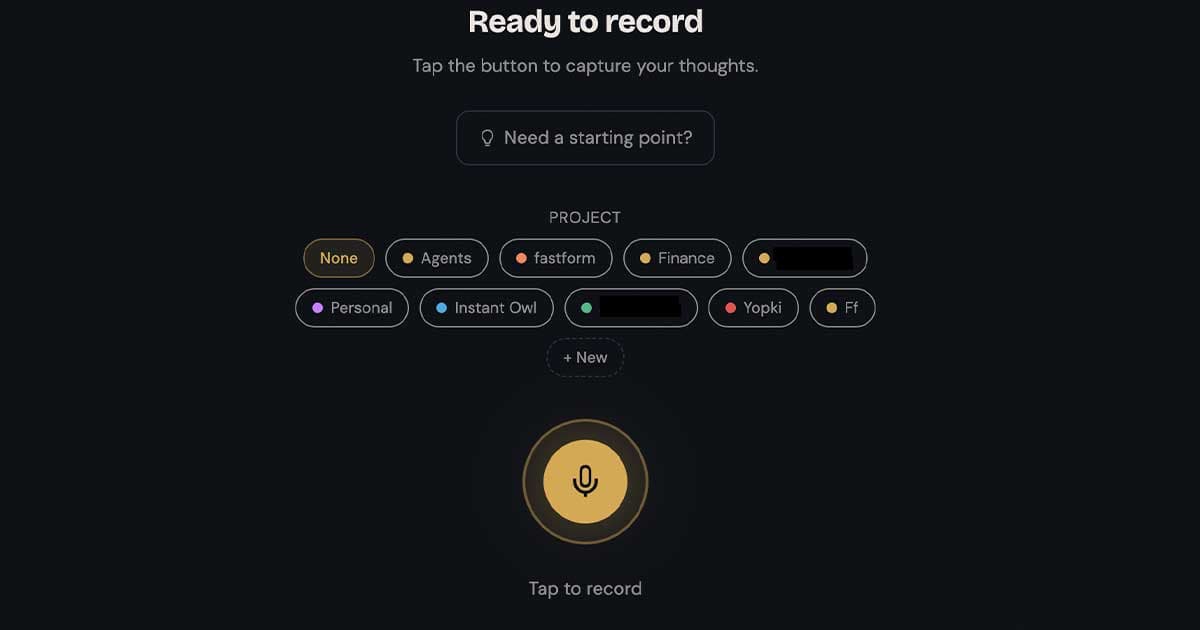
That gap is what InstantOwl is built to close. Full disclosure: InstantOwl is our product, and this blog belongs to it. It is not a recorder competing with Voice Memos or Google Recorder. It is the layer after one: talk, and the recording comes back as an organized note with a title, with any tasks pulled out automatically, instead of another file added to the pile. InstantOwl is currently free to use.
If plain recording and transcription are already solved for you by your phone, as covered above and in more depth in Voice Memos: The Complete Guide and voice notes, the open question is what to do with everything you have already recorded. A broader comparison of voice notes apps by the job each one is actually good at covers more of that ground, including where InstantOwl fits next to meeting-focused tools like Voicenotes.com and Otter.
Frequently asked questions
What is the best free voice recorder app?
Voice Memos on iPhone and Google's Recorder on Pixel are both free with no ads, and both transcribe automatically on supported phones. Among dedicated third-party apps, Simple Design's Voice Recorder & Voice Memos on Android adds a free Live Transcribe mode, though its own reviews flag crackling audio and lost recordings after updates.
Does my phone have a voice recorder?
Yes, on almost every phone. iPhone ships with Voice Memos built in. Pixel phones from Pixel 3 onward ship with Google's Recorder app. Other Android phones vary by manufacturer, so check for a preinstalled recording or dictaphone app before downloading a third-party one from the Play Store.
Which voice recorder app transcribes?
Apple's Voice Memos transcribes recordings automatically on iPhone 12 or later, in English and several other languages. Google Recorder transcribes in real time from Pixel 3 onward, with speaker labels and language detection on Pixel 6 and later, and AI summaries on Pixel 8 and later, per Google's own support pages.
Are voice recorder apps private?
It depends on the app, so check its privacy label or data safety section before recording anything sensitive. Apple's Voice Memos and Google's Recorder show no ads and disclose no third-party ad tracking. TapMedia's Voice Recorder & Audio Editor on iOS discloses that location data and identifiers are used for third-party advertising and can track users across other apps.

Written by
Jim BreeseJim Breese is the founder of InstantOwl. He's spent 15 years building companies, from an Airbnb host community he founded and exited to growth leadership at venture-backed SaaS startups. He built InstantOwl because his best ideas kept arriving mid-walk, out of order, and half-finished.
Stop losing good ideas.
InstantOwl turns a rambling voice note into a clean, organized document in moments. Just talk. We'll organize it.
 Try InstantOwl free