OGG to Text: The Voice Note Format and How to Transcribe It
By Jim Breese ·
Why do you have an OGG file?
OGG is a container, not a codec. Xiph.org, the nonprofit that maintains the format, describes Ogg as "a multimedia container format, and the native file and stream format for the Xiph.org multimedia codecs." A container is just a wrapper: the actual audio inside an .ogg file could be Vorbis (music, game audio) or Opus (voice messages), and the extension alone does not tell you which.
For most people who search "ogg to text," the answer is voice. WhatsApp and Telegram both settled on Opus-in-Ogg for their voice messages, and their own developer documentation says so directly. On Meta's WhatsApp Business Platform docs, voice message audio must be ".ogg files encoded with the OPUS codec," or "voice message transcription will fail." Telegram's Bot API still describes a voice recording as one "in an .OGG container encoded with OPUS," per Telegram's own documentation, though bots there can now also send a clip as a playable voice message in .MP3 or .M4A format.
That is the whole story in one sentence: OGG is the box, Opus is what is inside it, and two of the biggest messaging apps in the world chose that exact combination for voice notes. If you exported a voice message from a chat, forwarded a recording a friend sent you, or found an .ogg file sitting in a downloads folder, it is very likely someone's spoken voice, not a music track.
Which tools transcribe OGG directly?
Three tools accept .ogg files today without any conversion step first, and one common tool does not.
TurboScribe lists OGG among its accepted formats, per its own site, and gives 3 free transcripts a day with no card required. Any2Text lists OGG directly too, per its own page, and transcribes the first 15 minutes of any file free, no signup needed.
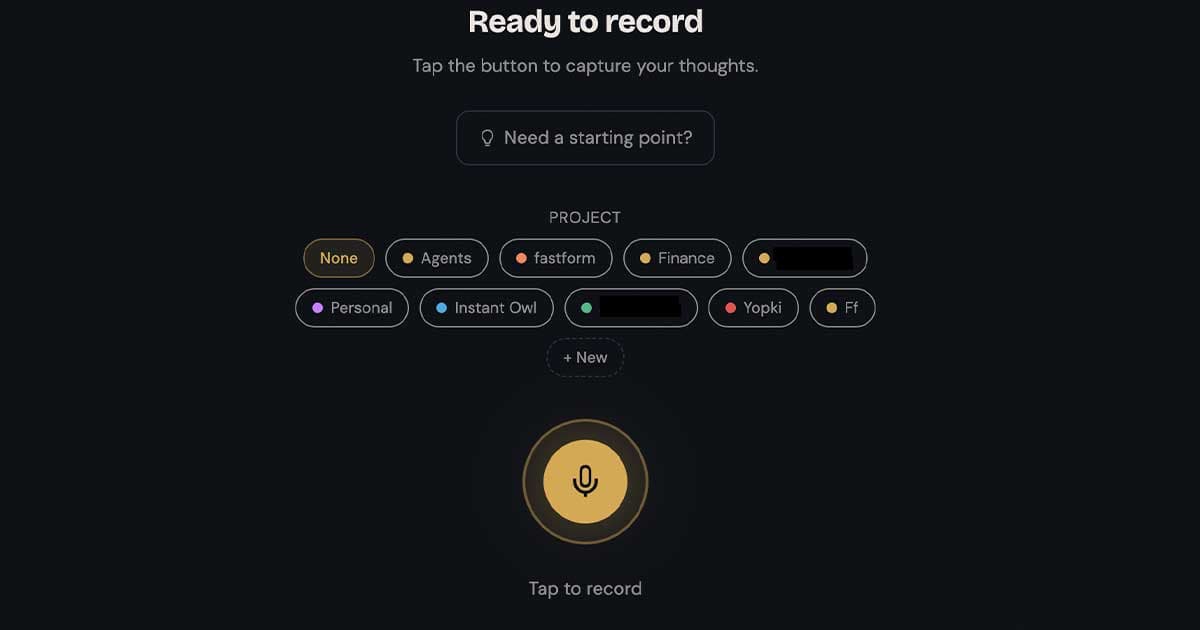
Full disclosure: InstantOwl is our product, and this is our blog. InstantOwl accepts .ogg natively as well, per its own upload documentation, and it is currently free to use. Where InstantOwl differs from a plain transcriber is what it hands back: not a wall of transcript text, but an organized note with any tasks pulled out, which matters most when the voice note is your own thinking rather than someone else's message.
Not every tool covers OGG. Per Microsoft's support page, Word's Transcribe feature "currently supports .wav, .mp4, .m4a, .mp3 formats" only. An .ogg file from WhatsApp or Telegram will not upload there at all, even though Word is the tool many people already pay for through Microsoft 365.
| Tool | Accepts OGG | Free tier |
|---|---|---|
| InstantOwl | Yes (listed) | Currently free to use |
| TurboScribe | Yes | 3 transcripts/day, 30 min each |
| Any2Text | Yes (listed) | First 15 min free |
| Microsoft Word Transcribe | No | 300 min/month with Microsoft 365 |
InstantOwl's own upload documentation lists .ogg among its accepted formats, alongside a 150MB file cap, with anything over 24MB automatically split for transcription. That is generous headroom for a voice note: even a long WhatsApp or Telegram recording, running at a low bitrate built for speech, lands nowhere near that ceiling.
How do you handle a WhatsApp or Telegram voice note?
The workflow is the same for both apps: get the file out of the chat, then upload it somewhere that accepts .ogg. In WhatsApp, tap and hold the voice message, choose Forward or Share, and send it to yourself or save it to Files. In Telegram, tap the voice message, choose Save to Downloads or Share, and the .ogg file lands wherever you point it.
Once the file is out of the chat, it behaves like any other .ogg upload: drop it into TurboScribe, Any2Text, or InstantOwl and get text back. This matters most for the sender's side. WhatsApp's own native transcription, covered in our guide to transcribing WhatsApp voice notes, only shows a transcript to the recipient, never the person who recorded it, so exporting the file yourself is the only way to get your own words back as text.
The same export-then-upload pattern applies beyond messenger apps. Voicemail to text covers the equivalent path for a missed call, and a full walkthrough for Telegram specifically, including where the app stores its voice messages, is in our Telegram voice-to-text guide. Opus to text covers the sibling format: WhatsApp's own exported voice notes carry the .opus extension instead of .ogg, even though the audio inside is identical.
When do you need to convert OGG first?
Convert first only when the tool you want to use does not list OGG, which mainly means Word's Transcribe feature or any app built around a narrower format list. The command is one line, per ffmpeg's own documentation: ffmpeg -i voicenote.ogg voicenote.mp3 converts the file, with the output format chosen automatically from the file extension you give it. Swap .wav in place of .mp3 if the tool you are uploading to prefers that instead.
The honest catch is that ffmpeg is not preinstalled on a Mac or a Windows machine. Mac users can run brew install ffmpeg through Homebrew; Windows users need a build from a source like gyan.dev, since ffmpeg's own project page only distributes source code, not a one-click installer. If a terminal is not something you want to deal with, uploading straight to a tool that already accepts .ogg, like TurboScribe, Any2Text, or InstantOwl, skips the conversion step entirely.
One more shortcut is worth knowing for WhatsApp specifically. A WhatsApp voice note exported as .opus and one saved as .ogg are the same audio in the same container, per Meta's own docs on the Opus-in-Ogg requirement: only the file extension differs. If an upload form rejects .opus but lists .ogg, renaming the file often gets it through without touching a single byte of the actual recording.
Related reading
- How to transcribe WhatsApp voice notes: native transcription's limits, and when a third-party tool is worth using instead.
- Voicemail to text: the free built-in paths for a missed call, before you reach for an upload tool.
- Telegram voice to text: the same Opus-in-Ogg story, walked through for Telegram specifically.
- Opus to text: the sibling format WhatsApp exports use, same container, different extension.
- InstantOwl: organized notes and tasks from one recording, currently free to use.
Frequently asked questions
How do I convert OGG to text?
Upload the .ogg file directly to a tool that accepts it, since OGG rarely needs converting first. TurboScribe and Any2Text both list OGG among their accepted formats, and InstantOwl accepts .ogg natively too, per each tool's own page. If a tool rejects .ogg, convert it first with ffmpeg using ffmpeg -i voicenote.ogg voicenote.mp3, per ffmpeg's own documentation, then upload the result.
Why are WhatsApp voice notes OGG files?
Because WhatsApp requires it. Meta's own WhatsApp Business Platform docs state that voice message audio must be .ogg files encoded with the OPUS codec or transcription will fail. Telegram's Bot API describes a voice recording the same way, an .OGG container encoded with OPUS, though bots there can now also send .MP3 and .M4A files as voice messages. Both messengers picked Ogg as the container for Opus, the codec built for compressing speech.
What app opens OGG files?
VLC, the free media player, opens OGG files directly on Windows, Mac, and Linux. On a phone, most messaging apps that generate .ogg files, like Telegram, also play them back inside the app itself, so you rarely need a separate player unless the file was exported or forwarded elsewhere.
Can Word transcribe OGG?
No. Per Microsoft's own support page, Transcribe currently supports .wav, .mp4, .m4a, .mp3 formats, and OGG is not on that list. The workaround is to convert the .ogg file to one of those four formats first, with ffmpeg or a free online converter, then upload the converted file to Word's Transcribe feature.

Written by
Jim BreeseJim Breese is the founder of InstantOwl. He's spent 15 years building companies, from an Airbnb host community he founded and exited to growth leadership at venture-backed SaaS startups. He built InstantOwl because his best ideas kept arriving mid-walk, out of order, and half-finished.
Stop losing good ideas.
InstantOwl turns a rambling voice note into a clean, organized document in moments. Just talk. We'll organize it.
 Try InstantOwl free