M4A to Text: What That File Is, and How to Convert It
By Jim Breese · · Updated
How do you convert M4A to text?
M4A to text happens through the same short list of paths as any other audio file: a free transcript that may already be sitting on your phone, or an upload to a tool like Any2Text, TurboScribe, Go Transcribe, or HappyScribe. Before any of that, one fact explains why you have an M4A file in the first place: iPhone's Voice Memos app exports recordings "in .m4a format" by default, per Apple's own guide to exporting a recording to Files. If you searched "m4a to text," you are very likely holding your own voice recording, not someone else's file.
That fact changes the right first move. M4A is a container, not a single codec: Voice Memos records either compressed or lossless audio (AAC or ALAC), and both live inside the same .m4a wrapper. Exporting flattens a layered recording and turns Spatial Audio into stereo; sharing the recording directly, instead of exporting it, can keep those layers and effects intact, per the same guide. Neither ranking page for this keyword mentions any of this. They jump straight to an upload box.
Can you skip uploading your M4A entirely?
Yes, if the M4A is your own voice memo and your iPhone is a 12 or later. Voice Memos transcribes recordings automatically and for free, directly on the device, in English and nine other languages, per Apple's support guide. Open the recording, and the transcript is already there. No upload, no signup, no converter.
Check this before anything else. Open Voice Memos, tap the recording, and look under the waveform for a transcript. If one appears, you are done: select the part you need and tap Copy, or tap Copy Transcript to grab the whole thing at once, per Apple.
The upload tools below are for a different reader: an iPhone 11 or earlier, a language Apple does not support, or an M4A that came from somewhere else, a lecture recording, a podcast clip, a colleague's memo forwarded to you.
Which upload tools take M4A, and what do they cost?
Four tools cover most of what shows up when you search this keyword, each with a real, verifiable free tier and a real price beyond it.
Any2Text, run by Puget Ross LLC, transcribes the first 15 minutes of any file free, no signup or card required, per its own page. Beyond that it charges $0.035 a minute pay-per-file, or $19.99 a month for 3,000 minutes on its Premium plan, which works out to about $0.007 a minute, roughly 50 hours of audio. It lists M4A directly among its accepted formats, alongside MP4, MP3, and OGG, with other formats available on request by email, per its FAQ. It claims 98% accuracy and 55+ languages, does not publish a hard duration limit, and exports as DOCX, XLSX, SRT, or TXT.
TurboScribe's free tier allows 3 transcripts a day, each up to 30 minutes, no card required, per its own pricing page. Its Unlimited plan costs $10 a month billed yearly ($120 a year) or $20 a month billed monthly, raising files to 10 hours or 5GB each, with 50 files at a time. TurboScribe lists M4A among its accepted formats and is openly built on Whisper; its "99.8% accuracy" figure is a marketing claim, not an independent benchmark. Paid or free, it exports as PDF, DOCX, SRT/VTT, CSV, or TXT, and adds speaker recognition on top.
Go Transcribe has a dedicated M4A page recommending files under 4GB, with no duration cap stated, and claims a 1-hour file finishes "in well under an hour," per its own site. It publishes no free-tier minute limit anywhere, only a card-free trial. Its Pay As You Go plan costs $12 an hour, and its Professional plan is $36 a month for 10 hours ($9 an hour beyond that). Its own pricing page carries a candid testimonial: results are "not 100% by any means, but good enough to save us days of manual transcription." Its M4A page lists speaker identification, custom dictionaries, and AI summaries among its features, with exports to Word, PDF, Avid DS, SRT, and WebVTT across 40+ languages.
That $12-an-hour PAYG rate is a real outlier once you convert it. It comes to $0.20 a minute, against Any2Text's $0.035-a-minute pay-per-file rate for the same one-off job, about 5.7 times more for a comparable hour of audio with no subscription on either side. Against Any2Text's $19.99-a-month subscription rate (about $0.007 a minute), Go Transcribe's PAYG price runs roughly 30 times higher. Go Transcribe may still earn its place for its exports and editing features; the price itself is not competitive with the alternatives above.
HappyScribe's free tier gives 10 minutes of AI transcription, once, no card required, per its site, across 45+ audio formats with no file size limits it says apply. Its own dedicated M4A page states three different accuracy numbers on one page: a headline of "98% accurate transcripts," followed by body text putting automatic transcription at "85% accuracy" and its human transcription service at "99% accuracy." HappyScribe's separate flagship page states AI accuracy as "up to 96% on clear audio," a fourth figure for the same claim. Read that as marketing incoherence, not a reason to skip the tool. Its human tier, delivered in hours to 24 hours, is the more trustworthy number here, since a person checks the words, not only a model.
Which tools accept M4A, and which don't?
Every tool named above lists M4A by name on its own page. Even the two tools whose format lists people most often second-guess, ElevenLabs, better known as a text-to-speech engine, and Evernote, now name M4A outright; what separates the tools in this table is their caps, not the format.
| Tool | Accepts M4A | Free tier |
|---|---|---|
| TurboScribe | Yes | 3 files/day, 30-min each |
| HappyScribe | Yes (dedicated page) | 10 min, one time |
| Go Transcribe | Yes (dedicated page) | Trial, limits unpublished |
| Any2Text | Yes | First 15 min free |
| Microsoft Word Transcribe | Yes (.m4a listed) | 300 min/month with Microsoft 365 |
| Evernote web converter tool | Yes (listed) | Free preview, login to save |
| ElevenLabs | Yes (listed) | 10,000 credits/month |
ElevenLabs' own mp3-to-text tool page states, "We accept MP3, WAV, M4A, AAC, FLAC, and OGG audio files, plus video formats like MP4, MOV, AVI, and MKV," per its site. M4A is named outright, so a voice memo uploads without a conversion step. Its free tier is measured in credits, 10,000 a month, rather than minutes, so what a long file consumes is the thing to check before relying on it.
Evernote lines up too. Its web converter tool lists M4A directly, with a free preview and a login required to save, and its AI Transcribe FAQ lists m4a among the formats the app feature accepts. Both run the same cap, 100MB or 60 minutes per file, per Evernote's own pages, so a long lecture recording may need splitting before either will take it.
Where does InstantOwl fit?
Full disclosure: InstantOwl is our product, and this is our blog. If your M4A files are voice memos of your own thinking, not someone else's audio, the fix worth considering is upstream of all the tools above: stop exporting and converting, and capture directly instead.
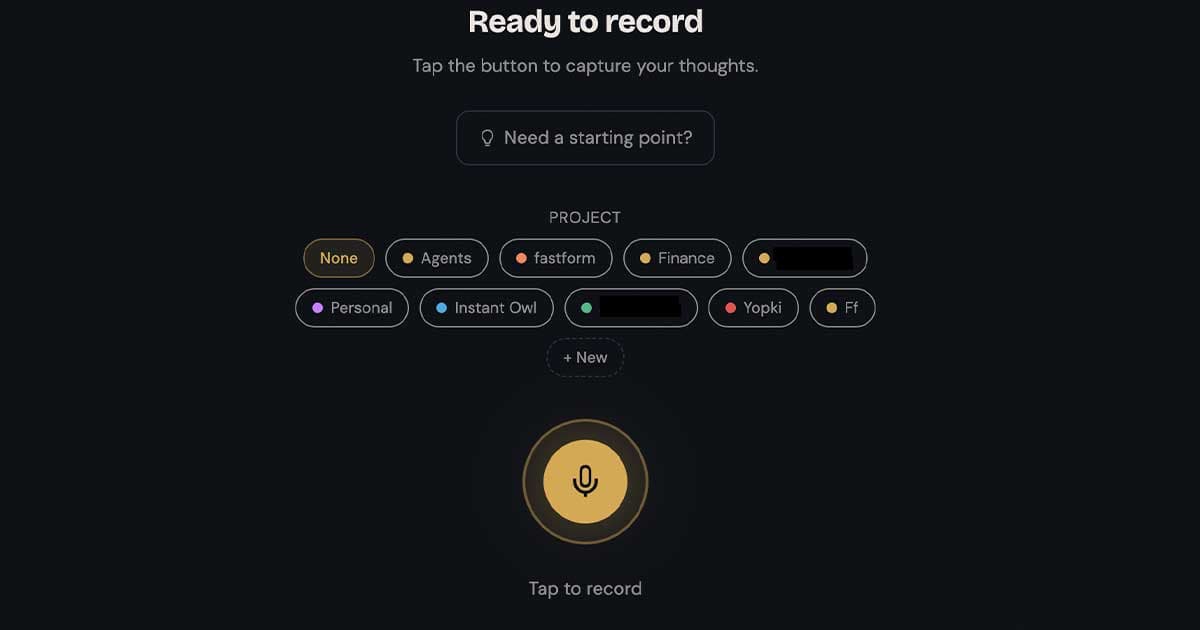
Instead of recording in Voice Memos, exporting to M4A, and uploading it somewhere to get a transcript back, you talk into InstantOwl and get an organized note back: titled, filed, with any tasks pulled out automatically. A transcript still leaves you with a wall of text to sort through yourself; an organized note skips that step. InstantOwl is currently free to use.
Related reading
- How to transcribe voice memos: the free native path on newer iPhones, plus every tool that fills the gap on older ones.
- Voice memos: recording mechanics, iCloud sync, and what happens to a memo after you capture it.
- Transcribe audio to text: the wider landscape of transcription tools and their free tiers.
- MP3 to text: the same situation for the other format most voice recordings end up in.
- InstantOwl: organized notes and tasks from one recording, currently free to use.
Frequently asked questions
What is an M4A file?
M4A is an MPEG-4 audio container, the format iPhone's Voice Memos app exports recordings in by default, per Apple's support guide. Inside that container sits either AAC (compressed) or ALAC (lossless) audio, depending on how the original recording was made.
Can I transcribe M4A free?
Yes. If your iPhone is a 12 or later, Voice Memos transcribes automatically at no cost, per Apple. Off that path, Any2Text gives 15 minutes free with no signup, TurboScribe gives 3 files a day at 30 minutes each, and HappyScribe gives 10 minutes free once, per each tool's own page.
How do I convert a voice memo to text?
Open Voice Memos and check for a transcript first if your iPhone is a 12 or later, since it is already there for free, per Apple. If not, export the memo (it saves as .m4a by default, per Apple) and upload it to a tool like Any2Text, TurboScribe, Go Transcribe, or HappyScribe.
What accepts M4A files?
TurboScribe, HappyScribe, Go Transcribe, Any2Text, and Microsoft's Word Transcribe all list M4A by name, per their own pages. ElevenLabs' mp3-to-text tool lists it by name too, alongside MP3, WAV, AAC, FLAC, and OGG, per its site. Checking a tool's own format list before uploading is still the safe habit.

Written by
Jim BreeseJim Breese is the founder of InstantOwl. He's spent 15 years building companies, from an Airbnb host community he founded and exited to growth leadership at venture-backed SaaS startups. He built InstantOwl because his best ideas kept arriving mid-walk, out of order, and half-finished.
Stop losing good ideas.
InstantOwl turns a rambling voice note into a clean, organized document in moments. Just talk. We'll organize it.
 Try InstantOwl free