Voice Notes for Teachers: Your Own Notes, Not Another Student Tool
By Jim Breese ·
What does "voice notes for teachers" actually mean?
It means two different things. Every tool that ranks for this phrase answers only one of them: how a teacher sends voice to students. The other meaning, how a teacher captures her own thinking, goes unanswered across the entire search results page. This post is about the second one.
Mote is the category leader for the first job. Its homepage headline is "Everyone can read, write & be heard," and it pitches its read-aloud, speech-to-text, and translation features at diverse learners, including emerging bilinguals and learners with special needs. Its free forever tier gives 20 recordings a month, capped at 1 minute each. The paid Unlimited individual license runs $99 a year and raises the cap to 5-minute recordings, plus Mote's sidebar accessibility tools and human-like Read Aloud voices. Mote itself says it is used in more than 25,000 schools by over 2 million people.
Reverb does something similar. Its tagline, "Stop typing. Send reverbs," pitches async voice messaging at students, educators, and workplace teams. Its free plan caps you at five stored recordings of thirty seconds each, with a paid Premium tier that lifts recordings to thirty minutes.
If you searched this phrase looking for a way to leave audio feedback on student work, Mote or Reverb is the purpose-built tool. Keep reading if you meant the other kind of voice note: the one only you ever hear.
Why do teachers need their own voice notes, not just feedback tools?
Because most teachers already live inside a document-everything culture, and typing all of it out is not realistic between class periods. On r/Teachers, a community of more than two million members, one recurring thread asks exactly this: how do you actually document everything people say to document.
One teacher of more than 700 students already answered it with voice: if something significant happens, she speaks it into a dated Google Doc on her phone, because she barely gets a minute between classes and it is the fastest, most accurate way she has found to keep a record. That is the whole case for a teacher's own voice notes in one sentence.
Parent-call logging is the most universal version of the pain. Teachers describe keeping a running notebook of who they called, when, and whether the parent answered or got a voicemail, or a simple chart of date, name, and a few bullet points. Several said they moved to email-only contact after a parent later denied what was actually said on a call.
A legal-awareness habit sits underneath most of it. Teachers describe the same instinct in different words: emails are discoverable documents, keep it professional, photocopy a write-up because the original mysteriously disappears once admin gets it, and email admin so there is a dated trail admin cannot later claim they never saw. Handwritten notes, several said, are simply unmanageable for keeping any of this straight, and the sprawl of tools teachers described using instead, OneNote, Word, a gradebook's notes field, a Google Drive folder per student, planner margins, and seating-chart symbol codes, is its own kind of overhead.
What should you capture with your own voice notes?
Four things cover most of a teaching day: parent-call debriefs, incident notes, lesson ideas that show up between classes, and grading-pattern observations for your own workflow, not feedback delivered to a student.
A parent-call debrief works best recorded the moment you hang up, while the facts and your own commitments are still fresh: who you spoke to, what was said, what you agreed to do next. The same consent questions that apply to any phone call apply here too, worth knowing before you record any call, parent or otherwise, even though this particular use is a solo debrief after the call ends, not a recording of the call itself.
Lesson ideas rarely show up at your desk. They show up in the hallway, the parking lot, or the two minutes before the next class walks in, which is exactly why a spoken note beats a sticky note here: nothing needs unlocking, finding, or writing legibly while you are already moving. It is the same instinct behind our before/during/after breakdown for taking notes: capture what you can in the moment, process it properly afterward.
Grading is the fourth. As you move through a stack, patterns show up that matter more than any single paper: half the class missed question 4, the essay prompt needs to be reworded next time, three kids need a check-in before Friday. Saying that out loud as you notice it beats trying to remember it once the stack is done. If a nightly version of that habit appeals to you beyond grading, a spoken debrief habit covers what it takes to make that stick as an actual routine.
A short practical list covers most of it: tomorrow's tweak to today's lesson, supplies to grab before first period, which kids, by initials, to check in on, the facts from a parent call, an idea for next unit, and anything the sub needs to know if you are out.
What's off-limits for a teacher's personal voice notes?
Anything that is a student record, IEP documentation, or contains a student's identifying details tied to a formal file. That belongs in your district's systems, not a general voice app.
FERPA governs education records held by schools, and InstantOwl is not a district-approved student-record system; nothing here claims otherwise. The distinction that matters is between your own working memory and an actual student record. Lesson ideas, what to re-teach tomorrow, a debrief of what you said and agreed to on a parent call, and grading-pattern notes for your own workflow are personal thinking. IEP meeting minutes, formal behavior documentation, and anything that becomes part of a student's file are not, and belong in your district's approved systems and forms.
The safest habit, already common practice among teachers juggling dozens of names, is talking about the situation and your own next action while leaving out identifying detail: initials instead of full names, and a brief, fact-only note rather than a running narrative.
IEP meetings deserve their own caution. Minutes and formal documentation are the district's job in the district's system, and recording the meeting itself can raise consent questions and state-law issues, so check your district's policy and your state's consent law before recording anyone. A cleaner habit than recording the room is speaking your own debrief right after the meeting ends, in the car, while it is still fresh.
What about voice feedback for students?
This is genuinely a solved problem, served by tools built for it. Ross Morrison McGill, the UK teacher and workload-reduction writer behind TeacherToolkit, names Kaizena, then a free Chrome plugin, as one he used for five or six years: voice notes, color-coded feedback, rubrics, and a way for students to record voice notes back. Kaizena has since shut down (its site is offline as of August 17, 2026), but McGill's account remains one of the clearest published descriptions of what voice feedback does to a grading workload.
McGill cites a 2017 EdD dissertation hosted by Kaizena, a 283-page Walden University study of six high school teachers, for its research support. All six teachers in that study believed they gave more high-quality, personalized feedback to students in less time with Kaizena's audio feature than with written feedback, and the same study found teacher self-efficacy suffers because the workload and emotional energy of grading papers is arduous, with students often ignoring or misunderstanding written feedback.
It is worth naming the study's own limitation in the same breath: with only six teachers and no test of actual student writing outcomes, its author concluded no conclusions could be drawn about Kaizena's impact on student writing achievement. Treat it as six teachers' experience, not proof that audio feedback improves grades.
McGill's own practice backs up how normal this is for an experienced teacher: he has used voice technology in his classroom for the last decade, and the blog post citing that study ends with a line that makes the same point another way: "p.s. I used my voice to write most of this!"
Even the most complete guides in this space point the same direction. BookWidgets' own "complete guide" to classroom voice recording lists 18 separate uses, from dictation assignments to pronunciation practice to "make it personal" storytelling, and every one of them is audio delivered to or from students. None of the 18 are about a teacher's own notes.
That gap across the entire ranking landscape, purpose-built tools for reaching students and nothing for a teacher's own head, is the whole reason this post exists. If you are a student rather than a teacher, the same time-crunch problem shows up on your side of the desk too, and for largely the same reasons.
Where does InstantOwl fit?
Full disclosure: InstantOwl is our product, and this blog belongs to it. Everything above sits outside our lane on purpose. If you want to send feedback to students, Mote and Reverb are built for exactly that, and nothing below replaces them.
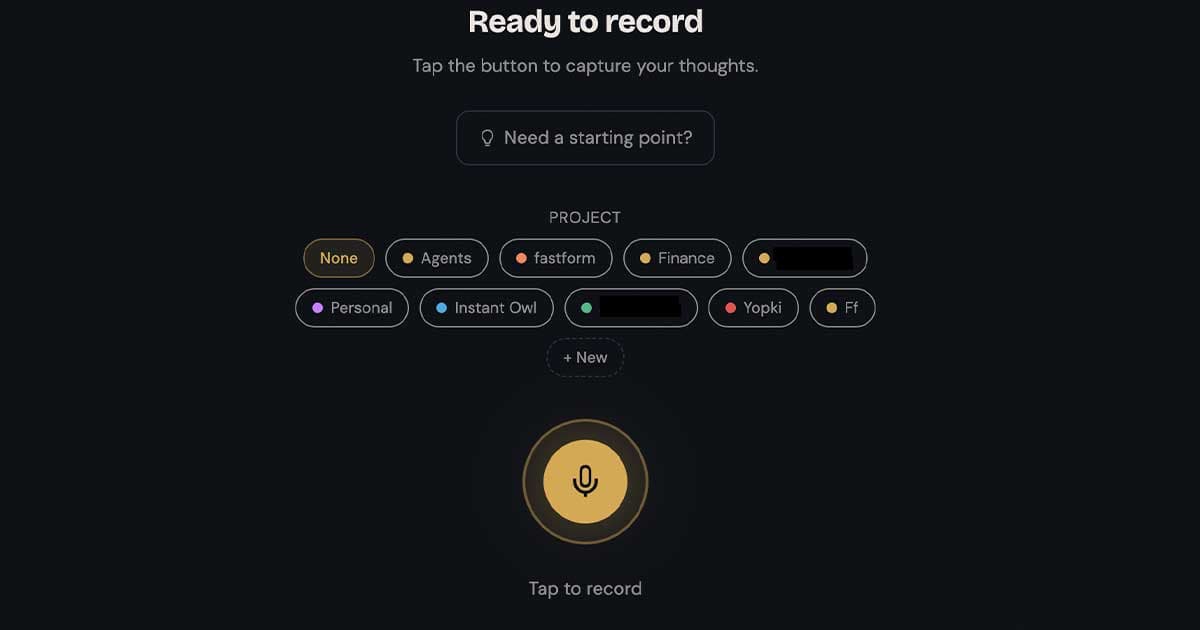
InstantOwl is built for the other side: the parent-call debrief, the lesson idea between classes, the grading-pattern memo you leave for yourself, not a student. Talk it out the way you would to a colleague in the hallway, and it comes back organized, tasks pulled out as tasks, notes filed instead of buried in one long transcript, and a project you can return to across a semester instead of a folder of audio files.
That last part is the real difference from the Voice Memos app most teachers already default to. Voice Memos gives you back exactly what you said, word for word, in the order you said it. It does not know that "check in with the two kids in third period" is a to-do and "re-teach ratios Monday" is a decision for next week's plan. InstantOwl pulls the to-dos out as to-dos and keeps the rest as an organized, dated note, which is the part a transcript alone never does. InstantOwl is currently free to use.
Related reading
- Voice notes for students: the same time-crunch capture problem, from the other side of the desk.
- How to take lecture notes: the before, during, and after method our capture-then-process advice above is drawn from.
- How to record and transcribe phone calls: the consent rules that apply before you record any call, not just a parent's.
- Voice journaling: what it takes to build a nightly spoken debrief into an actual habit.
Frequently asked questions
What is the best voice notes app for teachers?
It depends on the job. For voice feedback delivered to students, Mote is the purpose-built leader, free for up to 20 one-minute recordings a month, $99 a year for unlimited 5-minute recordings, with Reverb as the main alternative. For a teacher's own notes, parent-call debriefs, lesson ideas, and grading-pattern memos, InstantOwl is built for that side and is currently free to use.
Is it legal to record a parent phone call?
It depends on your state, and this is not legal advice: some states require only your own consent to record a call, others require everyone on the line to agree, so check the rule for your state before you record anyone. The consent-free option is skipping the recorder during the call itself and speaking your own debrief right after you hang up instead.
Can I record voice feedback for my students?
Yes, and purpose-built tools already do this well. Mote lets you record feedback students replay and reply to with their own voice notes, inside Google Docs, Slides, and Forms. Reverb offers a similar voice-feedback workflow; Kaizena, an older option in this space, has been discontinued. InstantOwl is not built for this; it is built for the notes you keep for yourself, not the feedback you send to a student.
Can I grade by voice?
Yes, for your own workflow, not for delivering feedback to a student. Speaking grading-pattern notes as you move through a stack, which questions the class missed, what to re-teach, which papers need a second look, is faster than writing them out and easier to act on later. Delivering the actual feedback to students by voice is a different job, served by tools like Mote and Reverb, not by a personal note-taking app.

Written by
Jim BreeseJim Breese is the founder of InstantOwl. He's spent 15 years building companies, from an Airbnb host community he founded and exited to growth leadership at venture-backed SaaS startups. He built InstantOwl because his best ideas kept arriving mid-walk, out of order, and half-finished.
Stop losing good ideas.
InstantOwl turns a rambling voice note into a clean, organized document in moments. Just talk. We'll organize it.
 Try InstantOwl free