Voice Notes for Students: Recording Rules, Study Science, and Free Tools
By Jim Breese ·
How can students use voice notes?
Students use voice notes three ways: to catch a stray thought between classes before it disappears, to speak a short recap right after a lecture ends, and to talk through material out loud while studying. Each is a different job, and each solves a different kind of forgetting.
Most guides to voice recording for students are written for the classroom-to-teacher direction: record a verbal assignment, share a feedback clip, submit a language exercise through a link. That is a real use case, and later in this piece we cover a free tool built exactly for it. But it skips the questions students actually search for: can I record the lecture itself, does talking help me study, and what happens to a recording once it exists. Those three questions are the rest of this piece.
The between-classes case is the smallest and easiest to miss. You are walking across campus and a thought shows up: a question for office hours, a line for a paper due Friday, a reminder to email a group project partner. Typing it means stopping, unlocking your phone, and finding the right app. Talking it into a recording takes seconds and does not break your stride, which is the whole reason voice capture beats text for anything you think of while your hands are already busy.
Can you record lectures?
The honest answer is conditional, not yes or no. Whether you can record a lecture depends on your syllabus, your university's recording policy, and your professor, not on whether your phone is able to do it.
Start with the syllabus. Many courses state a recording policy in writing, and some already answer the question for you: a number of universities run official lecture capture, recording every session centrally so students can review it later. The London School of Economics records lectures this way, which is part of why its own student note-taking guidance assumes you can always go back and check what you missed.
If your course has no official recording and no stated policy, ask the professor directly before you record anything. Frame it as a study aid, not a right. If you have a documented disability, recording permission is commonly granted as an accommodation through your school's disability office, worth raising if note-taking itself is the barrier.
Never record a professor or classmates on the assumption that it is allowed by default. When in doubt, do not record, and use the consent-free option below instead.
If you do have permission, a recording is a backup for your attention, not a replacement for it. The point of an approved lecture recording is to check a spot you missed or confirm a detail before an exam, the way LSE's own guidance treats its recorded lectures. Sitting back and planning to relisten to the whole thing later almost never happens once the week gets busy, so keep taking notes during class and treat the recording as insurance, not your primary method.
The one voice note that needs no permission from anyone
There is a voice note you can always make, no matter what your syllabus says: a spoken debrief of your own memory, recorded right after class ends. Walk out of the lecture hall, hit record, and talk for two or three minutes about the main idea and anything you are still unsure about. You are recording your own voice recalling your own thoughts, not the lecture, so there is nothing to ask permission for.
This is not busywork. It is retrieval practice, one of the better-supported ideas in how people learn. One student writer, working from Benedict Carey's "forget-to-learn" theory in his book How We Learn, argues against transcribing a lecture word for word and instead jotting only brief cues during class, then reconstructing what you remember afterward, entirely from memory. Speaking that reconstruction out loud, right after class, is the fastest version of the same exercise, no notebook required.
Students already do a version of this without calling it retrieval practice. On r/college, students describe a two-pass system: type or scribble messy notes during the lecture, then rewrite them properly afterward, because rewriting is the remembering step. A spoken debrief is that same rewrite pass, just faster to produce. For the fuller before-during-after breakdown, including how to take notes during the lecture itself, see how to take lecture notes.
Voice notes while studying
Talking is also a study method on its own, separate from anything you recorded in class. Two moves do most of the work: talking through a problem out loud, the way you would explain it to a study partner, and self-quizzing by asking yourself a question and answering it from memory before checking the textbook. Both force you to produce the answer instead of just recognizing it on a page, the same retrieval-practice logic as the after-class debrief above.
A concrete version of self-quizzing: before opening your notes, ask yourself out loud "what were the three main points from today's reading" and answer in full sentences before checking. Getting an answer wrong out loud is not wasted effort, it tells you exactly what to review, which a quiet reread of the same page will not do nearly as clearly.
The catch is what happens after you have ten or twenty of these recordings. A pile of audio files with no titles and no structure is not a study system, it is a new mess to sort through later, and sorting through it is exactly the step people report giving up on. This is the same pattern behind why capture-first tools matter for anyone whose thoughts move fast: our ADHD note-taking app guide covers the broader version of this problem, where the gap between capturing a thought and organizing it is where good intentions go to die.
If you want a structured system for the written side of your notes, note-taking methods compared walks through Cornell, outline, and mapping approaches you can apply to whatever a voice note turns into.
Free allowances first
Before paying for anything, know what your phone already does for free. On an iPhone 12 or later, Apple's built-in Voice Memos app transcribes recordings automatically in English and several other languages, no extra app required; our complete Voice Memos guide covers setup and its limits. On a Pixel phone, Google Recorder transcribes in real time from the Pixel 3 onward and can summarize a recording from five minutes up to an hour on the Pixel 8 and later, also free.
If you need to share a recording with a professor or classmate rather than keep it for yourself, Reverb Record is worth knowing: it turns a recording into a link you can paste straight into an LMS or a message thread. Its free plan has tightened, now capping you at five stored recordings of thirty seconds each, with a paid Premium tier for thirty-minute recordings. It is built for verbal assignments and feedback, not for turning your own rambling thoughts into study notes, which is the gap the rest of this piece covers.
For transcription beyond what your phone offers, check the actual free tier before choosing a tool. TurboScribe's free tier allows three files a day at up to thirty minutes each, no subscription required. Voicenotes.com's free plan gives 100 minutes of transcription a week with a 30-day history. Evernote used to belong on this list, but its AI transcription now starts on a paid tier, and its free plan caps you at fifty notes total, so it no longer covers this job for free. Neither of the free tiers above requires a card to try, and each covers a normal week of student use before you would ever need to consider paying for anything.
AudioPen is worth a mention for a narrower job: cleaning up one rambling recording into readable text, free to try before you pay for anything. It polishes a single note at a time, not a semester's worth of them, so treat it as a tool for one recording, not a system for all of them. Read the free-tier fine print on any of these before a deadline: limits usually reset weekly or daily, but they do run out mid-project if you push past them.
Where InstantOwl fits
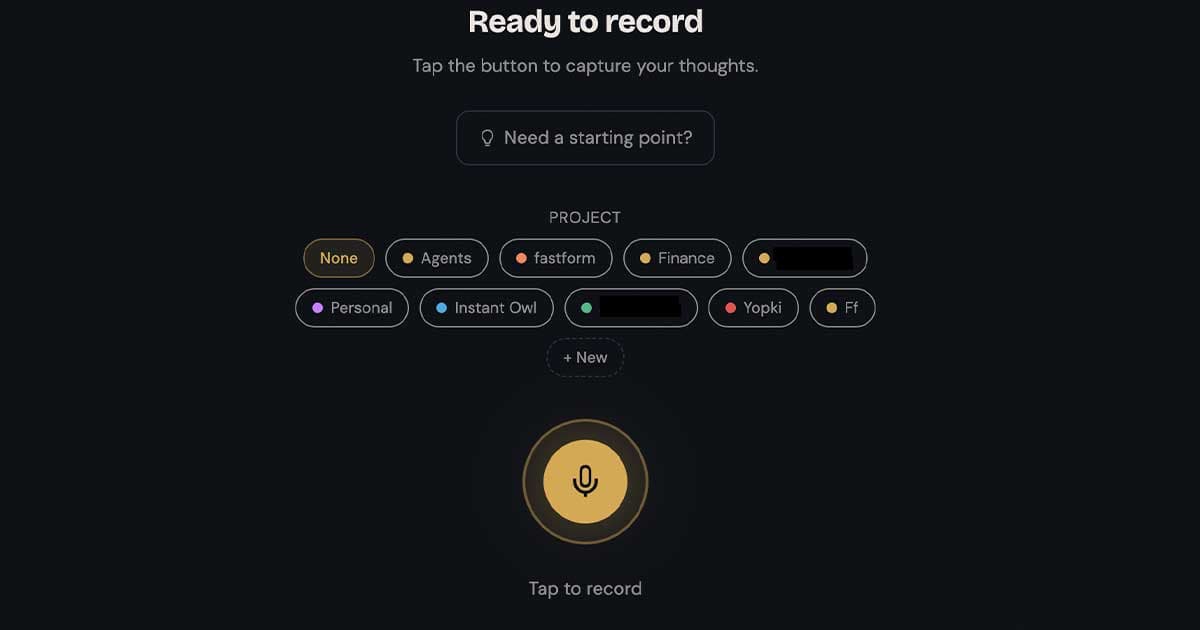
Full disclosure: InstantOwl is our product, and this blog belongs to it. Its fit here is narrow and specific: the after-class debrief and the study-session ramble described above, the parts of this piece that involve your own voice and no one else's, turned into an organized note instead of a transcript you have to sort through yourself. InstantOwl is currently free to use.
Related reading
- How to take lecture notes: the full before, during, and after breakdown, including the recall trick.
- Note-taking methods compared: Cornell, outline, mapping, and more, for the written side of your notes.
- Voice Memos: the complete guide: setup, transcription limits, and gotchas on iPhone and Android.
- ADHD note-taking app: the broader capture-to-organized-note problem, for a mind that moves fast.
Frequently asked questions
Can I record my professor?
Only if your syllabus, university policy, or professor allows it. Check the syllabus first, many universities run official lecture capture that already covers you, and ask the professor directly if nothing is stated. Recording permission is also commonly granted as a disability accommodation. Never assume recording is allowed by default.
Do voice notes help you study?
Yes, when they make you recall material instead of just replaying it. Speaking a short debrief from memory right after class is a form of retrieval practice, an idea drawn from Benedict Carey's forget-to-learn theory in How We Learn. Talking through a problem or quizzing yourself out loud works the same way.
What is the best free voice notes app for students?
Apple's Voice Memos is free on every iPhone and transcribes automatically on iPhone 12 or later. Google Recorder does the same for free on Pixel phones, with real-time transcription from the Pixel 3 onward. Both cover plain recording and transcription without any subscription.
How do I organize lecture recordings?
Run a two-pass system: keep messy in-class notes for the board content, then record a short spoken debrief of what you remember right after class, which does the organizing work of a rewrite. Pair that with a structured note-taking method to keep the written side organized too.

Written by
Jim BreeseJim Breese is the founder of InstantOwl. He's spent 15 years building companies, from an Airbnb host community he founded and exited to growth leadership at venture-backed SaaS startups. He built InstantOwl because his best ideas kept arriving mid-walk, out of order, and half-finished.
Stop losing good ideas.
InstantOwl turns a rambling voice note into a clean, organized document in moments. Just talk. We'll organize it.
 Try InstantOwl free