Voice Notes for Therapists: For Your Own Thinking, Not Client PHI
By Jim Breese ·
Voice notes for therapists: what this actually covers
Voice notes for therapists split into two different jobs, and mixing them up is where the risk lives. The first is documenting a session: progress notes, treatment plans, anything that becomes part of a client's record. That is protected health information (PHI), and it needs a HIPAA-compliant tool with a signed Business Associate Agreement (BAA). The second is capturing your own thinking between sessions, with no client names or identifiers. That does not need a clinical tool at all.
This post is about the second one. To be plain about it: InstantOwl is a consumer voice app. It is not HIPAA-certified and does not sign a BAA. Client-identifying content should never go into it, or into any consumer app that is not built for that job. What it is honestly good for is everything in your head that is not a client's record: your own reflections, practice ideas, and the mental clutter that piles up between sessions.
A common thought at this point is "I could just do this with ChatGPT." For your own non-PHI thinking, that is true, and the same rule applies to InstantOwl: fine for your own head, not for a client's file. For anything that touches a client's session, the honest answer is no, you could not, because standard ChatGPT plans do not come with a signed BAA. That distinction runs through the rest of this post.
If you are looking for the broader category of what a voice note even is and how people use one day to day, our voice notes guide covers that ground.
Progress notes vs psychotherapy notes: the distinction that governs everything
Progress notes are part of the medical record. Psychotherapy notes are the therapist's own private process notes, kept separate from that record, and specially protected. This distinction, defined by the U.S. Department of Health and Human Services under HIPAA, decides what any given piece of writing (or recording) actually is, and therefore how it must be handled.
Under HHS guidance, psychotherapy notes are notes a mental health provider keeps documenting or analyzing the contents of a conversation during a private, group, joint, or family counseling session, kept separate from the rest of the record. By definition, they exclude medication information, session start and stop times, treatment modalities, results of clinical tests, and any summary of diagnosis, functional status, treatment plan, symptoms, prognosis, and progress to date. That last part matters: if it summarizes diagnosis or progress, it is a progress note, not a psychotherapy note, and it belongs in the medical record.
That separation is why psychotherapy notes get heightened legal protection under HIPAA, generally requiring specific client authorization to disclose, beyond what the rest of the record requires. You can read the full HHS guidance on psychotherapy notes directly.
The practical takeaway: both categories, progress notes and psychotherapy notes, contain client PHI once they reference an actual client or session. Both belong only in a HIPAA-compliant system. Neither belongs in a general consumer app, including InstantOwl.
Why ChatGPT and generic dictation are not the answer for session notes
Consumer ChatGPT is not HIPAA-compliant for therapy documentation. OpenAI does not sign a Business Associate Agreement for its standard consumer and self-serve business plans, and without a signed BAA, entering client-identifying information into the tool is a HIPAA violation, according to a breakdown from ICANotes. A BAA path exists only through OpenAI's enterprise offerings (ChatGPT Enterprise, and a newer ChatGPT for Healthcare workspace built to support HIPAA compliance), a narrow, deliberate exception a practice has to set up, not something that applies to a therapist typing into the free or Plus version between sessions.
Generic dictation tools have a different, simpler limitation: they type what you say, they do not generate a structured clinical note. TherapyNotes, a widely used EHR, now ships an integrated Dictation feature as part of its TherapyFuel suite for enrolled clinicians, and its support guidance still points everyone else to device-level dictation (Mac Dictation, Windows Speech Recognition, or the iOS keyboard microphone) to speak directly into a note field inside the record. Either way, dictation gets words onto the page faster; it does not solve compliance, because the words still land inside a system that has to be HIPAA-compliant in the first place.
For the actual clinical documentation job, purpose-built tools exist and are worth naming honestly. Mentalyc generates SOAP, DAP, BIRP, and other progress note formats from session content, states it is HIPAA-compliant, and provides a signed BAA. Supanote does the same job, converting session audio into structured clinical notes, also stating HIPAA compliance and providing a BAA, with recordings deleted after the note is generated. Both are the right category of tool for anything that touches an actual client session. InstantOwl is not in that category, and does not try to be.
Where each tool actually belongs
| Tool type | Example | Handles client PHI? | Right use |
|---|---|---|---|
| Clinical AI scribe (BAA-signing) | Mentalyc, Supanote | Yes, by design | Progress notes, treatment plans, session documentation |
| EHR dictation | TherapyNotes (built-in or via OS dictation) | Only inside the EHR's own protections | Typing directly into an existing client record |
| Consumer AI chat | ChatGPT (standard plans) | No, no BAA on consumer tiers | General writing, never client-identifying content |
| Consumer voice-to-text app | InstantOwl | No, not HIPAA-certified | Your own non-PHI thinking between sessions |
What a therapist can honestly capture by voice (no PHI)
A therapist's own non-PHI voice notes cover a specific, useful list: the reflection that surfaces on the walk to the car after a hard session, a practice or business idea that hits between clients, de-identified supervision or consultation prep with no client names attached, a takeaway from a continuing education course, or a newsletter, workshop outline, or blog post you are drafting in your head. None of it names or could identify a specific client.
The dividing line is simple and worth keeping in view every time you hit record. If it names, or could reasonably identify, a client, it is PHI, and it belongs only in your HIPAA-compliant system. If it is your own thought, with no identifiers attached, a consumer app is fine for it. When in doubt, the safer move is always to leave the identifying detail out and generalize the thought instead, since a de-identified version of the same idea usually captures what you actually need to remember.
The reflection piece of that list deserves its own note. A hard session rarely gets processed on its own between back-to-back appointments, and a quick spoken reflection, said out loud with no client details attached, is one of the lowest-friction ways to clear your own head before the next one starts. That is closer to voice journaling than to clinical work, and it is worth treating as its own habit rather than an afterthought.
Capturing that kind of thinking is exactly what how to capture ideas is about more broadly, and turning a spoken ramble into something you can actually use afterward is covered in how to organize your thoughts.
The honest InstantOwl fit
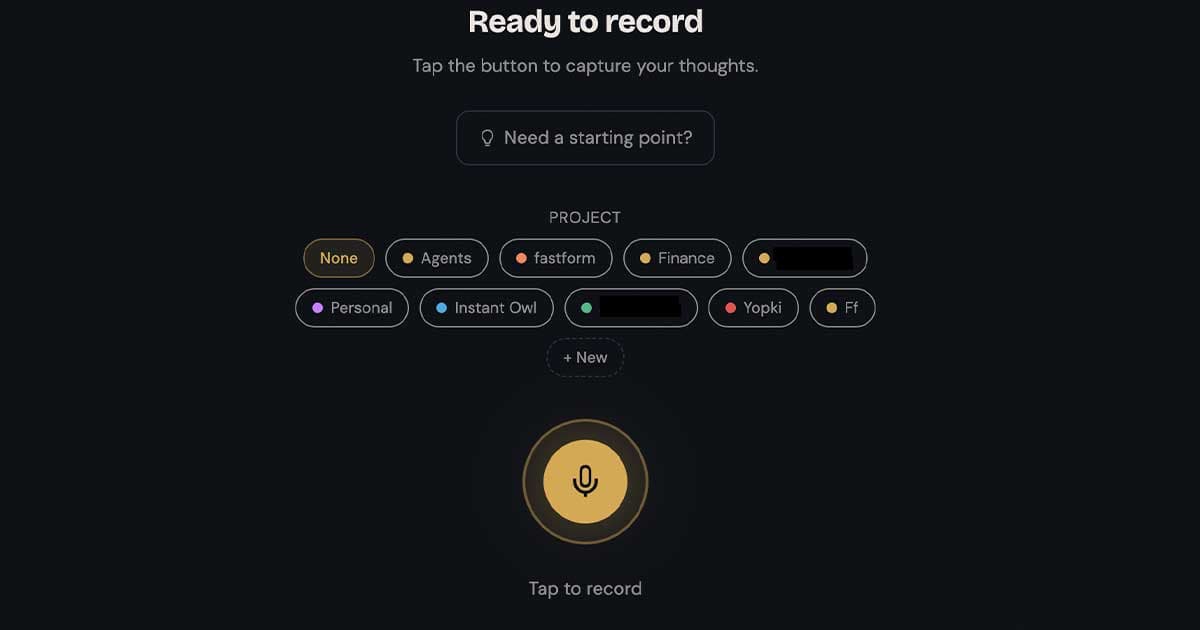
InstantOwl is currently free to use. You talk, and a rambling voice note comes back as a clean Summary or a list of Action Items, both real, shipped output formats, instead of a wall of transcript you have to sort by hand yourself. For a therapist, that means the idea you had walking to your car, or the workshop outline forming in your head between clients, gets captured and organized without you having to write it down by hand.
The guardrail stays the same every time: for progress notes, treatment plans, and anything that comes out of an actual session, use a BAA-signing HIPAA tool like Mentalyc or Supanote, or your EHR's own dictation feature. InstantOwl helps you as a person and a professional thinking through your own ideas. It is not, and does not claim to be, a clinical documentation system. You can see how the free InstantOwl app handles a rambling voice note for yourself.
This post is general information, not legal or clinical advice. Check your state licensing board and your practice's compliance officer for guidance specific to your situation.
Frequently asked questions
Can you use ChatGPT to write therapy notes?
Not with client-identifying information. Consumer ChatGPT plans do not include a signed Business Associate Agreement, so entering anything that could identify a client is a HIPAA violation. Only OpenAI's enterprise offerings, such as ChatGPT Enterprise, offer a BAA path, and that is a narrow, deliberate exception, not the default consumer product.
What is the best platform for therapy notes?
A HIPAA-compliant, BAA-signing clinical tool built for the job, such as Mentalyc or Supanote, or your EHR's own dictation feature. A general consumer voice app, including InstantOwl, is not built or certified for client documentation and should not hold it.
How do therapists keep notes?
Two separate categories. Progress notes go in the medical record and cover diagnosis, treatment plan, and progress to date. Psychotherapy notes are the therapist's private process notes, kept physically or digitally separate from the record, with stronger legal protection and no requirement to share them even with the client.
What can a therapist safely use voice notes for?
Your own non-PHI thinking: reflections after a session on the walk to the car, practice or business ideas between clients, de-identified supervision or consultation prep with no names, CE takeaways, and drafting a newsletter or workshop in your head. Anything that names or could identify a client belongs in your HIPAA-compliant system instead.

Written by
Jim BreeseJim Breese is the founder of InstantOwl. He's spent 15 years building companies, from an Airbnb host community he founded and exited to growth leadership at venture-backed SaaS startups. He built InstantOwl because his best ideas kept arriving mid-walk, out of order, and half-finished.
Stop losing good ideas.
InstantOwl turns a rambling voice note into a clean, organized document in moments. Just talk. We'll organize it.
 Try InstantOwl free