Todoist vs TickTick: Verified Prices and Real Tradeoffs
By Jim Breese · · Updated
Which is better, Todoist or TickTick?
TickTick is the better fit if you want one app that also covers your calendar, habits, and focus timer, at roughly half Todoist's yearly price. Todoist is the better fit for the cleanest task list, the fastest natural language dates, and the most advanced recurring-task rules.
This split repeats across a decade of community comparisons between the two apps. People who want one all-in-one system land on TickTick. People who want a fast, focused task list land on Todoist. Both keep loyal, long-term users. The rest of this page verifies the actual prices and the free-tier fine print that each vendor's own comparison page leaves out.
Match the choice to the job, not the app's popularity. If your job is "see everything I have to do laid out on a calendar without opening a second app," TickTick is built for that job directly. If your job is "type a task in three words and trust the due date parsing," Todoist is built for that job directly. Both jobs are legitimate, and neither app is trying to do the other one better.
What do Todoist and TickTick actually cost?
TickTick Premium costs $35.99 a year, or $3.99 a month through the App Store, per TickTick's own pricing page. Todoist Pro costs $60 a year ($5 a month billed yearly) or $7 a month billed monthly, per Todoist's pricing page, updated for renewals from December 10, 2025.
| Plan | Price | What it includes |
|---|---|---|
| TickTick Premium | $35.99/year or $3.99/month | Up to 299 lists, 999 tasks per list, share a list with up to 29 people |
| Todoist Pro | $60/year ($5/month) or $7/month | 300 personal projects, 150 filter views, calendar layout, full activity history |
| Todoist Business | $96/user/year or $10/user/month | Shared team workspace, up to 500 team projects, roles and permissions |
TickTick is roughly half Todoist's yearly price, which matches how Reddit users describe the gap when they compare the two apps directly.
Todoist's own comparison page against TickTick, titled "Focused Clarity or Feature Everything?", does not list a single price for either app. It argues that TickTick's breadth makes the interface "busy" and "layered," but never mentions that TickTick costs about half as much. This page prints the numbers Todoist's page leaves out.
A third-party comparison from Rambox, a workspace-aggregator app with no stake in either product winning, independently confirms the same figures: TickTick Premium at $35.99 a year, Todoist Pro at $60 a year, and Todoist Business at $96 per user per year. When a neutral source and both vendors' own pricing pages agree this closely, the numbers are safe to plan a budget around.
What do the free plans actually include?
Todoist's free plan, called Beginner, is fully documented: 5 personal projects, 3 filter views, and 1 week of activity history, per Todoist's pricing page. TickTick's free plan is real too. Its own App Store listing states plainly that "TickTick is always free," with Premium unlocking the most advanced features on top.
TickTick's exact free-tier list and task limits are not published anywhere on its current help center, which we checked across all 94 of its articles. Two free-tier numbers TickTick does publish: free accounts get one attachment upload per day, capped at 10MB per file, while Premium multiplies both the daily upload count and the per-file size limit. Free accounts can also add only one member to a shared list, versus up to 29 members on Premium.
The one limit TickTick doesn't publish anywhere is its free-tier task cap. A detailed switcher account on r/productivity describes hitting it the hard way, after setting up lists and workflows on the free plan, TickTick "slams you with 'no more tasks' without specifying how many tasks you can have without paying." That same user's overall verdict: "Todoist is more advanced and worth the extra cost, but I like TickTick's layout better." Budget time to test your real workload against TickTick's free plan before committing to it long term.
For contrast, once you do pay, TickTick's Premium ceiling is generous and fully disclosed: up to 299 lists, 999 tasks per list, 199 subtasks per task, and up to 5 reminders per task, per TickTick's own App Store listing. Todoist Pro's ceiling is disclosed too: 300 personal projects and 150 filter views, up from the free plan's 5 and 3. Both companies publish the paid ceiling in detail. Only TickTick leaves the free floor unpublished.
Where does TickTick win?
TickTick wins on breadth: a built-in calendar view, habit tracking, a Pomodoro timer, and time tracking, all inside one app. In a long-running r/productivity thread comparing the two, the calendar view is the single most-cited reason people switch to TickTick and stay, named independently by at least five separate users.
Other TickTick strengths named repeatedly in that same thread: exportable habit data, notification snooze, converting a task into a note, a kanban board that shows subtasks inline, cross-platform sync, and widgets. One ten-year user summed up the loyalty simply: "Tried both. Stuck with Ticktick for about 10 years or more," crediting a developer who "regularly listen[s] to users."
TickTick's own features page backs up the breadth users describe: multiple calendar views, a timeline view, an Eisenhower matrix for prioritizing by urgency and importance, and both natural-language and voice input for adding tasks. Location-based reminders are also built in, useful for a task like "remind me when I'm near the pharmacy" that neither a plain calendar nor a plain task list handles well on its own.
Where does Todoist win?
Todoist wins on focus and language. Its Quick Add captures tasks in what Todoist calls "easy-flowing, natural language," and its recurring-date engine handles patterns TickTick's simpler recurrence can't, per Todoist's own features page. One TickTick user switched specifically for the ability to repeat a task by "the xth workday of the month," adding that "otherwise I would have stayed with TickTick for half the price."
Todoist also wins on restraint. A user who tried TickTick for a year returned to Todoist because TickTick had "too many features that were just distracting side quests." Todoist's own features page describes this as the point: "Reminders without the clunky date pickers. Add them by typing them into quick add," a pitch aimed squarely at people who find TickTick's density overwhelming rather than helpful.
Todoist's own comparison page against TickTick now also markets a voice-capture feature called Ramble, alongside stronger team workspace tools on the Business plan: shared workspaces, up to 500 team projects, and role-based permissions, none of which have a TickTick equivalent in our research.
What caveats do users raise about TickTick?
Two caveats come up repeatedly from TickTick's own longtime fans in community threads. We present these as user-raised concerns, not as claims we have independently verified about TickTick's security practices.
First, TickTick doesn't offer two-factor authentication, a gap its own users call out directly. Second, several users note that TickTick is owned by a China-based company, with one writing plainly: "I wouldn't keep any sensitive information in TickTick." These are user opinions about data sensitivity. If two-factor authentication or data jurisdiction matters to how you'll use a task manager, check TickTick's current security documentation yourself before storing anything sensitive there.
None of this stops the same community from recommending both apps. Multiple users in the r/productivity thread say plainly that you cannot go wrong either way, and "download both and try them" appears verbatim in the discussion. That's the honest close on the comparison itself: the free tiers on both sides exist so you can find out which job fits your actual habits before you pay for either one.
What neither app solves: the capture gap
Todoist and TickTick both organize tasks once a task already exists. Neither one solves getting the task out of your head in the first place. Typing a task into either app still means stopping, opening the app, and typing, which is exactly where a fast-moving thought gets lost.
That gap is itself the reason both vendors now ship their own voice input: Todoist markets Ramble, and TickTick's help center now documents an AI Voice Add feature with automatic task-splitting. When two competing task managers both add voice capture, that's a signal that typing first is the actual bottleneck for a lot of users, not a lack of task-list features.
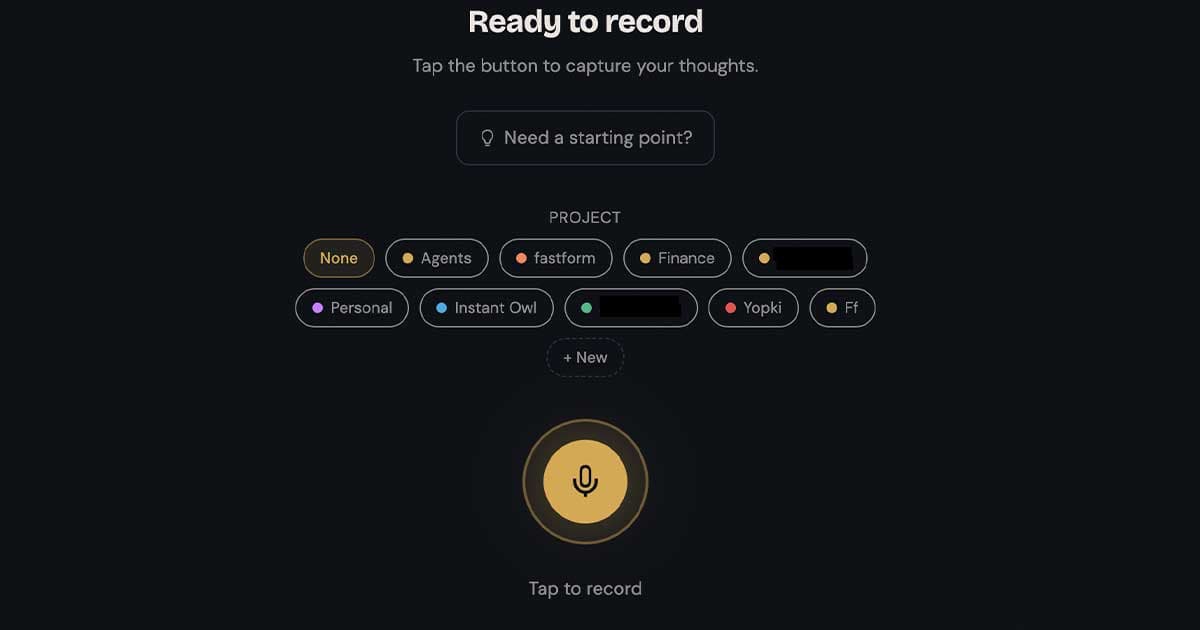
Full disclosure: InstantOwl is our product, and this is our blog. InstantOwl is voice-first capture: talk through a messy brain dump, and it comes back as organized tasks you can send to whichever app you already use, Todoist, TickTick, or neither. It doesn't compete with either app for where tasks live. It solves how they get captured in the first place, before you've opened an app at all. InstantOwl is currently free to use.
If capture, not organization, is your actual bottleneck, what a brain dump is covers why talking beats typing for getting a thought out fast, before you decide which app should hold the resulting tasks.
Related reading
- What is a brain dump: why talking beats typing when a thought needs to get out fast, whichever task app it lands in afterward.
- ADHD apps that people actually keep using: the same capture-before-organization problem, covered from the ADHD community's side.
- The ADHD calendar problem: a deeper look at the calendar-view need that drives most TickTick switches.
- InstantOwl: voice-first capture that feeds whichever task app you use, currently free to use.
Frequently asked questions
Is TickTick cheaper than Todoist?
Yes. TickTick Premium is $35.99 a year, or $3.99 a month through the App Store, per TickTick's own pricing page. Todoist Pro is $60 a year ($5 a month billed yearly) or $7 a month billed monthly, per Todoist's pricing page. TickTick costs roughly half what Todoist Pro costs, which matches how Reddit users describe the price gap between the two apps.
What are TickTick's free-plan limits?
TickTick does not publish exact free-tier list or task limits anywhere on its current help center, which we checked in full. Two numbers it does publish: free accounts get one attachment upload per day at 10MB per file, and can add only one member to a shared list, versus up to 29 on Premium. A detailed user report describes the free plan enforcing an undisclosed task cap without warning.
Is TickTick safe to use?
TickTick's own longtime users raise two caveats worth knowing, and we present them as user opinions, not claims we have verified ourselves: TickTick does not offer two-factor authentication, and some users note it is owned by a China-based company, with one writing they would not keep sensitive information in the app. Check TickTick's current security documentation directly if this matters to you.
Which is better for ADHD, Todoist or TickTick?
TickTick edges ahead for ADHD by the same reasons it wins overall: a built-in calendar view removes the need for a second app, and notification snooze and habit tracking add reminders without extra setup. Todoist's natural language dates are the bigger draw for anyone who finds TickTick's density overwhelming. Either way, the real bottleneck is getting the task into the app before the thought is gone.

Written by
Jim BreeseJim Breese is the founder of InstantOwl. He's spent 15 years building companies, from an Airbnb host community he founded and exited to growth leadership at venture-backed SaaS startups. He built InstantOwl because his best ideas kept arriving mid-walk, out of order, and half-finished.
Stop losing good ideas.
InstantOwl turns a rambling voice note into a clean, organized document in moments. Just talk. We'll organize it.
 Try InstantOwl free