Dictation Punctuation Commands: The Cross-Platform Cheat Sheet
By Jim Breese · · Updated
How does saying punctuation actually work?
You say the name of the punctuation mark at the exact point in your sentence where it should appear, and the software inserts the mark instead of typing the word. Say "period" after a finished sentence and a period lands there instead of the letters p-e-r-i-o-d. That single idea is the whole trick, and it works the same way whether you are dictating into an iPhone, a Word document, or a Chromebook.
The trap is everything after that idea. Each platform ships its own list of recognized phrases, and the lists do not match. A command that works in Microsoft Word does nothing in ChromeOS Dictation. A phrase a friend swears by on their iPhone may not exist in Apple's own documentation. Cheat sheets that copy one platform's list onto another get this wrong constantly, which is exactly why this one is organized by platform, not by punctuation mark.
Several platforms also add punctuation automatically now, without you saying anything. Apple's Mac and iPhone dictation guides both note that supported languages get "certain punctuation" added automatically as you talk. Word for the web has an auto-punctuation toggle in its dictation settings. Windows voice typing has the same toggle, and Copilot+ PCs go further with a feature called Fluid dictation that corrects grammar and punctuation as you speak. Commands are the manual override layer for when auto-punctuation guesses wrong, not the only way to get a comma where you want one.
The four commands that work the same everywhere
Four punctuation commands are documented, word for word, on all seven platforms in this cheat sheet: Mac, iPhone, Microsoft Word Dictate, Windows voice typing, Windows Voice Access, Gboard, and ChromeOS Dictation.
| Say this | You get |
|---|---|
| period | . |
| comma | , |
| question mark | ? |
| exclamation mark (or exclamation point) | ! |
Everything past these four starts to diverge, sometimes by a little and sometimes by a lot. The tables below are pulled directly from each platform's own support documentation, dated July 2026.
Mac dictation punctuation commands
Say "period," "point," "dot," or "full stop" for a period; Apple's Mac guide accepts all four as equivalents. The fuller table below covers what else macOS dictation understands.
| Say this | You get |
|---|---|
| period, point, dot, or full stop | . |
| comma | , |
| question mark | ? |
| exclamation mark | ! |
| colon | : |
| semicolon | ; |
| apostrophe | ' |
| hyphen | - |
| dash | an en dash |
| ellipsis | ... |
| quote / end quote | curly double quotes |
| begin quote / end quote (single) | curly single quotes |
| open/close parenthesis | ( ) |
| open/close square bracket | [ ] |
| open/close brace | { } |
| open/close angle bracket | < > |
| new line | starts a new line |
| new paragraph | starts a new paragraph |
Source: Apple's Mac dictation commands guide. The one that trips people up: Mac's "dash" command inserts an en dash, and Apple documents no separate em-dash command on Mac at all.
iPhone and iPad dictation punctuation commands
Apple's iPhone dictation guide lists a shorter punctuation set than Mac, and it is missing something several competing cheat sheets assume exists.
| Say this | You get |
|---|---|
| period | . |
| comma | , |
| exclamation point | ! |
| question mark | ? |
| dollar sign | $ |
| open parenthesis | ( |
| close parenthesis | ) |
| quote | opening quotation mark |
| end quote | closing quotation mark |
| colon | : |
| semicolon | ; |
| hashtag | # |
| new line | starts a new line |
| new paragraph | starts a new paragraph |
Source: Apple's iPhone dictation commands guide. That list is the entire documented set: no hyphen, no dash of any kind, no standalone apostrophe, and no ellipsis command exists for iPhone dictation. Apple also phrases its quote commands as "quote" and "end quote," not "open quotes" and "close quotes," which is the wording Word and Windows use instead.
Microsoft Word Dictate punctuation commands
Word's command list is the deepest of the seven, and it is the only platform here that documents both an em-dash command and an en-dash command by name.
| Say this | You get |
|---|---|
| period, full stop | . |
| comma | , |
| question mark | ? |
| exclamation mark, exclamation point | ! |
| colon | : |
| semicolon | ; |
| apostrophe-s | 's |
| hyphen | - |
| m-dash | an em dash |
| n-dash | an en dash |
| ellipsis, dot dot dot | ... |
| open quotes, close quotes | " " |
| begin single quote, end single quote | ' ' |
| left/right parentheses | ( ) |
| left/right bracket | [ ] |
| left/right brace | { } |
| new line | new line |
Source: Microsoft's Word Dictate support page. Word also accepts "full stop" for a period, a detail two ranking university guides for Word Dictate leave out entirely. Dictate requires a Microsoft 365 subscription; it is not available in perpetual Office 2016, 2019, or 2021 licenses without one.
Windows voice typing punctuation commands (Win + H)
Press Windows key + H to open voice typing anywhere text can be entered, not just in Word. Its punctuation table matches Word's closely, including the same em-dash and en-dash split.
| Say this | You get |
|---|---|
| period, full stop | . |
| comma | , |
| question mark | ? |
| exclamation mark, exclamation point | ! |
| colon | : |
| semicolon | ; |
| apostrophe-s | 's |
| hyphen, minus sign, n-dash | a hyphen |
| m-dash | an em dash |
| ellipsis, dot dot dot | ... |
| open quotes, close quotes | " " |
| begin single quote, end single quote | ' ' |
| new line | new line |
| new paragraph | new paragraph |
Source: Microsoft's Windows voice typing support page. Windows voice typing needs an internet connection; it runs on Azure speech recognition and supports 50-plus languages. That online requirement is the detail that separates it from the next table.
Windows Voice Access punctuation commands
Voice Access is a separate Windows 11 feature from voice typing, and the difference that matters most is connectivity: Voice Access works, in Microsoft's own words, "without an internet connection," while voice typing needs one. The tradeoff is language support: Voice Access currently covers English, Spanish, French, German, Chinese, and Japanese, versus voice typing's 50-plus.
| Say this | You get |
|---|---|
| period | . |
| comma | , |
| question mark | ? |
| exclamation mark | ! |
| colon | : |
| semicolon | ; |
| apostrophe-s | 's |
| ellipsis | ... |
| left parentheses | ( |
| open bracket | [ |
| left brace | { |
Source: Microsoft's Voice access command list. That is the complete documented punctuation set for Voice Access: no closing-bracket counterparts, no hyphen, and no dash command of any kind are listed, which makes it the thinnest punctuation table of the two Windows systems.
Gboard (Android) punctuation commands
Gboard's voice typing, the microphone icon on Google's keyboard, keeps its punctuation list short on purpose.
| Say this | You get |
|---|---|
| period | . |
| comma | , |
| exclamation point | ! |
| question mark | ? |
| new line | starts a new line |
| new paragraph | starts a new paragraph |
Source: Google's Gboard voice typing support page. Google's own caveat, verbatim: "Punctuation might not be available in all languages." Pixel 6 and later phones add Advanced voice typing on top, which punctuates automatically and adds emoji by name, in English, French, German, Italian, Japanese, and Spanish.
ChromeOS Dictation punctuation commands (Chromebook)
ChromeOS Dictation is a system-level feature (Settings, Accessibility, Dictation, or the Search + D shortcut) that works in most places you type on a Chromebook, not just inside one app. Its punctuation set is the shortest of any platform here, and it is worth stating plainly rather than glossing over.
| Say this | You get |
|---|---|
| comma | , |
| period | . |
| question mark | ? |
| exclamation mark, exclamation point | ! |
Source: Google's ChromeOS Dictation support page. That four-row table is the entire documented punctuation set. No quotes, no colon, no semicolon, no hyphen, no dash, and no parentheses command exists for ChromeOS Dictation, which is a real limitation that most generic "voice typing on a Chromebook" articles do not mention. One more habit worth knowing: ChromeOS waits for your spoken text to clear from the box before it will recognize a command, so a command spoken too quickly after your last word can get typed as text instead of run as a command.
Punctuation commands that do not actually exist
A few commands circulate in forums and other cheat sheets without appearing in any official documentation from Apple, Microsoft, or Google. None of the following should be trusted as a real, working command:
- An em-dash command on Apple platforms. Neither the Mac nor the iPhone dictation guide documents one. Mac's "dash" command inserts an en dash, and iPhone has no dash command at all.
- "Smiley face" producing a real emoji on Mac or Windows dictation. It produces the text emoticon
:)instead. Only iPhone and iPad's "[name] emoji" commands, and Windows voice typing's "heart emoji," insert an actual emoji glyph, and Apple limits emoji insertion to certain languages. - "Open quote" and "close quote" as the iPhone phrasing. Apple's iPhone guide documents "quote" and "end quote," not "open quotes" and "close quotes." That wording belongs to Word and Windows voice typing instead.
- Any ChromeOS Dictation punctuation beyond comma, period, question mark, and exclamation mark. It is not documented, no matter how many general "voice typing" roundups imply otherwise.
- A tab key command on iPhone. Mac's dictation guide documents one; Apple's iPhone guide does not.
- Percent, degree, or currency-symbol commands on iPhone. These exist in Apple's Mac guide and in Microsoft's Windows table, but not in Apple's iPhone punctuation table. Cheat sheets that copy the Mac list straight onto iPhone get this one wrong often.
If a command is not in one of the seven official tables above, treat it as unverified until you test it yourself.
Download the punctuation cheat sheet (PDF or Word)
All seven tables above, on one printable page you can keep next to your keyboard or pin above your desk.
- PDF: print it or keep it open on a second screen
- Word (DOCX): edit it, trim it to just your platform, or drop it into a team wiki
The DOCX file opens directly in Google Docs too, no download or conversion needed.
Where InstantOwl fits
Full disclosure: InstantOwl is our product, and this blog belongs to it. Everything above is a real, useful skill if you dictate into Word, Messages, or a Chromebook and need the text to land exactly where the cursor is.
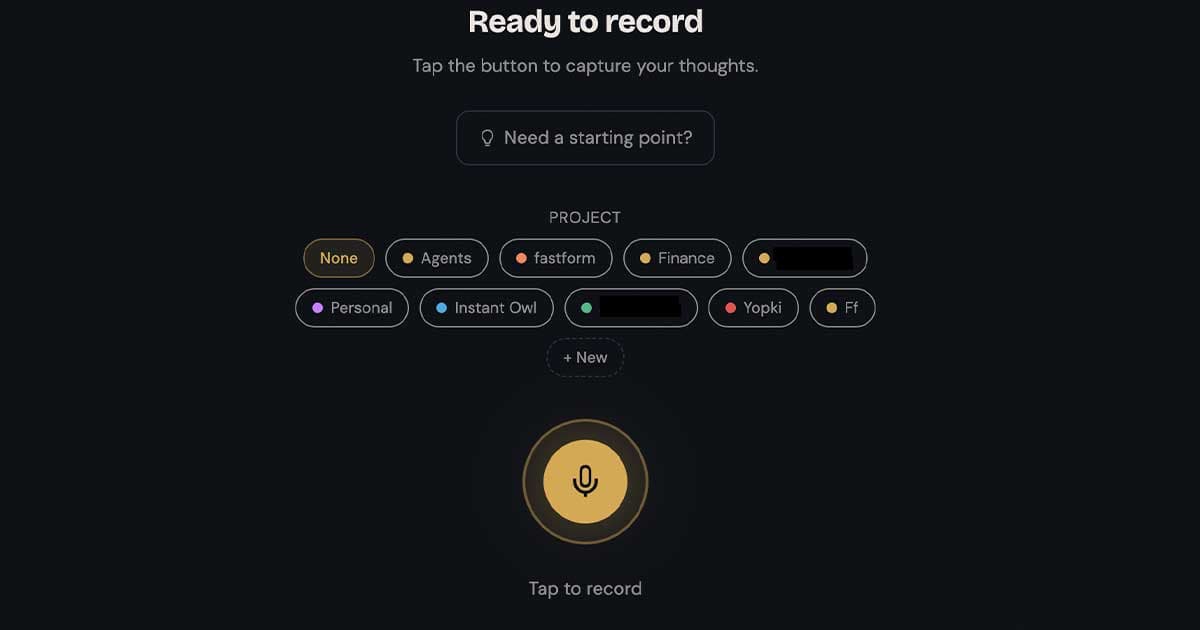
If saying "comma" out loud is the part of dictation you actually hate, that is a different problem, and it is the one InstantOwl solves. You do not learn a command list at all. Ramble the way you would to a friend, run-on sentences and all, and the transcript comes back cleaned up and organized into notes or tasks, punctuation included, without you managing any of it mid-sentence. InstantOwl is currently free to use.
The two tools solve different jobs. Dictation into Word or your iPhone's Messages app is genuinely good at what it does: typing exactly what you say, exactly where your cursor is, with commands as the manual override. InstantOwl is for the ramble that needs to come back as something shaped, a task list or a structured note, not a transcript you have to sort through yourself afterward. If you are on a Mac or a Windows PC, the platform command tables above still apply either way.
Related reading
- Dictation in Microsoft Word: the full setup guide, including Dictate versus Transcribe.
- Dictation on iPhone: where the button lives and what it can and cannot do.
- Dictation on Mac: setup, shortcuts, and accuracy tips for macOS.
- Voice typing on Windows: the full Win + H walkthrough.
- Dictation software compared: built-in options versus paid upgrades, side by side.
Frequently asked questions
How do you say a period out loud when dictating?
Say the word period (or full stop, the phrasing Microsoft Word also accepts) at the exact point where the mark should land, then keep talking without pausing. Mac, iPhone, Word, Windows voice typing, Windows Voice Access, Gboard, and ChromeOS Dictation all document period as a command, so this is the one instruction that works identically everywhere.
What is the difference between saying new line and new paragraph?
New line moves the cursor down one line without the extra blank-line spacing of a real paragraph break, and new paragraph starts a fresh paragraph with that spacing included. Mac, iPhone, Microsoft Word, Windows voice typing, and Gboard all document the two as separate commands, so saying the wrong one gives you the wrong kind of break in your document.
Can you say em dash out loud to insert one while dictating?
It depends on the platform. Microsoft Word and Windows voice typing both document an m-dash command that inserts a true em dash. Apple documents no em-dash command on Mac or iPhone at all: Mac's dash command inserts an en dash instead, and iPhone has no dash command of any kind, documented or otherwise.
Is there a downloadable version of this punctuation cheat sheet?
Yes. A free PDF and Word version covering all seven platforms on one page is linked further up this article, so you can print it or keep it open next to your keyboard while you dictate.

Written by
Jim BreeseJim Breese is the founder of InstantOwl. He's spent 15 years building companies, from an Airbnb host community he founded and exited to growth leadership at venture-backed SaaS startups. He built InstantOwl because his best ideas kept arriving mid-walk, out of order, and half-finished.
Stop losing good ideas.
InstantOwl turns a rambling voice note into a clean, organized document in moments. Just talk. We'll organize it.
 Try InstantOwl free