Dictation in Microsoft Word: Versions, Commands, and the M365 Catch
By Jim Breese · · Updated
Where is the Dictate button in Word?
The Dictate button lives under Home, then Dictate, in Word for Windows, Mac, and the web. But the button is not the real gate. Per Microsoft's support page, "The dictation feature is only available to Microsoft 365 subscribers." A perpetual license, like Word 2016, 2019, or 2021 bought outright rather than through a subscription, does not include it.
Microsoft's own applies-to list on that page names Word 2016 and Word 2019 as supported versions, which makes the subscription gate easy to miss. The same page clarifies the contradiction directly: "Dictate is not available in Office 2016 or 2019 for Windows without Microsoft 365." The applies-to list describes which Word interface can show the button. The subscription is what actually turns it on.
If you are on Windows, Word also needs Windows 10 or later, per Microsoft. Dictate needs a microphone and a reliable internet connection every time you use it, since it sends your speech to Microsoft's cloud for recognition rather than processing it on your device. No internet, no Dictate, on any version.
The honest workaround for anyone without a Microsoft 365 subscription: open Word for the web at word.office.com and sign in with any Microsoft account. Dictate there works the same way and needs nothing installed, though the account still needs an active Microsoft 365 subscription attached to it.
How do you start Dictate on Mac and the web?
On Windows and Mac desktop, click Home, then Dictate, to start listening. On a Mac, the keyboard shortcut is Option + F1, per Microsoft's guide.
In Word for the web, click Home, then Dictate, the same as desktop. If you pause and want to resume without reaching for the mouse, press Alt + backtick, the key with the tilde above Tab, or click the microphone icon in the floating dictation menu.
Dictate fully supports 15 languages: Chinese (China), English (Australia, Canada, India, the UK, and the US), French (Canada and France), German, Hindi, Italian, Japanese, Portuguese (Brazil), and Spanish (Spain and Mexico). More than 30 additional languages are available in preview, including Arabic, Korean, Russian, Swedish, Thai, Turkish, and Vietnamese. Microsoft's caveat on those: "Preview Languages may have lower accuracy or limited punctuation support."
One more detail worth knowing before you dictate anything sensitive: Microsoft states plainly, "This service does not store your audio data or transcribed text. Your speech utterances will be sent to Microsoft and used only to provide you with text results."
If you want to skip the Microsoft 365 requirement entirely, Windows voice typing works inside Word too, costs nothing, and only needs Windows key plus H.
What can you say while dictating in Word?
Word listens for two kinds of speech: what you want typed, and named commands for punctuation, editing, and formatting. Say the phrase in the left column and Word inserts what is on the right, per Microsoft's official command list.
| Say this | Word inserts |
|---|---|
| period, full stop | . |
| comma | , |
| question mark | ? |
| exclamation mark, exclamation point | ! |
| new line | a line break |
| apostrophe-s | 's |
| colon | : |
| semicolon | ; |
| open quotes, close quotes | " " |
| hyphen | - |
| ellipsis, dot dot dot | ... |
| begin single quote, end single quote | ' ' |
| left parentheses, right parentheses | ( ) |
| left bracket, right bracket | [ ] |
| left brace, right brace | { } |
That table is the complete punctuation set Word documents, wider than what the ranking university guides list, both of which stop at roughly a dozen commands total once you mix in editing and formatting.
Beyond punctuation, Word documents four more command families. Editing commands include "backspace," "delete that," "scratch that," and "delete" followed by a count, like "delete 3 words." Selection commands include "select that," "select sentence," and "select from" one phrase "to" another. Formatting commands cover bold, italicize, underline, strikethrough, subscript, superscript, capitalize, and alignment, each usable alone, on a specific word or phrase, or on your last selection. List commands start and exit bulleted or numbered lists and move between items.
Word also recognizes dozens of named symbols by voice: asterisk, backslash, forward slash, ampersand, at sign, percent sign, and currency signs including dollar, pound sterling, euro, and yen. Saying "m-dash" inserts an em dash, and saying "n-dash" inserts an en dash. A handful of emoji work by name too, like "smiley face" and "heart emoji."
On the web version specifically, a setting under the gear icon turns on auto-punctuation, so Word adds commas and periods from your natural pauses instead of you saying them. A second setting masks phrases Word considers sensitive with asterisks. Spoken punctuation commands still work on top of either setting; they are not mutually exclusive.
For the complete command reference across every platform, not just Word, see our dictation punctuation commands cheat sheet.
Why is Dictate not working?
Microsoft documents six specific Dictate failures, and matching your problem to the right one saves time.
- Can't find the Dictate button. Confirm you are signed in with a Microsoft 365 subscription; without one, the button either does not appear or does nothing when clicked.
- Dictate button is grayed out. This usually means Word cannot detect a microphone, or your account is not currently signed in to Microsoft 365.
- Microphone doesn't have access. Check your operating system's privacy settings and confirm Word has permission to use the microphone, separate from Word's own settings.
- Microphone isn't working. Test the microphone in another app first to rule out a hardware or driver problem before troubleshooting Word.
- Dictation can't hear you. Move closer to the microphone, reduce background noise, and confirm the correct input device is selected if more than one is connected.
- Accuracy issues or missed words. Speak at a natural pace, use the punctuation commands above instead of typing punctuation manually mid-dictation, and check that your dictation language matches what you are actually speaking.
Every one of these traces back to one of three root causes: the Microsoft 365 subscription, the microphone connection, or the internet connection. Check those three first, in that order, before digging into anything more specific.
Dictate vs Transcribe: what is the difference?
Dictate and Transcribe are two different Word features under the same Home tab, and searchers mix them up constantly. Dictate types what you say live, as your cursor sits in the document. Transcribe takes a recording, one you make in the moment or upload from a file, and turns it into a written, speaker-labeled transcript.
Both require a Microsoft 365 subscription. Dictate has no stated minute limit; you can dictate as long as your internet connection and patience hold out. Transcribe caps uploaded audio at 300 minutes a month on a standard Microsoft 365 plan, or 30,000 minutes a month with a Copilot license, per Microsoft's Transcribe support page.
Transcribe accepts uploaded files in .wav, .mp4, .m4a, and .mp3 formats, works in Word for the web through Edge or Chrome, and labels speakers "Speaker 1," "Speaker 2," and so on, with the option to relabel them by name. It supports more than 80 locales and, like Dictate, needs an internet connection.
The rule of thumb: if you are talking into Word right now, you want Dictate. If you already have a recording, whether a meeting, an interview, or a voice memo, and need it turned into text after the fact, you want Transcribe, or a dedicated transcription tool if the file never needs to live inside Word at all.
Where InstantOwl fits
Full disclosure first: InstantOwl is our product, and this blog belongs to it. Word Dictate types exactly what you say, at your cursor, in the order you said it. That is genuinely useful for dictating into a Word document specifically, and we are not going to pretend otherwise.
What Dictate does not do is restructure anything. Say four unrelated things in one breath: a task, a deadline, a half-formed idea, a reminder, and Dictate hands back four unrelated sentences in the order you spoke them, right where your cursor was sitting. Ramble first, structure later is not part of the job.
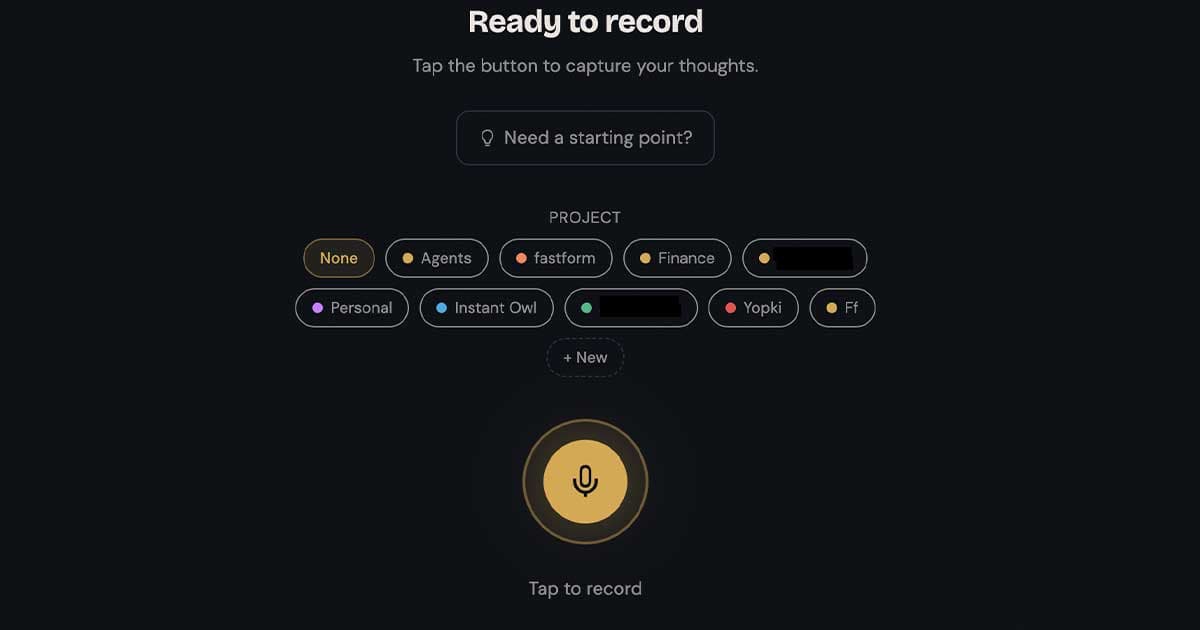
InstantOwl exists for that second step. Talk into it the way you would talk to a person, out of order, correcting yourself mid-thought, and it hands back organized output instead: a task list, a summary, a document shaped for what you actually needed, not a transcript to sort through yourself afterward. If the ramble happened somewhere other than inside a Word document already open on your screen, that is where InstantOwl picks up. InstantOwl is currently free to use.
The same split shows up one level down, in a different app. Google Docs has its own voice-typing feature with a similarly narrow job: type what you say, nothing more. Our Google Docs voice typing guide covers its setup and its two language catches.
Related reading
- Dictation punctuation commands: the full cross-platform command reference, sourced from Apple, Microsoft, and Google's own documentation.
- Google Docs voice typing: setup, commands, and the language catches for Word's closest sibling feature.
- Voice typing in Windows 11: the free, no-subscription way to dictate into any app, including Word.
Frequently asked questions
Where is the Dictate button in Word?
Click Home, then Dictate, in Word for Windows, Mac, or the web. The button only works with an active Microsoft 365 subscription. Word 2016, 2019, and 2021, bought as a one-time perpetual license, do not include Dictate, even though Microsoft's own support page lists them as compatible versions.
Is Dictate in Word free?
No. Per Microsoft, "the dictation feature is only available to Microsoft 365 subscribers." There is no free standalone version of Word Dictate. The closest free path is signing into Word for the web with a Microsoft 365 subscription rather than buying desktop Word outright.
What is the keyboard shortcut for Dictate on Mac?
Option + F1 starts and stops Dictate on a Mac, per Microsoft's support page. On Word for the web, Alt + backtick resumes dictation after a pause instead.
What is the difference between Dictate and Transcribe in Word?
Dictate types what you say live, as your cursor sits in the document, with no stated time limit. Transcribe turns an uploaded or recorded audio file into a speaker-labeled written transcript, capped at 300 minutes of uploaded audio per month on a standard Microsoft 365 plan, per Microsoft.

Written by
Jim BreeseJim Breese is the founder of InstantOwl. He's spent 15 years building companies, from an Airbnb host community he founded and exited to growth leadership at venture-backed SaaS startups. He built InstantOwl because his best ideas kept arriving mid-walk, out of order, and half-finished.
Stop losing good ideas.
InstantOwl turns a rambling voice note into a clean, organized document in moments. Just talk. We'll organize it.
 Try InstantOwl free