WAV to Text: Why File-Size Caps Bite So Fast
By Jim Breese ·
How do you convert WAV to text?
Upload the WAV file to a transcription tool and it returns text, the same basic flow as any other audio format. The catch with WAV is not the conversion step. It is that the file arrives at the upload button far bigger than a listener expects, and that size is what trips every cap along the way.
WAV is the Microsoft and IBM format, part of the Resource Interchange File Format built for Windows 3.1, per the Library of Congress format registry. It is a wrapper, not a single fixed encoding, but the encoding it commonly carries is LPCM, uncompressed audio with no data thrown away.
Uncompressed means big. CD-quality stereo audio runs 44,100 samples a second at 16 bits across 2 channels, which works out to about 10MB per minute. An hour of stereo WAV lands around 600MB. Basic WAVE also carries a 4GB structural ceiling from its 32-bit chunk-size field, though extensions like RF64 exist to exceed it.
None of that matters for a compressed format like MP3 or M4A, where a 100MB cap holds hours of audio. For WAV, the same 100MB cap holds about 10 minutes. That gap is the entire story of this post.
WAV shows up most often in audio production, field recording, and archival work, not casual voice memos. The Library of Congress lists WAVE as a preferred format for digital audio in its Recommended Formats Statement, which is exactly why libraries, sound engineers, and podcasters default to it: nothing is thrown away, at the cost of the file staying large. If your WAV file came from a recorder, a mixing session, or an archive, the size was a deliberate tradeoff someone made before you ever tried to transcribe it.
How much WAV fits under each cap?
Not much, once you do the arithmetic. Every transcription tool publishes a file-size or file-length limit, and at roughly 10MB per minute of stereo WAV, those limits translate into far fewer minutes than they sound like.
| Cap | Source | Stereo WAV it holds |
|---|---|---|
| 100MB | Evernote's web converter (which also caps files at 60 minutes) | About 10 minutes |
| 500MB | Adobe's free Enhance Speech tool | About 50 minutes by size, but Adobe also caps each file at 30 minutes, so the time cap binds first |
| 4GB | Go Transcribe's recommended ceiling; also basic WAVE's own structural limit | About 6 hours 40 minutes |
| 5GB | TurboScribe's Unlimited plan | About 8 hours 20 minutes |
Mono WAV uses half the data of stereo, so double every figure above for a mono recording. TurboScribe's free tier works differently: it caps files at 30 minutes regardless of size, a duration limit rather than a byte limit, so it never runs into this math at all.
The takeaway: a byte-based cap that sounds generous for MP3 or M4A can be tight for WAV. Check whether a tool's limit is measured in megabytes or minutes before you upload, because the two behave completely differently for uncompressed audio.
This is also why the 4GB numbers line up more than once in the table above. Go Transcribe recommends staying under 4GB on its own page, and that figure is not a marketing choice: it matches the structural ceiling built into basic WAVE's own 32-bit chunk-size field, per the Library of Congress. A tool warning you about 4GB WAV files is echoing a real limit in the format itself, not inventing one.
What are the real WAV to text tools, with real numbers?
Three tools cover the practical range for WAV files, each verified on its own page. TurboScribe fits long or frequent files: 3 free transcripts a day at 30 minutes each, no card required, then $10 a month billed yearly (or $20 monthly) for Unlimited, which raises the file cap to 10 hours and 5GB, 50 files at a time, per its own pricing page. It openly runs on Whisper and claims "99.8% accuracy," a marketing figure worth treating as a claim, not a measurement.
Any2Text fits an occasional short file. Its operator, Puget Ross LLC, is named on the page, unusual for this tool class. The first 15 minutes are free, no signup required, then $0.035 a minute, or $19.99 a month for 3,000 minutes on its Premium tier.
One catch worth knowing before you trust the rest of the page: the supported-formats section on Any2Text's own wav-to-text page points to its MP4, MP3, M4A, and OGG converters without ever naming WAV itself, even though the page's own title and uploader are built for wav files. It reads like a template whose format list never got updated for the page it sits on.
Go Transcribe's wav-to-text page has the same problem in a different shape. It reads as a word-for-word clone of Go Transcribe's m4a-to-text page, same feature list, same exports, same "smaller than 4GB" recommendation, with only the generic audio-quality tips swapped in as wav-flavored content. Its pricing runs $12 an hour pay-as-you-go, or $36 a month for 10 hours (Professional) and $90 a month also for 10 hours (Business), which makes it one of the more expensive per-hour options here next to Any2Text's per-minute rate.
HappyScribe rounds out the set for a single one-off file: 10 free minutes, one time only, no card needed, then subscription or pay-as-you-go pricing not shown on its landing page. It accepts WAV among 45-plus formats with no stated file-size limit, per its own page.
Accuracy claims across all three are worth reading skeptically. TurboScribe's "99.8% accuracy" and HappyScribe's own stated range, "up to 96% accuracy on clear audio" for its AI tier versus "close to 99%" for its human tier, are two different numbers for two different services on the same page. Treat any flat accuracy percentage as a claim about ideal conditions, not a guarantee for a noisy field recording or a crowded room.
Should you compress the WAV first?
Often, yes. Speech transcription accuracy does not require uncompressed audio, so converting a WAV file to a compressed format like AAC or MP3 before uploading can shrink it 5 to 10 times with no real accuracy cost, sidestepping every cap in the table above in one step.
The other way around the same problem is picking a tool with a duration-based free limit instead of a byte-based one. TurboScribe's 30-minute-per-file free tier does not care how uncompressed the file is, since it counts minutes, not megabytes. A 30-minute WAV file is around 300MB, which clears TurboScribe's free tier easily while blowing past a 100MB cap on other tools.
Either fix works. Compressing first helps everywhere you upload afterward. Picking a duration-capped tool is faster if you only need to transcribe the one file in front of you.
The one place this advice does not apply is archival WAV files you need to keep uncompressed for reasons that have nothing to do with transcription, a preservation copy or a mix session master. In that case, keep the original WAV untouched, make a compressed copy just for the transcription upload, and treat the transcript as a separate output from the archive itself.
Where does InstantOwl fit?
Full disclosure: InstantOwl is our product, and this is our blog. Most people searching for a WAV to text converter are handling someone else's audio, a podcast recording, a field recording, or an archival file, since WAV is a preferred format for audio preservation, per the Library of Congress. That is squarely what the tools above are built for, not what InstantOwl is built for.
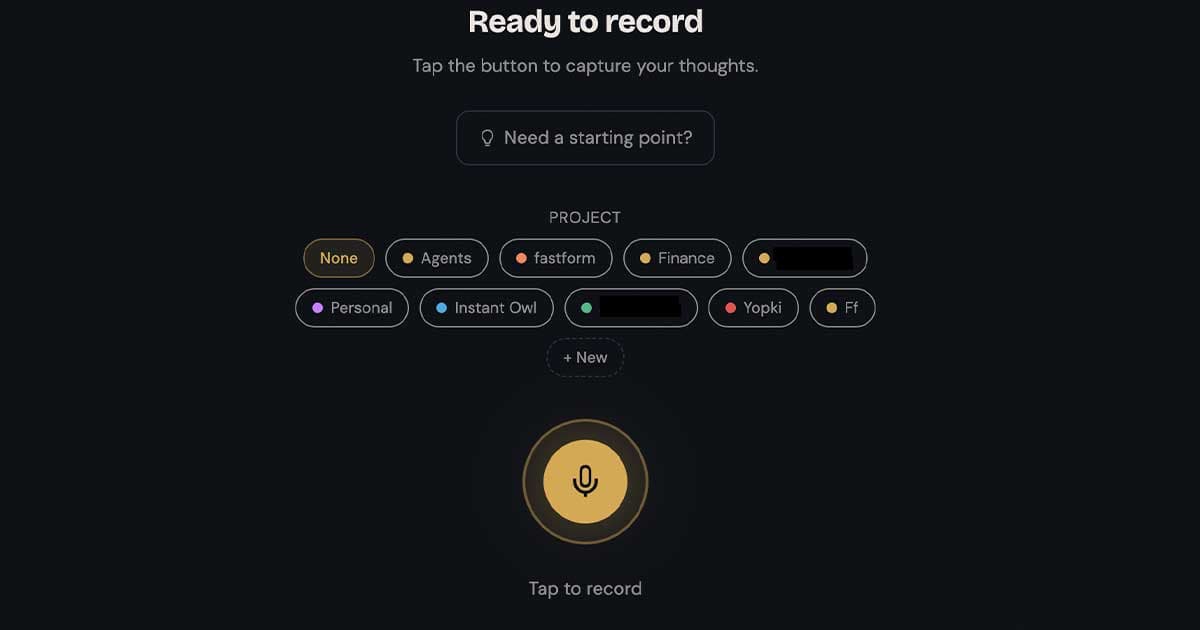
The exception is the person whose own voice ends up in a WAV file out of habit, from a recorder or an app that defaults to it, who then hits these same caps trying to get it transcribed. For that case, the fix sits upstream of the file format entirely: capture directly in InstantOwl and skip the recording, exporting, and cap-checking loop altogether. InstantOwl is currently free to use.
Related reading
- M4A to text: the compressed sibling format, where a 4GB size cap almost never bites.
- Transcribe audio to text: the fuller picture of free and paid transcription tools across every format.
- MP3 to text: eight verified ways to convert the most common compressed format.
- InstantOwl: organized notes and tasks from one recording, currently free to use.
Frequently asked questions
Can I transcribe a WAV file for free?
Yes, with real limits attached. TurboScribe gives 3 free transcripts a day at 30 minutes each, Any2Text gives the first 15 minutes free then charges per minute, and HappyScribe gives 10 free minutes one time, per each tool's own page. None of them are unlimited free WAV transcription.
Why is my WAV file so big?
WAV is a wrapper format that commonly holds uncompressed LPCM audio, per the Library of Congress format registry, unlike MP3 or M4A which compress the audio data. Uncompressed CD-quality stereo runs about 10MB per minute, so a WAV file is roughly 5 to 10 times larger than a compressed file of the same recording.
What is the best WAV to text converter?
It depends on your file. TurboScribe fits long or frequent files best, with 10-hour, 5GB files on its $10-a-month Unlimited plan. Any2Text fits occasional short files at $0.035 a minute after 15 free minutes. HappyScribe fits a single one-off file with its 10 free minutes, per each tool's own page.
How many minutes is a 100MB WAV file?
About 10 minutes of stereo WAV, or about 20 minutes mono, based on uncompressed CD-quality audio running roughly 10MB per minute in stereo. That is why a 100MB cap, like the one on Evernote's web converter, feels much smaller for WAV than it does for a compressed MP3 of the same length.

Written by
Jim BreeseJim Breese is the founder of InstantOwl. He's spent 15 years building companies, from an Airbnb host community he founded and exited to growth leadership at venture-backed SaaS startups. He built InstantOwl because his best ideas kept arriving mid-walk, out of order, and half-finished.
Stop losing good ideas.
InstantOwl turns a rambling voice note into a clean, organized document in moments. Just talk. We'll organize it.
 Try InstantOwl free