Voice Typing on a Chromebook: The System Toggle, Not the Docs Trick
By Jim Breese ·
How do you turn on voice typing on a Chromebook?
"Voice typing on a Chromebook" usually means one of three different things: ChromeOS Dictation, a system-wide accessibility feature; Google Docs voice typing, which only works inside Docs; or a browser extension like Voice In. This post covers ChromeOS Dictation, the system toggle, since it is the one built into the Chromebook itself.
ChromeOS Dictation lets you speak to enter text "in most places you type," per Google's support page, not just inside one app. Turn it on once in Settings > Accessibility, then trigger it anywhere with a keyboard shortcut. It works in the address bar, chat boxes, and non-Docs apps, which Docs voice typing cannot touch.
If you actually landed here wanting the Docs-only feature, Google Docs voice typing has its own setup, its own deeper English command set, and its own two language catches worth knowing before you rely on it. The two features do not share settings, and turning one on does not turn on the other.
How do you set up and use ChromeOS Dictation?
Turn on Dictation once, then start it with a keyboard shortcut anywhere you can type. Select the time at the bottom right, or press Alt + Shift + s, then choose Settings > Accessibility. Under "Keyboard and text input," turn on Dictation, per Google's support page.
To start dictating, tap or select where you want to type, then select Speak, or skip that step entirely and press Search + d, or Launcher + d, per the same page. Speech converts to text at the cursor as you talk.
One behavior trips up almost everyone the first time: to use a voice command mid-dictation, wait for your spoken text to clear from the box, then say the command. Speak too soon and Dictation types the command as literal words instead of running it. Give it a beat of silence before saying "period" or "delete the previous word."
Dictation also depends on matching languages. Per Google, "speech won't work if the spoken language doesn't match the device language," so a Chromebook set to English will not transcribe Spanish speech correctly, regardless of what language you actually speak.
What voice commands work on a Chromebook?
ChromeOS Dictation has a real command set beyond typing raw text: punctuation, editing, navigation, and selection, all documented on Google's support page. Say the command clearly, after your spoken text has cleared the box, and it runs instead of getting typed as words.
| Category | Say this | What it does |
|---|---|---|
| Punctuation | "Comma," "Period," "Question mark," "Exclamation mark" or "Exclamation point" | Inserts the mark |
| Editing | "Undo," "Redo," "Select all," "Unselect," "Cut," "Copy," "Paste," "New line" | Runs the matching text-editing action |
| Deleting | "Delete the previous character," "Delete the previous word," "Delete the previous sentence," "Delete [word or phrase]" | Removes the specified text |
| Navigation | "Move to the next/previous character," "Move to the next/previous word," "Move to the next/previous line," "Move to the next/previous sentence" | Moves the cursor without touching the trackpad |
| Advanced editing | "Replace [word/phrase] with [word/phrase]," "Insert [word/phrase] before [word/phrase]," "Select from [word/phrase] to [word/phrase]" | Edits existing text; only works if the referenced word or phrase is before the cursor |
| Control | "Help," "Cancel," "Type [word/phrase]" | Opens the help article, stops dictation, or forces literal text when your sentence is itself a command word |
Google also documents a newer set of commands, verbatim: "Delete all," "Move to the start," "Move to the end," "Select the previous/next word," "Select the next/previous character," and "Repeat." The catch, stated directly on Google's support page: "You can only use these new commands in English, French, German, Italian, and Spanish." Google also notes that "some voice commands aren't yet supported in right-to-left languages," so Dictation's command depth is not the same in every language.
What can't ChromeOS Dictation punctuate?
Only four punctuation commands are documented for ChromeOS Dictation: comma, period, question mark, and exclamation mark or exclamation point. That is the entire punctuation set Google publishes for this feature, per its own support page.
No colon, semicolon, hyphen, quotation mark, or parenthesis command is documented. If you need any of those inserted by voice, Dictation will not do it; you will need to type the mark yourself or edit it in afterward. Compare that with Microsoft Word Dictate or Windows voice typing, both of which document more than a dozen punctuation and symbol commands, and the gap on ChromeOS is real, not a rumor.
This is worth knowing before you rely on Dictation for anything longer than a sentence or two. A quick reply or search query survives fine without commas and semicolons. A paragraph you actually want to read back later will not.
What if you want richer punctuation? The Voice In extension
Voice In is a Chrome extension that adds dictation to text fields across the web, with more punctuation control than ChromeOS Dictation offers out of the box. Since it runs in the browser rather than the operating system, it works on any Chromebook without needing a system toggle at all.
Per its own Chrome Web Store listing, Voice In has 600,000 users and a 4.4-star rating from 2.8K ratings, and pitches itself for voice typing across "10,000+ sites" in "50+ languages," covering email, CRMs, and messaging apps. It has a free basic plan and a paid Voice In Plus tier with custom voice commands and multi-tab dictation; the store listing does not publish Plus pricing, so we won't guess at a number here.
There are real limits to the system feature worth naming: some of its voice commands don't always register, and using it in public can feel awkward when you are speaking something personal out loud. An extension like Voice In does not solve the public-speaking-out-loud problem, but it does close the punctuation gap for anyone typing into web forms and apps all day.
Voice typing on Chromebook not working? Fixes that help
Most "Chromebook voice typing not working" complaints trace back to one of a handful of documented causes, not a broken feature. Start with the setting itself: if Dictation is off, Search + d does nothing. Recheck Settings > Accessibility > Keyboard and text input and confirm the Dictation switch is on.
Next, check the language match. Google states plainly that "speech won't work if the spoken language doesn't match the device language," so if your Chromebook's system language is English and you are speaking another language, Dictation will not transcribe it correctly no matter how clearly you talk.
If commands are not registering, that is almost always the timing issue: you have to wait for your spoken text to clear from the box before saying a command, or Dictation just types the command as words. Give it a pause.
If you are trying a command like "Select from [word] to [word]" and it does nothing, remember the documented limit: it only works if that word or phrase already appears before your cursor. And if you are using one of the newer commands, "Delete all" or "Repeat," confirm your Chromebook's language is set to English, French, German, Italian, or Spanish; those commands are not documented outside that list.
One more tip: turning on "Show accessibility options in Quick Settings" puts a dictation icon directly on the shelf, so you can start and stop it with a tap instead of remembering the keyboard shortcut.
Where InstantOwl fits
Full disclosure: InstantOwl is our product, and this blog belongs to it. ChromeOS Dictation types what you say wherever your cursor sits. It is genuinely useful for that, and honest about its limits: four punctuation commands, no restructuring, no cleanup.
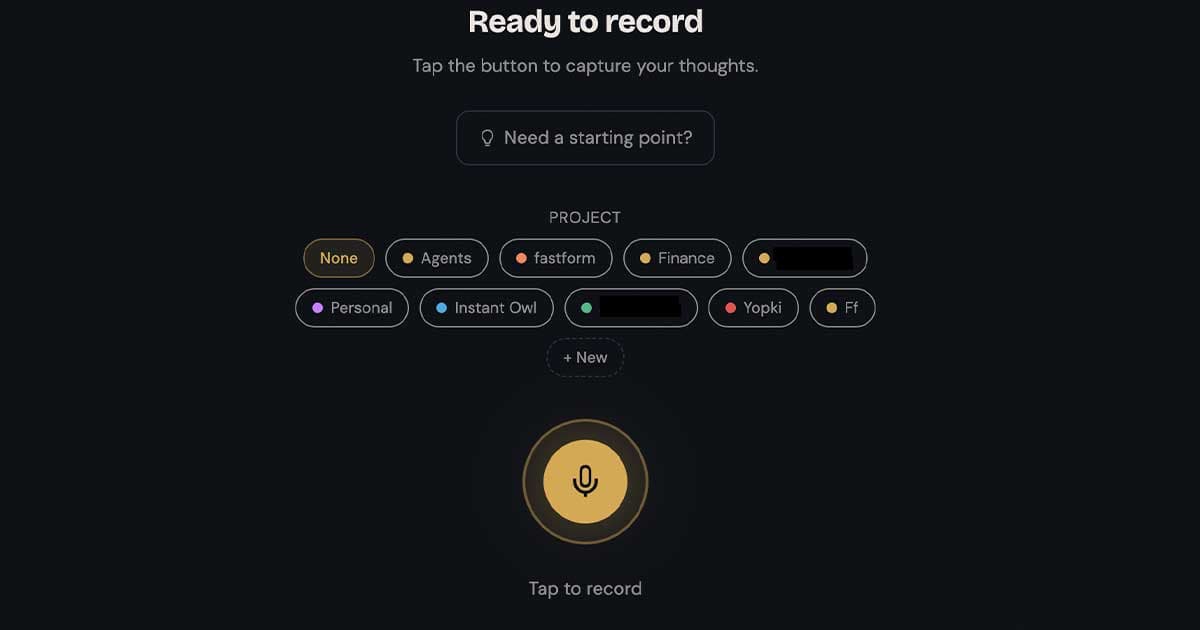
InstantOwl runs in the browser, so it works on any Chromebook without a system toggle or an extension install. It is built for a different moment: you talk for a few minutes about several things at once, and instead of raw typed words sitting at a cursor, you get back an organized document, a summary, or a task list. InstantOwl is currently free to use.
If your job is filling in a form field or a chat box, ChromeOS Dictation or Voice In are the right, lightweight tools. If what you actually have is a messy, rambling thought you want turned into something usable, that is the gap InstantOwl is built to close.
Related reading
- Google Docs voice typing: setup, the full command table, and the two language catches specific to Docs.
- Voice to text on Android: the same live-dictation idea, built into Android's Gboard keyboard instead of ChromeOS.
- Best dictation software: a wider comparison of dictation tools beyond what ships on a Chromebook.
Frequently asked questions
How do you turn on voice typing on a Chromebook?
Select the time in the bottom right, or press Alt + Shift + s, then choose Settings > Accessibility. Under Keyboard and text input, turn on Dictation. Tap where you want to type, then press Search + d, or Launcher + d, to start speaking, per Google's support page.
How do you turn off voice typing on a Chromebook?
Say Cancel while dictating to stop that session, per Google's command list, or press Search + d again to toggle it off. To remove the feature entirely, go back to Settings > Accessibility > Keyboard and text input and turn the Dictation switch off.
What commands does ChromeOS Dictation support?
Google's official command table covers punctuation (comma, period, question mark, exclamation mark), editing (undo, redo, delete the previous word or sentence), navigation (move to the next line or word), and selection commands, plus newer commands like Delete all and Repeat in English, French, German, Italian, and Spanish only.
What is the difference between ChromeOS Dictation and Google Docs voice typing?
ChromeOS Dictation is a system-wide accessibility feature that works in most places you type on a Chromebook, turned on in Settings and started with Search + d. Google Docs voice typing lives only inside Docs, turned on with Tools > Voice typing, and works on any operating system, not just Chromebooks.

Written by
Jim BreeseJim Breese is the founder of InstantOwl. He's spent 15 years building companies, from an Airbnb host community he founded and exited to growth leadership at venture-backed SaaS startups. He built InstantOwl because his best ideas kept arriving mid-walk, out of order, and half-finished.
Stop losing good ideas.
InstantOwl turns a rambling voice note into a clean, organized document in moments. Just talk. We'll organize it.
 Try InstantOwl free