How to Dictate on iPhone: Setup, Commands, and the Fixes That Work
By Jim Breese ·
How do you turn on and use Dictation on iPhone?
Turn on Dictation once, then use it anywhere you can type. Open Settings, tap General, tap Keyboard, and turn on Enable Dictation. If a prompt appears, tap Enable Dictation again to confirm, and tap About Dictation & Privacy below the toggle if you want the specifics on what Apple does with your voice.
To dictate, tap inside a text field to place your cursor, then tap the microphone on the onscreen keyboard, or in any text field where it appears. Wait for the mic icon to show up near your cursor, then start talking. Per Apple's iPhone support guide, "you can dictate text anywhere you can type it," and the keyboard stays open the whole time so you can freely switch between voice and touch.
Dictation runs on your device for most languages. Apple's guide states requests are "processed on your device in many languages," and separately, that no internet connection is required for those languages. One exception most guides skip: "When dictating in a search box, dictated text may be sent to the search provider in order to process the search."
Dictation stops itself after a pause, not after a set length. Apple's guide states plainly: "Dictation stops automatically when you stop speaking for 30 seconds." That is a silence timer, not a length cap. A lot of guides describe this as a flat 30-second limit, as if the whole session ends on a clock no matter what you are doing. It does not. The clock only starts once you go quiet, and it resets the instant you speak again, so a five-minute ramble with short pauses between sentences never trips it.
To stop on purpose, tap the stop control or say "Stop dictation." To turn the feature off entirely, go back to Settings > General > Keyboard and turn off Enable Dictation. One more detail worth knowing: Apple notes "When using Dictation, cellular data charges may apply," and dictation follows whatever keyboard language you have active, so adding a second keyboard also adds that language to Dictation.
What are the iPhone dictation commands?
iPhone Dictation understands two kinds of spoken commands: punctuation and formatting, which work for everyone, and editing commands, which are gated (covered next). All of the following comes from Apple's own command reference.
Say a punctuation mark's name and iPhone inserts the symbol instead of the word:
| Say | Inserts |
|---|---|
| Period | . |
| Comma | , |
| Exclamation point | ! |
| Question mark | ? |
| Dollar sign | $ |
| Open parenthesis | ( |
| Close parenthesis | ) |
| Quote | opening quotation mark |
| End quote | closing quotation mark |
| Colon | : |
| Semicolon | ; |
| Hashtag | # |
Formatting works the same way, by name:
| Say | Result |
|---|---|
| Cap | Capitalizes the next word |
| Caps on ... caps off | Capitalizes everything said in between |
| All caps | Capitalizes the next word in all capitals |
| All caps on ... all caps off | Capitalizes everything said in between, in all capitals |
| No caps on ... no caps off | Keeps everything said in between lowercase |
| No space | Removes the space before the next word |
| No space on ... no space off | Removes spacing across a longer stretch (not available in all languages) |
| New paragraph | Starts a new paragraph |
| New line | Starts a new line |
To spell out a word instead of letting Dictation guess it, say the letters one by one. Apple's own examples: "Let's invite Steven S-T-E-P-H-E-N," and "Change tea to T-E-E." Emoji work the same way: say a name like "heart emoji" or "car emoji" and iPhone inserts the symbol.
In supported languages, iPhone adds commas, periods, and question marks on its own as you talk, without you saying them. If you would rather punctuate everything yourself by voice, turn that off at Settings > General > Keyboard > Auto-Punctuation. Auto-Punctuation has its own supported-language list, shorter than the list of languages Dictation itself works in, a nuance the troubleshooting section below covers.
Why don't your editing commands work?
Because editing by voice, saying "select," "delete," or "change one word to another," only works when two conditions are both true at once: your language has to be U.S. English, and your iPhone has to be a 12 or later, with one exception. Apple states it exactly: "Dictation commands to edit text are available in U.S. English on iPhone 12 and later (except iPhone SE)."
| Say | What it does |
|---|---|
| "Change [word] to [word]" | Replaces one word or phrase with another |
| "Insert [word] before [word]" | Adds a word ahead of another |
| "Insert [word] after [word]" | Adds a word right after another |
| "Select [phrase]" | Highlights a phrase so the next command can act on it |
| "Delete [phrase]" | Removes a phrase |
| "Delete all" | Clears everything dictated so far |
| "Undo" | Reverses the last change |
| "Redo" | Reapplies the change just undone |
Most guides to iPhone Dictation list these commands without mentioning who actually gets to use them. Two gates apply together, not one or the other. An iPhone 13 set to British English does not get edit commands. Neither does an iPhone SE set to U.S. English, since the SE is named as an explicit exception. Only the exact combination, U.S. English on an iPhone 12 or later that is not an SE, unlocks the feature.
Apple's own feature availability page confirms this from a second angle: "Dictation: Voice-Based Editing" is listed as English (United States) only, with no other language on that list at all, while ordinary Dictation supports around 60 locales. Voice editing is the narrowest feature in the whole system.
Why does Dictation on iPhone say it's not working?
Before assuming Dictation is broken, check five things Apple gates by setting, language, or device, since most "not working" reports trace back to one of these rather than an actual bug.
Enable Dictation might simply be off. Go to Settings > General > Keyboard and confirm the toggle is on. It is the one setting the entire feature depends on, and it is easy to have missed during setup or turned off by accident.
Your language or region might not be supported. Apple states plainly that "Dictation may not be available in all languages or in all countries or regions, and features may vary," and points users to its feature availability page to check theirs specifically.
Punctuation might not be appearing on its own, and that is not necessarily a bug. Auto-Punctuation has its own shorter list of supported languages, separate from the longer list where Dictation itself works. If your language is not on that shorter list, saying punctuation by name still works; only the automatic version is unavailable.
Edit commands like "select" or "delete" might not respond at all. That is almost always the two-part gate from the last section: U.S. English and an iPhone 12 or later, except SE. Outside that exact combination, edit commands are not something to fix, they are a feature that is not available on that setup.
Dictation stopping mid sentence without warning is most often the 30-second silence timer catching a real pause, not a crash. If it stops while you were actively talking, check your connection instead: cellular data charges can apply per Apple, and any language outside the on-device list still needs an internet connection to work at all.
How do you dictate with a Magic Keyboard on iPhone?
If you use a Magic Keyboard with your iPhone, per Apple's guide for dictating with an external keyboard: "Go to Settings > General > Keyboard, turn on Enable Dictation, then choose a dictation shortcut." Once that shortcut is set, dictating no longer needs the onscreen keyboard at all.
To dictate, tap to place your cursor, then press your chosen dictation shortcut key twice. Press it twice again to stop and return to typing. Apple adds one more detail: "As you speak to insert text, iPhone automatically inserts punctuation for you," the same Auto-Punctuation behavior covered above, just triggered from a hardware key instead of the onscreen mic.
Beyond dictation: when a text field isn't the real problem
iPhone Dictation is built to do one job well: type where your cursor already is. It punishes long pauses with the 30-second silence stop, hands back a flat block of text in a single field, and only unlocks its editing commands for a narrow slice of language and device combinations. None of that makes it a bad tool. Wirecutter tested Apple's Dictation directly, rated it 94% accurate, and called it "worth using as a built-in tool for occasional, quick dictation." That framing is exactly right: it is a quick-dictation tool, not a thinking tool.
If your dictation questions are really about a different platform, the same silence-timer myth shows up on Mac, and Android's Gboard runs the equivalent job differently.
For every platform's punctuation and formatting commands laid out side by side in one place, see the full dictation punctuation command list.
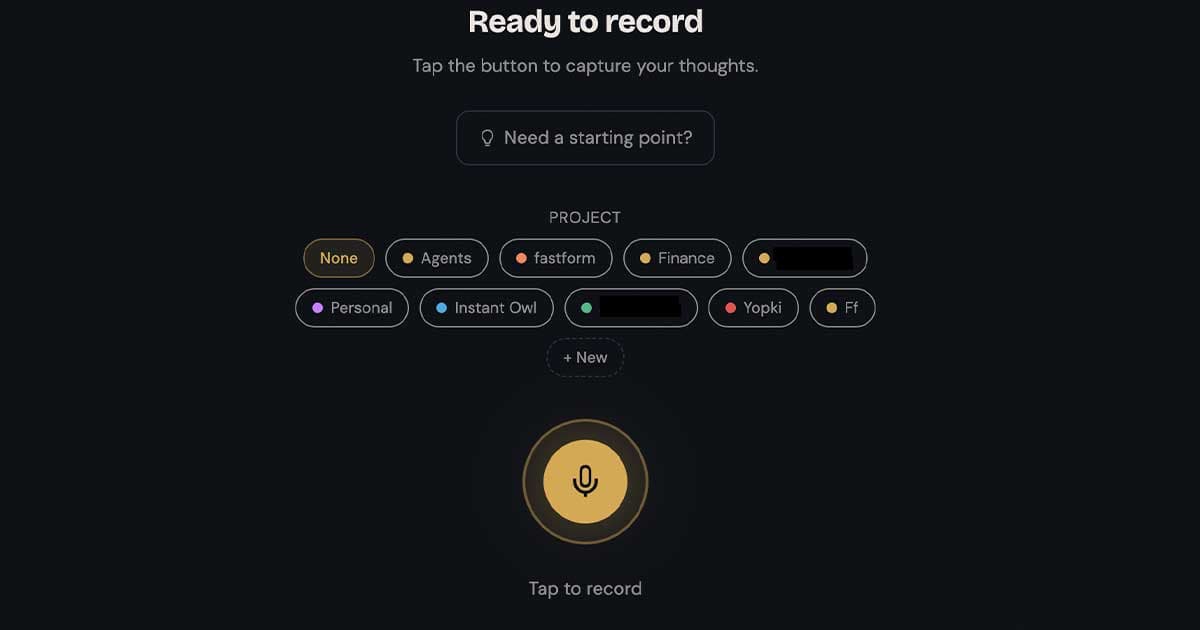
Full disclosure: InstantOwl is our product, and this blog belongs to it. InstantOwl is not a dictation replacement. It is built for the moment Dictation was never meant to handle: five or ten minutes of real thinking, pauses and backtracks included, that needs to come back as an organized document instead of a wall of transcript.
If what you actually want is better dictation, not organized documents, our breakdown of dictation software compares the field, including Wispr Flow, which cleans up speech as you talk instead of transcribing it raw. InstantOwl is currently free to use, and it is for the people a quick text field was never built for: a mind that generates ideas faster than it can type them, or a parent with three minutes to talk before the next thing starts.
Frequently asked questions
How do I turn on Dictation on my iPhone?
Open Settings, tap General, tap Keyboard, and turn on Enable Dictation. If a prompt appears, tap Enable Dictation again to confirm. Tap the microphone on the keyboard in any text field to start speaking, and tap the stop control or say Stop dictation to end.
What are the dictation commands on iPhone?
You can say punctuation by name (period, comma, question mark), say new line or new paragraph to format, spell a word letter by letter to correct it, say an emoji's name to insert it, and on U.S. English iPhone 12 and later except SE, say commands like select, delete, change X to Y, undo, and redo to edit what you already dictated.
Why does Dictation on iPhone stop by itself?
Apple's guide states Dictation stops automatically when you stop speaking for 30 seconds. That is a silence timer, not a length limit: talk continuously and it keeps going, and every time you speak again, the 30 second clock resets.
Does Dictation on iPhone work without an internet connection?
Often, yes. Apple's guide states Dictation requests are processed on your device in many languages, so no internet connection is required for those languages, though a search box is an exception since dictated text there may still be sent to the search provider, and cellular data charges may apply.

Written by
Jim BreeseJim Breese is the founder of InstantOwl. He's spent 15 years building companies, from an Airbnb host community he founded and exited to growth leadership at venture-backed SaaS startups. He built InstantOwl because his best ideas kept arriving mid-walk, out of order, and half-finished.
Stop losing good ideas.
InstantOwl turns a rambling voice note into a clean, organized document in moments. Just talk. We'll organize it.
 Try InstantOwl free