Voicenotes Alternatives: 7 Apps for Turning Talk Into Notes
By Jim Breese · · Updated
Why do people look for a Voicenotes alternative?
Mostly because Voicenotes stopped being built for them. Its homepage now promises to turn "every meeting into perfect notes and instant answers," a full pivot toward AI meeting notetaking, per voicenotes.com. Someone who talks to themselves to catch a stray thought is no longer who that copy is written for.
The free plan reflects the same shift. Basic gives unlimited recordings but only 100 weekly transcription minutes, shared across everything you record, plus 30-day history, after which older notes stop being accessible. That is a reasonable limit for occasional meeting notes. It is a real constraint if you think out loud daily.
Reliability is the second driver, and it splits sharply by platform. Voicenotes holds 4.8 stars from about 6,600 App Store ratings, against 3.9 stars from 2.64K Google Play reviews, nearly a full star lower. Android reviewers describe the app reverting to a logged-out state on restart and losing recordings mid-upload; iOS reviewers separately report recordings stopping mid-session without warning.
Pricing trust is the third, and it is dated and specific. On a December 2025 Reddit thread comparing capture apps, one shopper who had signed up for Voicenotes' old annual plan at $50 described what happened next: "they changed the price to us$70 and my trial ended and they charged me us$70 instead of us$50," adding that support "tried to blame it on conversion to Canadian dollars" and "absolutely refused to acknowledge or fix it."
Voicenotes' current web pricing page shows no annual plan at all today; Pro is a flat $9 a month. Treat the story above as a 2025 pricing-transition account of how support handled one billing dispute, not a description of a live price.
None of this makes Voicenotes a bad app. It is a well-rated, capable meetings tool for the job it now leads with. These are the specific, sourced reasons someone who wants personal capture, not meeting recaps, goes looking for something else.
Best for polished rewrites: AudioPen
AudioPen is not a subscription. It sells prepaid passes: $33 for 3 months, $99 for 1 year, or $159 for 2 years, each charged once with nothing renewing behind your back, per its own pricing page. A free plan exists too, though AudioPen never publishes its exact limits; users consistently report roughly 3 minutes per recording and about 10 saved notes before Prime becomes necessary.
The fit: one rambling voice note, rewritten into a single polished piece of text in a style you choose, preset, custom, or trained on your own past writing. The honest limitation: every pass caps individual recordings at 15 minutes, even the priciest one, and AudioPen polishes one note at a time. It is not built to take a daily stream of captures and organize them into projects.
Best for Apple-native structure: Cleft
Cleft's own positioning is direct: "Talk it out. Get a structured note." Its free Basic plan allows 5-minute recordings with on-device transcription and 3 built-in output styles. Plus costs $6.99 a month or $39.99 a year, per its pricing page, and adds 30-minute recordings, custom AI instructions, and integrations with Notion, Apple Notes, Obsidian, Bear, and Zapier.
The fit: the closest philosophical cousin to a talk-and-get-structure workflow, with on-device transcription that works offline. The honest limitation: Cleft is Apple-only, iPhone, iPad, Mac, Apple Watch, and CarPlay, with no Android and no web app, and it structures one note at a time rather than organizing across a growing set of notes.
Best for live coaching during a call: Hedy AI
Hedy is a different category entirely: a real-time conversation coach that listens during meetings, interviews, classes, and calls, then gives live suggestions as you talk. Its free tier gives up to 5 hours a month, though live AI insights are capped to the first 30 minutes of each session, per its pricing page. Pro costs $12.99 a month or $99.99 a year, and a $299 one-time Lifetime plan exists too, a rare option in this category.
The fit: coaching in the moment, not capturing a thought after it happens. The honest limitation: Hedy is not a place to dump a rambling idea and get it organized afterward. If what you need is help sounding sharp during a live conversation, it is a real, verified tool for that job. If you need somewhere to put your own thoughts once the conversation is over, it is the wrong shape.
Best for output-style breadth: TalkNotes
Worth a name-collision warning first: talknotes.io, reviewed here, is a different product from TalkNotes.tech, despite the near-identical name. talknotes.io has no free plan at all, only a 7-day trial, then $19.97 a month or $197 a year (about $16 a month), per its own site. Paid access includes unlimited notes, a 2-hour recording limit, file uploads, and exports to PDF, plain text, markdown, or a shareable URL.
The fit: more than 100 premade output styles from a single recording, more format variety than anything else on this list. The honest limitation: it is the most expensive entry here and the only one with zero free tier, so there is no way to try it without starting a trial clock.
Best for dictating into any app: Superwhisper
Superwhisper is a different kind of tool than the rest of this list: a dictation app, not a notes archive. Instead of returning an organized note after you finish talking, it turns your voice into text live, inside whatever app you already have open, an email, a document, a chat window. It is Mac-first, with versions for other platforms too.
The fit: typing by voice everywhere on your computer, not building a searchable archive of ideas. The honest limitation: it is not building a searchable notes archive for you; once the text lands in the app you were using, that app is responsible for it. Our full Superwhisper review has its exact pricing and privacy details.
Wrong lane for personal memos: Otter
Otter is meetings-shaped from the ground up: it joins your calendar, transcribes calls live, and identifies speakers. Its free Basic plan gives 300 transcription minutes a month, capped at 30 minutes per conversation, plus 3 lifetime file imports, per its pricing page. Pro costs $16.99 a month, or $8.33 a month billed annually.
The fit: transcribing meetings and calls with other people on them, a job it does well. The honest limitation, and it is one real users have already answered: on a Reddit thread asking whether Otter suited personal voice memo transcription, nobody recommended it for that job. One detailed reply said plainly, "I have never heard of Otter.ai," and pointed toward dictation and file-transcription tools instead. Our full Otter vs Voicenotes comparison covers both companies' meetings pivot in depth, and our AudioPen vs Voicenotes comparison covers the other personal-capture matchup.
For a daily stream of thoughts: InstantOwl (our product)
Full disclosure: InstantOwl is our product, and this blog belongs to it. It is not ranked first on this list because it is ours; it is included because the job a lot of these searchers actually have, personal voice capture that comes back organized, is what it is built for.
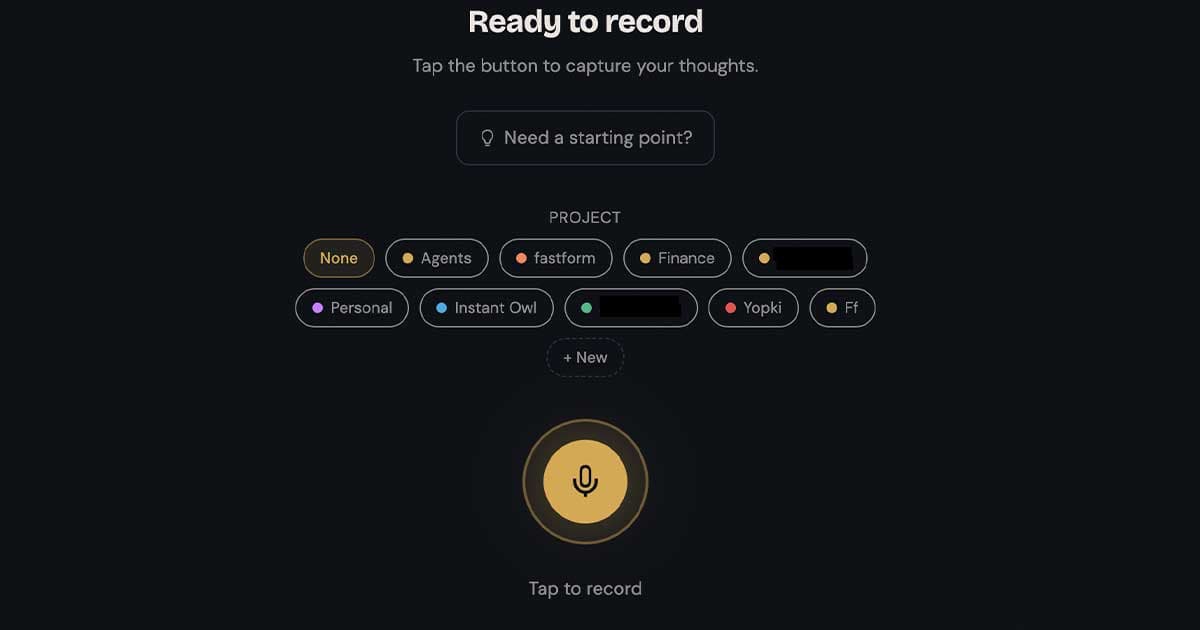
What is true today: one recording can regenerate into multiple output types, an email draft, a spec, a set of action items, a summary, a journal entry. Tasks get extracted automatically. Recordings auto-organize into projects, and you can ask questions across everything you have said. It also ingests YouTube links and files, not just voice. InstantOwl is currently free to use.
The fit: the voice note you record walking to your car or at your desk, that needs to become a task list or an organized note across a growing set of projects, not one polished paragraph or a meeting recap. The honest limitation: it is not built for running meetings with other people on the call; for that job, Voicenotes or Otter are the better-built tools, and this post says so above.
Skip this one: Limitless is dead
Product Hunt's own auto-generated Voicenotes alternatives list still recommends Limitless, complete with its old pre-acquisition tagline about preserving conversations. That listing is stale. Meta acquired Limitless in December 2025, and its Pendant hardware is no longer sold to new buyers. An aggregator page recommending a product you cannot actually buy is a good reminder to check any "alternatives" list's freshness before trusting it, including this one. The full story of the acquisition, and what existing Pendant owners keep, is in our Plaud vs Limitless post-mortem.
How do I pick the right Voicenotes alternative?
Match the pick to the job, not the app with the most reviews. If you want one rambling recording rewritten into a single polished piece of text, AudioPen is the strongest pick. If you want to dictate by voice into whatever app you are already using, all day, Superwhisper is built for exactly that.
If you want a stream of daily voice notes to come back organized into projects and tasks rather than one note at a time, that is InstantOwl's job, and full disclosure applies again here since it is ours. If all you have is one existing audio file that needs to become text, skip a subscription entirely; the transcription built into your phone's own voice recorder app already does that for free.
Whichever you pick, the honest starting point is the same one this whole list keeps returning to: figure out whether you are capturing your own thoughts or someone else's meeting, since that single distinction, more than any star rating, decides which of these seven actually fits. Our wider voice notes apps comparison covers more of the field if none of these seven quite fits, and our full Voicenotes review goes deeper on its pricing and privacy policy if you are still weighing Voicenotes itself.
Related reading
- Voicenotes review: full pricing, its pivot to meetings, and its privacy policy in depth.
- Voice notes apps compared: a wider look at capture apps beyond this list.
- Otter vs Voicenotes: the meetings-versus-capture matchup, with a real Reddit verdict.
- AudioPen vs Voicenotes: the other personal-capture matchup, compared by a third player.
Frequently asked questions
Is there a free Voicenotes alternative?
Yes, with real limits. AudioPen has a free plan, though it does not publish exact limits (users report roughly 3 minutes per recording and about 10 notes). Cleft's free Basic plan allows 5-minute recordings with on-device transcription. InstantOwl, our product, is currently free to use.
What is the best app like Voicenotes?
There is no single best one; it depends on the job. AudioPen is the strongest pick for rewriting one ramble into polished prose. Cleft is the closest Apple-native cousin. Otter is the better-built meetings tool. InstantOwl is built for a daily stream of personal voice notes that needs to come back organized.
Is Voicenotes worth it?
For meeting-heavy iOS or Mac users, yes; it is a genuinely capable, well-rated notetaker there. For daily personal capture, weigh the friction points first: its homepage has pivoted to meetings, its free plan caps out at 100 weekly minutes and 30-day history, and a December 2025 pricing complaint is worth reading before you subscribe.
Does Voicenotes work on Android?
Yes, but it rates noticeably lower there. Voicenotes holds 4.8 stars from about 6,600 ratings on the App Store, versus 3.9 stars from 2.64K reviews on Google Play, per both store listings. Android reviewers report the app reverting to a logged-out state on restart and losing recordings during upload.

Written by
Jim BreeseJim Breese is the founder of InstantOwl. He's spent 15 years building companies, from an Airbnb host community he founded and exited to growth leadership at venture-backed SaaS startups. He built InstantOwl because his best ideas kept arriving mid-walk, out of order, and half-finished.
Stop losing good ideas.
InstantOwl turns a rambling voice note into a clean, organized document in moments. Just talk. We'll organize it.
 Try InstantOwl free