AI Email Writers: What the Free Tools Really Are (and the Voice Shortcut)
By Jim Breese ·
What is an AI email writer?
An AI email writer is a free web tool that turns a short description you type in, plus a tone and a recipient, into a ready-to-send email draft. Search for the term and three tools currently dominate the results: Mailmeteor, Editpad, and Mailmodo. All three are free to use. None of them is quite what it looks like at first glance.
Here is the pattern, stated plainly: each of these free tools exists to funnel you toward a paid product the same company sells. That is not a criticism, it is how the tool got built and how it stays free. Knowing it upfront just means you know what you are stepping into before you type your context in.
Mailmeteor's AI email writer is genuinely unlimited: no sign-up, no credit card, no usage quota, per its own product page. You describe the situation, pick a tone (formal, friendly, concise, or "polite but direct"), set a length, and it hands back a draft you can copy into Gmail or Outlook. The catch is upstream of the free tool: Mailmeteor's core business is a paid Gmail mail-merge and AI email assistant, and the free writer is the on-ramp to that.
Editpad's version is a structured form: optional sender and receiver fields, a purpose description, presets for email type (Follow-up, Cold Outreach, Reminder, Customer Support), and tone (Formal, Friendly, Apologetic, Casual). The free tier needs no registration but is ad-supported and word-limited. Editpad's premium removes the ads and the cap at three price points, per its own pricing: Weekly $5.99 (50,000 words), Monthly $12.99 (300,000 words), Yearly $125 (2 million words). The page also claims "unlimited emails at no cost," a line that sits oddly next to a paid tier sold specifically on word quotas.
Mailmodo's tool needs no login either, and its own page states there is no explicit usage cap. Its options give the game away: campaign type (product launch, survey), audience targeting (subscribers, leads, investors), an emoji toggle, and even novelty themes like Harry Potter and Game of Thrones. This is a tool for marketing campaigns, built to feed Mailmodo's paid email-marketing platform. It writes a good marketing email. It is the wrong tool if you are writing a normal email to one person.
Can ChatGPT write your emails for free?
Yes, and this is the part the free tools above would rather you not think about too hard. ChatGPT, Claude, and Gemini all write a comparable email draft for free, right now, with no sign-up beyond an account you likely already have. Describe who it is for, what you want, and how you want it to sound, and any of them hands back a draft in seconds.
The one honest counterargument belongs to Mailmeteor, and it deserves credit rather than dismissal. Its own positioning is "purpose-built for email," giving "a clean, email-ready output without extra prompting." That is a real convenience claim. A form with a tone dropdown and a length field is faster than composing a good prompt from scratch, for someone who does not want to think about prompting at all.
So the honest split is this: if you already have ChatGPT or Claude open, use it, you will get a more flexible result and can keep editing in the same thread. If you want a purpose-built form that asks you the right three questions and hands back a draft with zero prompting skill required, a tool like Mailmeteor's is a fair, free way to get there. Neither path requires paying anything for a single email.
How do you get a good email out of any AI?
The formula is the same whether you use ChatGPT, Claude, or one of the free form tools above: give it the recipient, the goal, the tone, and the length. "Write a follow-up email to my manager about the Thursday deadline, friendly but direct, under 120 words" produces a far better draft on the first try than "write an email about my deadline."
Recipient tells the AI how formal to be and what context to assume. Goal tells it what the email needs to accomplish, a request, an update, an apology, a follow-up. Tone keeps the output from defaulting to generic corporate-speak. Length keeps it from writing three paragraphs when you needed three sentences. All four together take under 20 seconds to type, and they are exactly the four fields Editpad and Mailmodo turn into form fields for you.
A weak prompt like "email to sam" forces the AI to guess at all four fields, and it shows in the output: generic tone, no real context, a length that is either too short to be useful or padded to look finished. Filling in even a rough recipient, goal, tone, and length turns that same request into a draft you can send after two or three small edits instead of rewriting from scratch.
One rule applies no matter which tool you use, and it is worth repeating because Mailmeteor's own page says it too: always proofread before you send. An AI draft can still miss a specific fact, get a name wrong, or invent a detail that sounds plausible but is not true. The tool gets you 90% of the way there. The last read-through is still yours.
What is actually slowing you down when you write an email?
The prompting formula above works, but it assumes you already know what you want to say. For a lot of people, that is the actual bottleneck: typing four clear fields, recipient, goal, tone, length, is nearly as much effort as just typing the email. Dictation software helps partly, since apps built for dictation type your spoken words into a field about as fast as you can talk. But a straight transcript of you thinking out loud is not the same thing as a clean prompt, let alone a finished email.
Say the same thought instead of typing it, and the four fields disappear as a separate step. "Send Dave a quick note that the Thursday deadline is slipping to Monday because of the vendor delay, keep it short and not defensive" is a sentence you can say in ten seconds walking to the kitchen. Typing that same sentence into a form, then a separate note into a chatbot, is where most people actually lose time, not in the writing itself.
This gap shows up hardest for anyone whose thoughts move faster than their fingers can keep up: someone replying to six people in a row between meetings, or a parent typing one-handed with three free minutes. The email itself was rarely the hard part for them. Getting the loose, half-formed version of it out of their head before it scattered was.
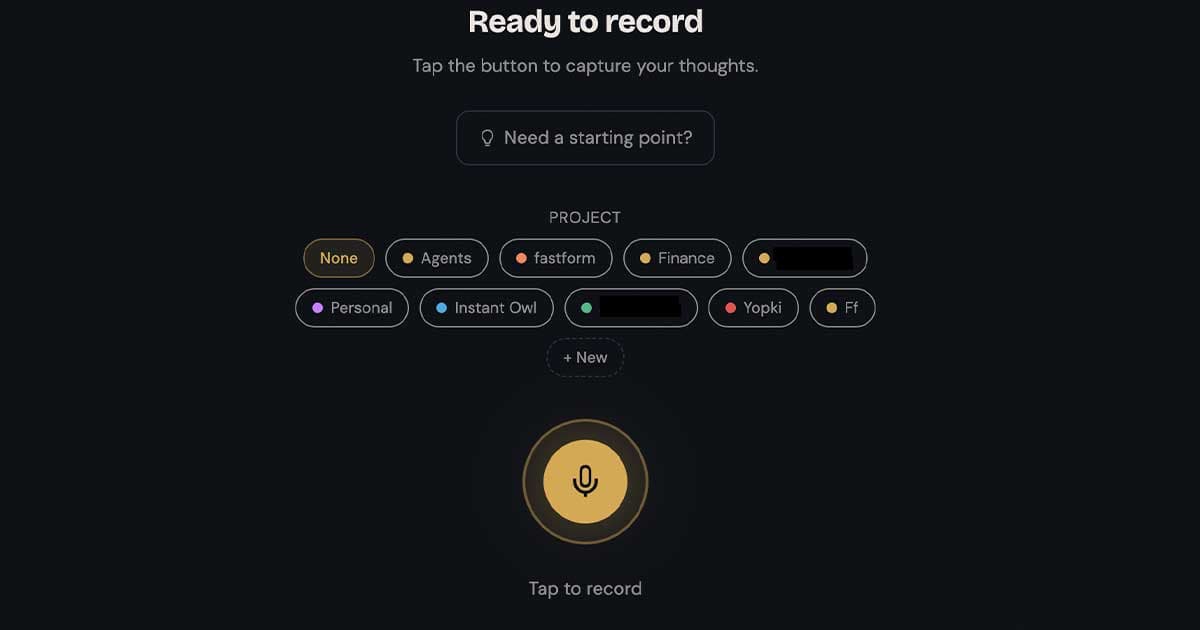
Full disclosure: this is InstantOwl's territory, and this blog belongs to InstantOwl. Reformatting a recording into an email draft is a core feature, alongside turning the same recording into notes, voice to do lists, or a summary. Say the gist of what you need while walking to the car or waiting in line, and InstantOwl turns the recording into a clean email draft, not a wall of transcribed filler words you still have to edit down yourself.
The proofread rule from Mailmeteor's own page applies to InstantOwl's output too, without exception. Any AI draft, including ours, can still misstate a fact, a name, or a number you said quickly and unclearly. Read it before you send it. InstantOwl is currently free to use, and the honest pitch is narrow: it solves the part where the thought never made it out of your head cleanly, not the part where AI writes a sentence. ChatGPT and Claude already do that part free.
Related reading
- The best dictation software in 2026: what happens when you speak a prompt instead of typing it, and where dictation stops short of a finished draft.
- Voice notes to text: every free and paid way to get a transcript, and why a transcript alone is not an email.
- Voice to do lists: the same capture problem, applied to tasks instead of email.
Frequently asked questions
What is the best free AI email writer?
There is no single best one, because the three that rank solve different jobs: Mailmeteor is unlimited and requires no signup for a quick personal email, Editpad gives you email-type and tone presets before its ad-supported free tier runs into a word limit, and Mailmodo is built for marketing campaigns rather than one-to-one email. ChatGPT and Claude write a comparable email for free, with more room to revise it afterward.
Can ChatGPT write my emails?
Yes. ChatGPT, Claude, and Gemini all write a ready email draft for free once you describe the recipient, the goal, the tone, and the length, and you can keep refining the same draft in the conversation, which a single-shot form tool like Mailmeteor or Editpad does not let you do.
Is it OK to use AI for work emails?
Generally yes for drafting, as long as you proofread before sending and follow your employer's policy on AI tools and confidential information, since an AI draft can still get a name, a fact, or a commitment wrong. Mailmeteor's own product page gives this exact advice: always proofread before you send.
Can I dictate an email?
Yes. Dictation software types your spoken words into an email field more or less verbatim, which works well if you already know the exact sentence you want to send. InstantOwl takes a different approach: it takes a rambling spoken recording and reformats it into a structured email draft, not just a transcript of what you said out loud.

Written by
Jim BreeseJim Breese is the founder of InstantOwl. He's spent 15 years building companies, from an Airbnb host community he founded and exited to growth leadership at venture-backed SaaS startups. He built InstantOwl because his best ideas kept arriving mid-walk, out of order, and half-finished.
Stop losing good ideas.
InstantOwl turns a rambling voice note into a clean, organized document in moments. Just talk. We'll organize it.
 Try InstantOwl free