AudioPen vs Voicenotes (Compared by a Third Player)
By Jim Breese ·

Which should you pick: AudioPen or Voicenotes?
Pick AudioPen if you want one ramble turned into a single, well styled piece of writing, and you would rather pay once than subscribe. Pick Voicenotes if you want a searchable archive of everything you have recorded plus meeting summaries, you are comfortable with a monthly bill, and you mostly live on iOS or Mac. Full disclosure before this goes any further: we build InstantOwl, a third product in this same voice capture space, and this comparison names that conflict of interest up front, then tries to be accurate and generous to both rivals anyway.
AudioPen and Voicenotes both turn spoken words into text, and that surface similarity is where the resemblance ends.
AudioPen has stayed in the personal capture lane since it launched: one spoken recording in, one polished text note out, sold on prepaid passes instead of a subscription. Voicenotes started in that same lane and has since pivoted its whole homepage toward AI meeting notes, giving dictation its own dedicated space alongside notes in an August 2026 app update, on a subscription model with documented reliability reports on both iOS and Android.
Those are different jobs wearing the same "voice notes" label. The rest of this comparison lays out the pricing, the real strengths, and the reliability question that matters most in this category: whether a recording you made survives long enough to become something useful.
How much do AudioPen and Voicenotes cost?
AudioPen is not a subscription, and its own marketing says so directly: "No subscriptions. No auto-renewals. Pay once, use for the full period" (AudioPen). It sells three prepaid Prime passes: 3 months for $33, 1 year for $99, and 2 years for $159, each charged once with nothing renewing behind your back.
Every Prime pass caps recordings at 15 minutes, even on the priciest pass, and there is no monthly plan and no lifetime plan today (AudioPen's Prime page). AudioPen's free plan needs no credit card, but AudioPen does not publish its exact free limits anywhere on its site.
Because the number is not official, treat it as a pattern, not a spec: users consistently report roughly 3 minutes per recording and about 10 saved notes before Prime becomes necessary. A third-party reviewer echoed the same figures again in 2024, but AudioPen itself has never printed them, so we will not either.
Voicenotes charges differently depending on where you sign up. On the web, its Pro plan is $9 a user per month with no annual discount shown (Voicenotes' pricing page). Buy the same access through the App Store instead and it costs $8.99 a week, $14.99 a month, or $89.99 a year, a familiar app store markup.
Voicenotes' free plan allows unlimited recordings but caps transcription at 100 minutes a week, shared across meetings, memos, and dictation, and keeps only 30 days of history before older notes stop being accessible (Voicenotes' pricing page). That 30-day ceiling is a real constraint if you are hoping to build a searchable personal archive rather than just get through this week's meetings.
One length trade-off is worth naming plainly: AudioPen caps every single recording at 15 minutes, even on its most expensive pass, while Voicenotes places no length cap on an individual recording at all, only a weekly minutes budget on free. A single long ramble fits Voicenotes' model better; a series of short ones fits AudioPen's just as well.
What is each one genuinely good at?
AudioPen's cleanup quality earns real praise, including from a reviewer with no relationship to InstantOwl. Writing for macautomationtips.com in June 2024, Bakari Chavanu found that AudioPen "figured out where to put the last paragraph of this article, even though it was not the last point I spoke," with turnaround under 45 seconds. That is AudioPen doing more than tidying sentences: it is reordering ideas into a coherent structure.
Date that review honestly. It is two years old, and AudioPen has kept shipping since; its App Store version had updated the day before this research was pulled. The same review also flagged that AudioPen's SuperSummaries feature, as of mid-2024, did not merge and revise combined notes into something new. AudioPen's current site now markets SuperSummaries as note combining, so that specific criticism may no longer hold. We are noting it as a dated observation, not a current flaw.
The style system is a genuine differentiator too. AudioPen lets you write in a preset style, a custom style, or a style trained on your own past writing, and it can take a recording in one language and hand back text in another (AudioPen). That level of control over the finished text is not something Voicenotes tries to match, because Voicenotes is not trying to rewrite your words into a style at all.
Voicenotes, in turn, is genuinely built for the job it now leads with: meetings. Its homepage promises a clear summary, action items, and next steps ready the moment a meeting ends, and its latest app update gives personal dictation its own dedicated space, separate from those meeting notes. That is real, useful engineering for anyone whose day is full of calls, even though it has little to do with the personal-capture problem AudioPen and InstantOwl both solve.
Voicenotes is also genuinely strong on integrations and reach. Its App Store listing shows syncing to Notion, Todoist, Readwise, WhatsApp, and Zapier (Voicenotes' App Store listing), and its own site lists apps for Mac, Windows, iPhone, Android, web, and Apple Watch. Ask AI recall lets you query across everything you have recorded, a real advantage for anyone building an archive rather than writing one styled note.
Both companies deserve credit for staying honest about what they promise. AudioPen never claims to extract tasks or organize projects; Voicenotes never claims to write polished, styled prose the way AudioPen does. Neither oversells the other's job, which is more than most comparison posts can say about the products they cover.
Are AudioPen and Voicenotes reliable?
Losing a recording you cannot get back is the one truly unforgivable failure in this category. It is worth asking honestly where each product stands, based only on what their own store listings show.
Voicenotes shows a real gap between platforms: 4.8 stars from about 6,600 ratings on the iOS App Store, versus 3.9 stars from about 2,600 ratings on Google Play (Voicenotes' Android listing). iOS reviewers report recordings stopping mid-session without warning. Android reviewers separately report the app reverting to a logged-out state on restart, and losing recordings during upload or an accidental back tap.
AudioPen's App Store reviews do not show that same loss-of-recording pattern. Its complaints run in a different direction: a tight free tier, and rewriting that sometimes lands heavier handed than the speaker intended.
Neither pattern makes either app unusable, and both hold decent to strong ratings overall. But if the entire point of a voice capture app is that your recording survives long enough to become something useful, Voicenotes' documented gap between iOS and Android is worth knowing before you commit, especially for an Android-first reader. Our full AudioPen review covers where AudioPen itself stops, beyond pricing and reliability.
Is there a third option?
Yes. InstantOwl is the product we build, and it sits in neither lane fully: not AudioPen's single styled note model, and not Voicenotes' meetings-and-archive model.
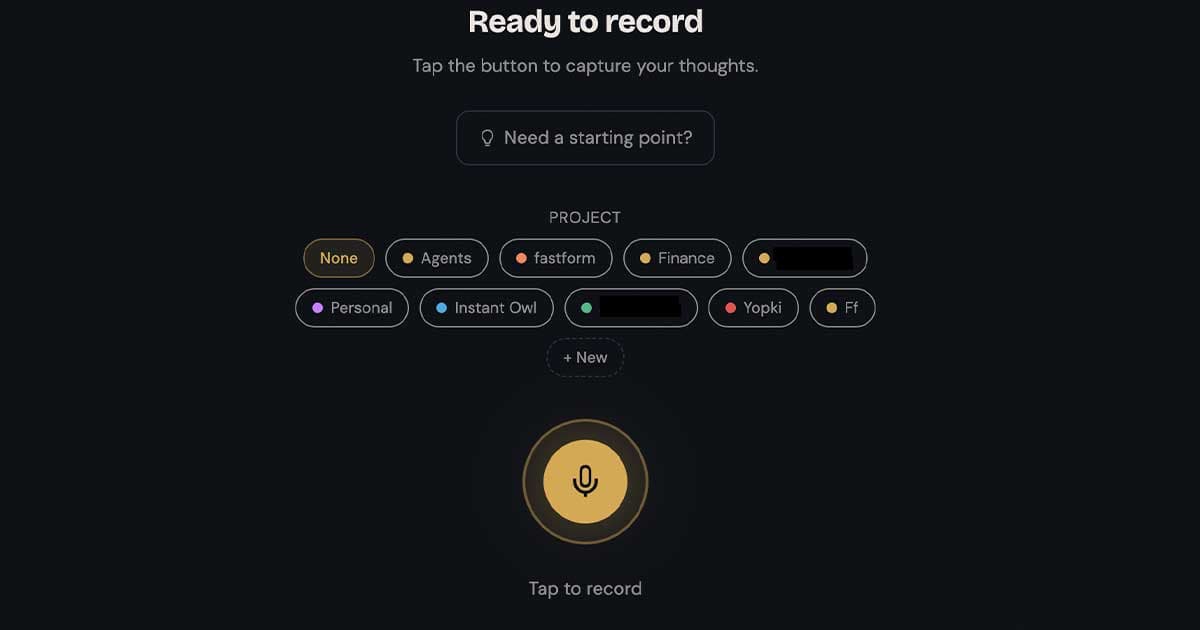
Where AudioPen turns your ramble into one clean piece of writing, InstantOwl turns the same ramble into organized notes plus tasks it pulls out automatically, sorted into the project they belong to. Where Voicenotes now leads with meeting summaries and a searchable second brain, InstantOwl stays focused on your own thinking out loud, not other people's conversations. Our deeper look at Voicenotes' meetings pivot covers its privacy policy and full pricing if that is the tool you are actually weighing.
Honest fit, all three: pick AudioPen if you want beautifully rewritten prose in your own style and would rather pay once than subscribe. Pick Voicenotes if you need meeting capture and a growing searchable archive in the same app, especially on iOS or Mac. Pick InstantOwl if what you want back is structure and a task list, not just cleaner prose or a transcript archive. InstantOwl is currently free to use.
None of these are wrong answers. They are different jobs that happen to share a category label, and the fastest way to choose is to know which output you actually want back. If you are weighing more than these two, our wider map of AI notes-from-audio tools covers the upload-first tools as well.
Related reading
- AudioPen review: a full look from a competitor at pricing, cleanup quality, and where AudioPen stops.
- Voicenotes review: pricing, its pivot to meetings, and its privacy policy in depth.
- AI notes from audio: the wider landscape, including tools built for audio you already have.
Frequently asked questions
Is AudioPen or Voicenotes better?
Neither is better in every case. AudioPen turns one ramble into a single polished text note and sells prepaid passes. Voicenotes has pivoted into an AI meeting notetaker with a monthly subscription. Pick AudioPen for clean, styled prose from your own voice. Pick Voicenotes for meeting summaries and a searchable archive, especially on iOS. InstantOwl, a third option, turns a ramble into organized notes and extracted tasks, and is currently free to use.
Is AudioPen a subscription?
No. AudioPen sells prepaid passes, not a subscription, per its own site: 3 months for $33, 1 year for $99, and 2 years for $159, each charged once with no auto-renewal. There is no monthly plan and no lifetime plan.
Is Voicenotes free?
Yes, with real limits. Voicenotes' free plan allows unlimited recordings but caps transcription at 100 minutes a week and keeps only 30 days of history, per its pricing page. Beyond that, Voicenotes charges $9 a month on the web or $14.99 a month through the App Store.
What is better than AudioPen?
It depends on the job you need done. If you want a single, beautifully rewritten piece of text from a ramble, AudioPen genuinely does that well. If you want the same ramble to come back as organized notes with tasks pulled out automatically, that is what InstantOwl, a competitor, is built for, and it is currently free to use.

Written by
Jim BreeseJim Breese is the founder of InstantOwl. He's spent 15 years building companies, from an Airbnb host community he founded and exited to growth leadership at venture-backed SaaS startups. He built InstantOwl because his best ideas kept arriving mid-walk, out of order, and half-finished.
Stop losing good ideas.
InstantOwl turns a rambling voice note into a clean, organized document in moments. Just talk. We'll organize it.
 Try InstantOwl free