AI Notes From Audio: The Two Tool Families (A Review From Inside One)
By Jim Breese · · Updated
How do you turn audio into AI notes?
Every tool that turns audio into AI notes falls into one of two families. Record-and-organize tools are the ones you talk into directly: open the app, speak your thoughts, and it cleans up and structures what you said. Upload-existing-audio tools work the other way around: a recording already exists, a meeting, a lecture, a memo, and you hand the file over to get notes back.
Full disclosure before anything else: we build InstantOwl, a direct competitor in the first family, and this post names that plainly up front rather than burying it, then tries to be fair to everyone in both families anyway.
Some tools blur the line on purpose, offering both a record button and an upload button on the same screen. What actually decides which family a tool belongs to is what its free plan and homepage lead with. A tool built around "hit record and talk" behaves differently from one built around "drop a file here," even when both options technically exist.
What do people actually want from an AI audio note taker?
People asking this question want one specific thing: light cleanup, not a full rewrite, plus some basic structure, not a wall of raw transcript. That is the real bar the whole category has to clear, described in the words of someone who actually needed it.
A long-running thread on r/ChatGPTPro, started by an article writer who thinks out loud, states the requirement almost like a product spec. The poster wanted "an app that I can talk my thoughts and notes into and it will transcribe what I am saying and put some basic structure or summary on." They were explicit about where the line sits: they did not want the transcript rewritten completely, just light corrections, enough to clean up the umms and ahhs.
That single thread pulled 58 comments recommending more than 18 different tools, several posted by their own founders promoting their own product, with zero structure to sort any of it by. A category with that much noise and that little organization is exactly what this post exists to fix: an honest, priced map instead of another pile of names.
What are the best tools when you're uploading an existing audio file?
The strongest upload-existing-audio tools right now are AudioNotes.ai and Minutes AI, both built around a file you already have, plus Otter and PLAUD's import features for anyone whose file came out of a meeting.
AudioNotes.ai
AudioNotes.ai, built by Novikov Studio LLC, is a web-first tool where the homepage doubles as the app itself: upload a file, record audio, or type a text note, all from one screen (AudioNotes.ai, fetched 2026-07-16). Its free plan allows up to 6 minutes per note, 30 minutes a month total, and up to 10 saved notes.
Its paid tiers, priced on the monthly toggle shown on its pricing page, run Advanced at $9 a month for recordings up to 60 minutes, multi-voice transcription, and automatic export to Notion, WhatsApp, and Zapier, and Pro at $24 a month for recordings up to 150 minutes and file uploads up to 400 megabytes. Annual pricing was not rendered on the page the day we checked, so these are stated as the monthly-toggle prices only, not annual ones. Lifetime passes also exist: $129 for Advanced and $289 for Pro, each backed by a 60-day money-back guarantee.
One clarification worth making plainly: audionotes.ai is a different product from audionotes.app. They are not the same company, and a recommendation for one online should never be read as a recommendation for the other.
Minutes AI
Minutes AI (myminutes.ai) does the opposite of AudioNotes.ai on pricing transparency. It publishes no public pricing page at all; myminutes.ai/pricing returned a 404 the day we checked. The only pricing that exists lives inside the App Store listing, which shows two "Unlimited Access" in-app purchases: $14.99 and $99.99.
Neither price is labeled with a billing period on the listing itself, but a Google Play reviewer who wrote about paying roughly $100 for a year corroborates $99.99 as the annual price, which makes $14.99 the monthly one (Minutes AI App Store listing, fetched 2026-07-16). The fair way to state it: about $15 a month or $99.99 a year for Unlimited Access, with a free version that exists but whose exact limits Minutes AI does not publish anywhere.
What Minutes AI does well: live recording with speaker labels, file uploads across mp3, mp4, m4a, wav, and webm, YouTube video import, and a "chat with your audio" feature layered on top of formatted notes (myminutes.ai, fetched 2026-07-16). That YouTube import in particular is a real convenience the other upload tools here don't match.
Its ratings tell an honest, split story too: 4.9 stars from roughly 14,000 App Store ratings, versus 4.0 stars from about 3,000 reviews on Google Play with 100,000-plus downloads. Reviewers praise its transcription accuracy on both platforms; the more common complaint is losing a saved recording after paying, a real reliability gap worth knowing before you subscribe.
Otter and PLAUD, credited fairly
Otter and PLAUD are both primarily meeting tools, but each also handles the upload-existing-audio job well, and each deserves credit for it. Otter's free plan includes three lifetime audio or video file imports on top of its 300 monthly transcription minutes, a detail our full Otter breakdown covers alongside its meeting pricing.
PLAUD's app and web dashboard accept imported audio and video files up to five hours each, processed the same way as a recording from its own hardware, once you're on the Starter plan that ships free with any device purchase. If your actual job is bulk file transcription rather than personal capture, our PLAUD breakdown and our wider look at transcription tools built for volume both go deeper.
Both deserve credit at real scale. Otter backs its free tier with 40 million-plus users and a 4.8-star rating from nearly 39,000 Google Play reviews. PLAUD's hardware runs $159 to $189 depending on the model, and its transcription earns praise even from otherwise critical reviewers, one calling it "99 percent precise." If you are weighing exactly these two against each other, our Plaud vs Otter head-to-head prices the hardware route against the meeting-bot route directly.
What are the best tools when you record straight into the app?
The strongest record-and-organize tools are AudioPen, Voicenotes, and InstantOwl, and this family splits again along one more line: tools built for meetings (Otter, PLAUD's hardware, and now Voicenotes) versus tools built for your own private thinking out loud (AudioPen and InstantOwl).
AudioPen
AudioPen takes one spoken recording and rewrites it into a single polished piece of text, in a style you choose, and it sells prepaid passes instead of a subscription: $33 for 3 months, $99 for a year, $159 for 2 years, capped at 15 minutes per recording even on paid plans. Its free tier isn't officially published either, though users consistently report roughly 3 minutes and 10 notes.
Credit where it's due: the cleanup quality is genuinely excellent, users call it "extremely good" at cutting filler, and the pay-once model with no auto-renewal is rare and consumer-friendly in this category. Our full AudioPen breakdown covers where it stops.
Voicenotes
Voicenotes has pivoted its whole homepage toward meetings, with "tap record at the start of any meeting" as its opening instruction. Its free plan still exists for personal capture: 100 weekly transcription minutes and 30-day history. It's genuinely strong on integrations, syncing to Notion, Todoist, and Zapier, and it works across phone, desktop, browser, and smartwatch. Our full look at Voicenotes' meetings pivot covers its pricing and privacy policy.
InstantOwl
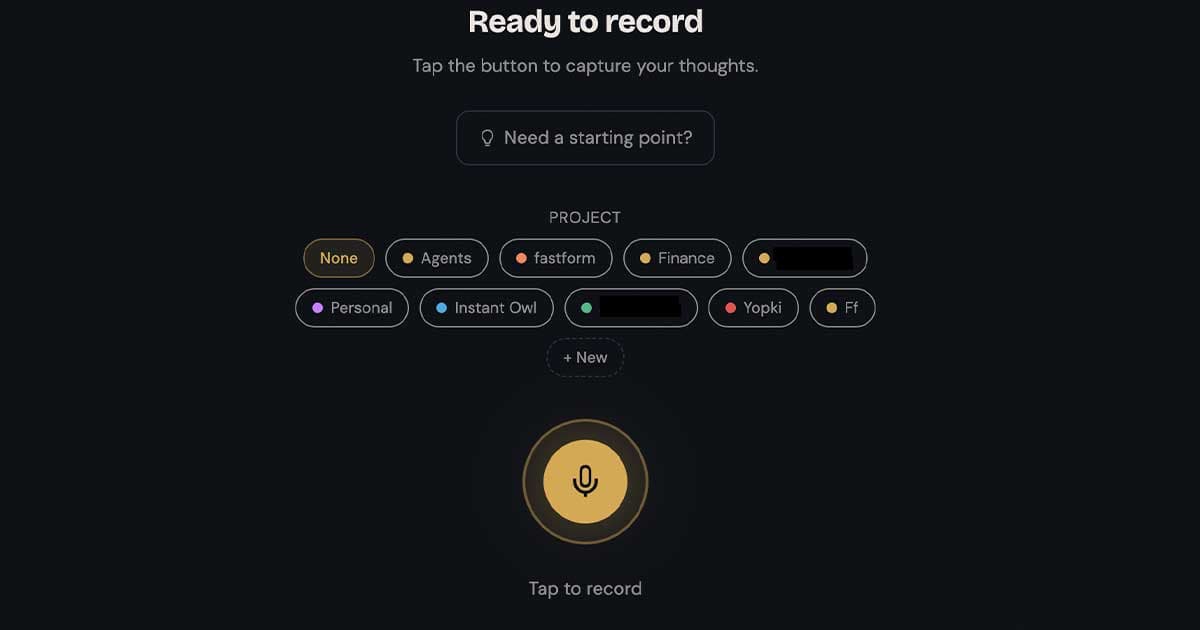
InstantOwl is ours, and it sits in the thoughts-first half of this lane, not the meetings half. You ramble into it the way you'd talk to a friend, and it hands back organized notes with tasks pulled out automatically, sorted into the right project. It does not compete on meeting transcription the way Otter, PLAUD, or Voicenotes now do. InstantOwl is currently free to use.
How do you choose between them?
Start with where your audio already lives. If it's a file that already exists, a lecture recording, a downloaded meeting, a podcast episode, an upload tool is the right shape: AudioNotes.ai for its cheap entry point, Minutes AI for YouTube imports, or Otter or PLAUD if the file came from a meeting you also attend live. If nothing has been recorded yet and the thought is still in your head, a record-and-organize tool is the right shape instead.
Then ask what you want back. A single polished piece of writing, in your own style: AudioPen. A meeting summary with action items for other people: Otter, PLAUD, or Voicenotes. Organized notes plus a task list pulled out of your own thinking: that's the specific job InstantOwl is built for.
The meetings-versus-thoughts split matters as much as the upload-versus-record split. Otter, PLAUD, and Voicenotes have all built themselves around other people's conversations: colleagues on a call, a patient in a room, a client across the table from a consultant capturing session notes, a lecture hall. AudioPen and InstantOwl are built around one person's own thinking, said out loud to nobody in particular. Match the tool to which kind of audio you actually have, not just its marketing homepage.
One more honest note: none of the record-and-organize tools here are built for bulk file processing. If you're sitting on a folder of old recordings rather than one new thought, our broader guide to transcription tools built for volume covers what actually handles that job.
Related reading
- AI note taker roundup: a wider comparison of note-taking apps beyond the audio-specific tools covered here.
- AudioPen review: an honest look from a competitor at pricing, cleanup quality, and where AudioPen stops.
- Voicenotes review: pricing, its pivot to meetings, and its privacy policy in depth.
- What is a voice note: the difference between sending a voice note and keeping one for yourself.
Frequently asked questions
What AI can make notes from audio?
Two families of tools do this. Upload-existing-audio tools like AudioNotes.ai and Minutes AI turn a file you already have into notes. Record-and-organize tools like AudioPen, Voicenotes, and InstantOwl are the ones you talk into directly. Otter and PLAUD do both, but they are built primarily for meetings.
Is there a free AI audio note taker?
Yes. AudioNotes.ai's free plan allows 6 minutes per note, 30 minutes a month, and 10 saved notes. Otter's free plan gives 300 monthly minutes with 3 lifetime file imports. PLAUD's Starter plan ships free with any device purchase, at 300 minutes a month, forever. InstantOwl is currently free to use.
Can ChatGPT take notes from audio?
Not directly. A normal ChatGPT conversation does not transcribe audio on its own, so you need a transcription step first, then you can paste or upload the resulting text. See what a transcript alone leaves out for how people actually bridge that gap, including tools that skip the manual step entirely.
What is the best app to turn voice into notes?
It depends on whether you already have a recording or are capturing a new thought. For an existing file, AudioNotes.ai or Minutes AI. For talking into an app to capture your own thinking, AudioPen for one polished note, or InstantOwl, our product, for organized notes plus tasks pulled out automatically.

Written by
Jim BreeseJim Breese is the founder of InstantOwl. He's spent 15 years building companies, from an Airbnb host community he founded and exited to growth leadership at venture-backed SaaS startups. He built InstantOwl because his best ideas kept arriving mid-walk, out of order, and half-finished.
Stop losing good ideas.
InstantOwl turns a rambling voice note into a clean, organized document in moments. Just talk. We'll organize it.
 Try InstantOwl free