Voice Notes for Consultants: Beating the Context-Rot Problem
By Jim Breese · · Updated
Why does client context rot between calls?
Client context rots because consultants bill for thinking and talking, not for note-taking, so the layer that used to catch it (a college hire scribing in the room) is gone and nobody replaced it. One consultant on r/consulting named the result exactly: "I mostly keep things in docs and my head, which works until I come back to a client after a while and have to rebuild everything." That rebuild is the tax on every context switch between engagements, and it is invisible on any invoice.
The thread that surfaces this most bluntly is titled, in full, "I wish we still had college hires to take notes... oh wait, AI can do it," a joke at the expense of the justification used to cut those roles. The post pulled 265 upvotes and a direct line from its author: "since it cannot, I am stuck doing grunt work on top of management work."
A reply reframed the old system rather than defending it: junior staff acting as "a glorified secretary/powerpoint monkey" was never sustainable as a career. A second commenter pointed out the trade-off nobody mentions when that role disappears, that minute-taking doubled as apprenticeship, the way a junior actually learned a client's business by scribing for it.
One commenter connected the note-taking burden to headcount directly: understaffing means "a whole litany of items must now be done by ever fewer and fewer people," and his team shrank roughly 50% while the work stayed the same size. Someone still has to hold the client's context. It just used to be someone junior, and now it is whoever ran the meeting.
What do consultants actually use for notes today?
Mostly OneNote, quietly. In a separate r/consulting thread about note-taking and task management, the top comment, at 91 points, put it plainly: "Am I on an island just using OneNote?... Even keep my to-do list on there." Several replies described the same pattern, one tab per client, meetings on one side and to-dos on the other. A smaller but vocal group runs Obsidian instead, prizing plain markdown and the ability to link between client notes, which one commenter called "a game changer for client work."
The most revealing answer in that thread came from a consultant running three tools at once: Microsoft To Do for tasks, Microsoft Loop for notes, and bare Windows Notepad the moment a call starts, because it opens instantly and "the client starts talking and I need something to start typing quickly." Structure gets rebuilt by hand later. In the moment, speed of capture beats everything else, which is the same instinct behind a voice debrief: talking is faster than typing, and the organizing can happen after.
Transcript-then-LLM workflows already show up in the same thread as an emerging habit: one consultant records with Fathom or Otter, then pastes the transcript into Claude and asks for a structured document. Another compares a Teams recording and Copilot summary against handwritten notes before trusting either. A third pairs Granola for meetings with Todoist and a PARA folder system for filing. None of it is a single tool. It is a stack, patched together, because nothing in that stack owns the after-call debrief specifically.
The two lanes: the client call and your own thinking
Consultant note-taking is really two separate jobs, and treating them as one is where most of the friction comes from. Lane one is capturing the client call itself, other people's words, which is notetaker-bot territory: Fathom, Otter, or a client's own Teams and Copilot setup, all of it requiring consent because someone else is being recorded. Lane two is capturing your own thinking after the call ends, which needs no bot and no consent, because it is only your voice.
Recording another person on a client call means checking your engagement letter or any NDA first, and this is not legal advice. Our guide to running meetings without a bot in the room covers the consent and policy risk in more depth, including the real story of a colleague who nearly got fired for pasting a client transcript into a consumer AI tool without checking company policy first. That risk lives entirely in lane one.
Lane two sidesteps it completely. A private voice debrief recorded the moment you hang up has no consent question attached, because you are the only person on the recording. It also answers a discomfort that shows up repeatedly in consultant discussions of meeting bots: one practitioner, describing note-taking tools on r/LocalLLaMA, put it this way: "Most of them are kind of annoying, either a bot joins the call, or everything gets shipped off to the cloud. Not great if you're on sensitive or client calls."
A debrief in your own words never touches the client's raw audio at all. It only contains what you need to remember.
The after-call debrief that keeps client context from rotting
Speak four things in about 60 seconds, right after you hang up, before you move to the next call: who you talked to, the pain or concern they raised, what you promised them, and the next step, plus anything political worth remembering, like the line "the CFO called the timeline unrealistic." This is the same shape as the debrief we recommend for sales calls, adapted for a client engagement instead of a prospect call.
Said out loud, unpolished, it sounds like this: "Just wrapped with Priya at Meridian. She's worried the phase two timeline slips into Q3 if procurement doesn't move faster. I told her we'd have a revised plan by Thursday. Next step is looping in their ops lead before that call. She mentioned her team is stretched thin through quarter end, so keep the ask light." Rough is fine. The debrief exists to catch the detail before it is gone, not to read like a finished memo.
Two things belong in the same 60 seconds that most note-taking advice skips entirely: scope-creep signals (a request that quietly grew past what the statement of work covers) and the personal detail that keeps the relationship human, a kid's name, an upcoming trip, anything a text-only note tends to lose. Both are exactly the kind of thing that rots first when you come back to a client three weeks later and have to rebuild everything, the same problem named in the "rebuild everything" quote above.
Capturing billable time before Friday timesheet archaeology
None of the ranking content or forum advice on consultant note-taking mentions billable time, and it is one of the most underserved parts of the job. A 60-second voice log at the end of each day, naming the client and what the time was for, beats reconstructing a week of hours from memory on Friday afternoon.
Said the way you'd say it to yourself: "Today on Meridian: two hours on the phase two revision, ninety minutes on the stakeholder call with Priya and their ops lead." That sentence is honest, because it is said the same day the hours happened, not guessed at five days later.
The debrief habit and the billing habit are the same habit, recorded at two different moments: right after a call for what was said, at day's end for where the hours went. Neither needs a special app category, both just need to happen while the memory is still accurate.
Every consultant note-taking roundup ranks its own product first
Worth knowing before you trust any "best notetaker for consultants" list, including implicitly this one: the most detailed roundup on this exact topic that we found is published by a company that competes in the meeting-bot category, and it ranks its own product the "top pick," ahead of nine competitors it also reviews. That is not unusual; it is close to universal among vendor-published roundups, and it is worth flagging rather than treating as neutral research.
The useful part of that roundup is not its verdict, it is the pain points it documents from actual practitioners, including a comment worth repeating here: "Most of them are kind of annoying, either a bot joins the call, or everything gets shipped off to the cloud. Not great if you're on sensitive or client calls," from a commenter on r/LocalLLaMA.
Its list of what consultants actually need, gathered from the same practitioner base, is a fair checklist regardless of who wrote it: client-ready summaries with decisions and action items fast, capture across video calls and in-person workshops alike, multi-client organization by project, a searchable archive of past meetings, and no bot showing up uninvited on a sensitive call. Read that list for the requirements. Discount the ranking.
Where InstantOwl fits
Full disclosure: InstantOwl is our product, and this blog belongs to it. It is not a meeting-bot notetaker and does not join client calls. It is built for lane two, the after-call debrief, the billable-time log, and the thinking you need to hold onto between engagements.
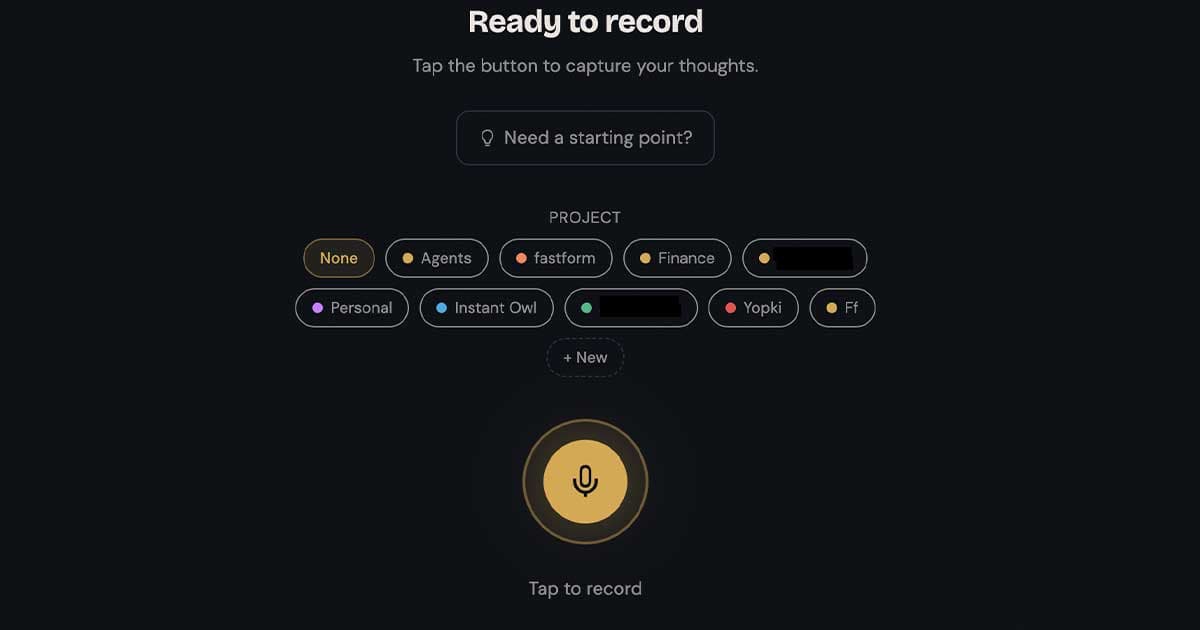
File one project per client, with folders per workstream if you want to go a level deeper. InstantOwl never guesses which project a recording belongs to, you choose it yourself, either from the project chips before you start talking or with the + Project action afterward. Pick the client project once, before you speak the debrief, and it lands filed under that client automatically from then on, with action items extracted automatically, up to 25 per recording, and any spoken due date like "by Thursday" resolved to a real calendar date you can export.
When you rotate back to a client after three weeks on someone else's work, Ask searches across everything you have recorded and answers in plain language, with clickable sources back to the original debrief, so "what did I already tell Priya about the timeline" gets a grounded answer instead of a memory you have to trust. The weekly client update you owe a partner or a steering committee is a Status Update, one of InstantOwl's 12 built-in output formats, generated from the same debriefs instead of written from scratch on Friday.
None of this replaces the notetaker bot on the client call itself. A voice memo app and typing it up afterward is a legitimate zero-cost version of the same habit; the difference is what happens once you stop talking. InstantOwl is currently free to use.
Related reading
- Voice notes for sales: the same after-call debrief pattern, built first for prospect calls.
- Taking meeting notes without a bot in the room: the consent and policy risk in lane one, covered in full.
- Fireflies alternatives: notetaker-bot options for the client call itself, sorted by the job they solve.
Frequently asked questions
What is the best note-taking app for consultants?
There isn't one universal winner. OneNote and Obsidian are the two stacks consultants describe most often in practitioner forums, both for their own working notes, not client-facing minutes. The gap neither one fills is the after-call debrief, which is why a voice-first tool like InstantOwl covers a different job than a text-based notebook.
How do consultants take notes on client calls?
Two ways, and most consultants use both. During the call itself, a notetaker bot (Fathom, Otter, or similar) or a live tool like Copilot captures the discussion, which requires telling the client and checking your engagement letter or NDA first, since recording another person needs consent. After the call, a private voice debrief in your own words needs no consent at all, because you are the only person on the recording.
How do consultants capture billable time without timesheet archaeology?
A short voice log at the end of each day or right after each call, naming the client and what the time was for while it is still honest memory, beats reconstructing a week of hours on Friday afternoon. Spoken time entries are far more accurate than end-of-week guesses, because the context is still fresh.
How do you keep client context straight across multiple engagements?
File one project per client and record a short debrief after every call or workshop. When you rotate back to a client after weeks on other work, the debrief trail gives you what was decided, what you owe them, and what they owe you, instead of forcing you to reconstruct it from memory.

Written by
Jim BreeseJim Breese is the founder of InstantOwl. He's spent 15 years building companies, from an Airbnb host community he founded and exited to growth leadership at venture-backed SaaS startups. He built InstantOwl because his best ideas kept arriving mid-walk, out of order, and half-finished.
Stop losing good ideas.
InstantOwl turns a rambling voice note into a clean, organized document in moments. Just talk. We'll organize it.
 Try InstantOwl free