Plaud vs Otter: A Recorder in Your Pocket or a Bot in Your Meetings
By Jim Breese ·
Plaud vs Otter: which one should you pick?
Pick Plaud if most of what you need transcribed happens on a phone call or in a room with no calendar invite. Pick Otter if most of it happens on a video call. That is the real decision, and it has almost nothing to do with which one is "better."
Plaud is hardware: a $159 to $189 recorder you carry, paired with an app that transcribes what it captures. Otter is software: a bot that joins your Zoom, Teams, or Google Meet calls from your calendar and transcribes them live. Comparing them as rivals for the same job is a category mismatch, and both companies' own comparison pages agree on the split once you read past the marketing.
Here is the detail most searches miss: once you account for the subscription, Plaud and Otter cost almost exactly the same to run every year. The gap that actually matters is the price of the device itself, not the software underneath it.
Plaud vs Otter: the real price difference, verified
Plaud Pro costs $99.99 a year. Otter Pro costs $99.96 a year, three cents less. That is not a rounding coincidence worth glossing over, it is the whole story: the two companies' paid software tiers land within pocket change of each other, per Plaud's own pricing page and Otter's pricing page.
The difference you actually pay for is the hardware. A Plaud Note is $159. A Plaud Note Pro, the model with the stronger microphone array, lists at $189 and is on sale for $159.99 as of 2026-08-20. Otter has no device to buy, because it runs entirely on the phone, laptop, or calendar you already own.
| Plaud Note | Otter | |
|---|---|---|
| Year 1, free tier | $159 device, $0 software (300 min/mo) | $0 (300 min/mo, 30 min/call cap) |
| Year 1, Pro tier | $159 + $99.99 = $258.99 | $99.96 |
| Year 2 and beyond, Pro | $99.99/yr | $99.96/yr |
Both free tiers cap out at 300 transcription minutes a month, ten minutes a day, another number the two companies happen to share exactly. Once you hit that wall and upgrade, the annual cost track is nearly identical between them: Plaud Unlimited runs $239.99 a year, Otter Business runs $239.88 a year, again less than a quarter apart.
So the honest framing is not "which is cheaper." It is "do you need $159 to $189 of hardware, or not." Everything downstream of that one question is close to a wash in price.
What is Plaud, honestly?
Plaud makes AI voice recorder hardware, not an app you install on a phone you already own. The lineup is four devices: the Note ($159) and Note Pro ($189 list, on sale for $159.99 today), both credit-card-shaped and built to clip magnetically to the back of a phone, and the NotePin ($159) and NotePin S ($179 list, on sale for $151.99 today), both wearable capsules. Every device ships with the free Starter plan, 300 transcription minutes a month, forever, no subscription required to use the hardware at all.
Only the Note and Note Pro can record phone calls. They do it through a Vibration Conduction Sensor that reads the phone's own speaker vibrations through the phone's body while the device sits magnetically attached to the back, per our full Plaud review. The NotePin and NotePin S cannot record calls at all, confirmed by Plaud's own support articles. That is a real gap if a call is the main thing you want captured and you own the wrong device in the lineup.
Plaud's transcription quality earns real praise. The app carries a 4.9 star rating from more than 21,000 App Store ratings and 4.6 stars on Google Play from 10.3K reviews. A major publication backs that up independently. Tom's Guide's Peter Wolinski, reviewing the Note, wrote that "the Note's GPT-4o transcription is extremely competent, and works better than online transcription services I've used in my career, such as Otter.ai and Google Meet's in-call transcriber," in his review for Tom's Guide.
Worth knowing before you trust a vendor's own comparison page: Plaud's own article stacking itself against Otter prints Otter's Business plan at "$20/month" with a "6,000 minute" cap. Live Otter pricing today is $30 a month, or $19.99 billed annually, with unlimited meeting minutes, not a fixed cap. Vendor comparison pages go stale, which is exactly why the numbers in this post are pulled fresh from each company's own site rather than borrowed from either one's marketing.
What is Otter, honestly?
Otter is a meetings-first tool built around one job: joining your video calls and transcribing them live. Its OtterPilot bot auto-joins meetings from your calendar, by default every meeting on it, transcribes in real time, identifies speakers, and hands you a recap with action items when the call ends. Nothing to charge, carry, or clip to anything.
The free Basic plan gives 300 minutes a month with a 30-minute cap per conversation and three lifetime file imports. Pro is $16.99 a month, or $8.33 a month billed annually ($99.96 a year), and raises the ceiling to 1,200 minutes a month with a 90-minute meeting cap. Business is $30 a month, or $19.99 annually, and removes the monthly minute cap for unlimited meetings, each up to 4 hours, plus three concurrent meetings, per our full Otter.ai rundown.
Otter's real weakness shows up the moment you leave a scheduled video call. It has no dedicated hardware, so an in-person conversation or a phone call has to go through your phone's regular microphone, with no vibration sensor, no wearable, and no offline capture. Its other well-documented weakness is the auto-join default itself: users have described the bot joining meetings uninvited and emailing every participant, behavior blunt enough that one reviewer called it "virus like." Typing "stop otter" in a meeting's chat removes it instantly, which is the fix but also a sign the default needed one.
What do real Plaud and Otter users say?
An immigration lawyer on the Plaud subreddit asked the exact question this comparison exists to answer: "why would I pay $260 for this product + pay for a monthly subscription when I can just get something like Otter (or Fireflies or Notta) that work on my phone? What am I missing?" The replies split cleanly by use case, not by brand loyalty.
The pro-hardware replies centered on what a phone cannot do while also being a phone. One owner pointed out that a standalone device matters "if you're using your phone for other things, don't have your phone on your person." Another described phone battery anxiety during long recordings, versus a dedicated pin that "records until I turn it off no matter what happens."
A third valued not needing a bot to join anything at all, writing that Plaud "blows Otter out of the water for me" specifically because there is no meeting to remember to invite it to. One commenter summed up the economics: "the $99 a year subscription hits the sweet spot."
The dissent came from an owner who returned a brand-new Note Pro for a refund. His complaint was friction, not accuracy: "my issue with Plaud is that it's clunky to use... you have to manually kick off the process," while with Otter or a similar tool, "I don't have to tweak anything. Summaries are concise and correct." He kept a software-only tool afterward, for one stated reason: "puts one less device to carry." (Other replies in the same thread note that automatic transcription is a setting, not a permanent limitation, so his experience may reflect a default he never changed.)
In-person recording or virtual meetings: that's the actual decision
This is the split that decides which tool fits, more than price or brand ever will. Plaud is built for rooms and phone calls: no internet connection required, no calendar invite needed, recording happens the moment you press a physical button. Otter is built for the opposite: it needs a scheduled video meeting to auto-join, and it does its best work live, inside Zoom, Teams, or Meet.
Consent works differently on each side, and it is worth knowing before you record anyone but yourself. Plaud's call recording, the Vibration Conduction Sensor mode on the Note and Note Pro, plays no announcement to the other person on the call, and Plaud's own product pages carry no disclosure language about it. Otter's bot, by contrast, joins a video meeting as a visible participant that everyone on the call can see and remove.
Whether recording someone without telling them is even legal depends entirely on where you and the other person are. Some states only require your own consent; others require everyone on the call to agree. This is not legal advice, just a reason to check the rule where you live before you record anyone else. We cover the state-by-state detail, plus how iPhone and Pixel build consent announcements into their own native call recording, in how to record and transcribe phone calls.
If you are also weighing hardware options beyond Otter, our Plaud vs Limitless comparison covers the other major AI wearable and what happened to it.
What if you don't need either one?
Full disclosure: InstantOwl is our product, and this blog belongs to it. Read the rest of this with that in mind.
Notice what Plaud and Otter have in common underneath their differences: both are built to capture other people. Plaud records the room or the call, Otter records the meeting. Neither one is shaped for a much simpler, much more common moment: the idea that shows up when you are alone, walking to your car or sitting at your desk, with nobody else to record.
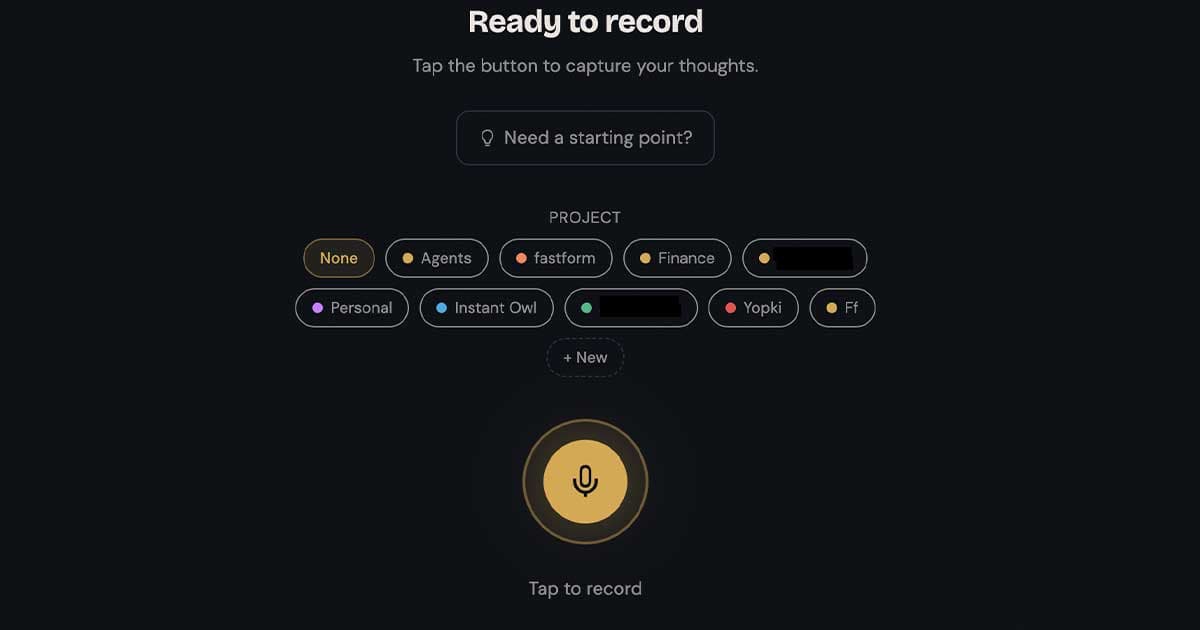
For that moment, you do not need $159 to $189 of hardware, and you do not need a bot on your calendar. Your phone's regular microphone is already enough. InstantOwl turns a rambling voice note into organized notes and tasks, no device to charge, no meeting to auto-join. InstantOwl is currently free to use.
If your actual problem is capturing your own thinking rather than someone else's meeting, that third option is worth trying before you spend on either of the two above.
Frequently asked questions
Is Plaud better than Otter?
Neither is better across the board. Plaud is better for phone calls and in-person recording, since it works without an internet connection and does not depend on being invited into a video meeting. Otter is better for virtual meetings, since it joins Zoom, Teams, and Meet automatically and transcribes in real time. Pick based on where you actually record, not on brand reputation.
Do I need the Plaud device?
Only if you record phone calls or in-person conversations regularly. If nearly everything you need transcribed happens on a video call, Otter's bot covers that without buying hardware. If you spend time in rooms or on calls Otter cannot reach, the device closes that gap.
Does Otter work for in-person meetings?
Only through your phone's microphone, since Otter has no dedicated hardware. It can transcribe an in-person conversation if you open the app and hit record, but it was built to auto-join calendar meetings on Zoom, Teams, and Meet, not to sit in a room.
Which is cheaper, Plaud or Otter?
Otter is cheaper up front because there is no device to buy. Software costs are nearly identical: Plaud Pro is $99.99 a year, Otter Pro is $99.96 a year. Plaud's real added cost is the hardware, $159 for the Note or $189 list for the Note Pro (on sale for $159.99 as of 2026-08-20), which Otter has no equivalent to.

Written by
Jim BreeseJim Breese is the founder of InstantOwl. He's spent 15 years building companies, from an Airbnb host community he founded and exited to growth leadership at venture-backed SaaS startups. He built InstantOwl because his best ideas kept arriving mid-walk, out of order, and half-finished.
Stop losing good ideas.
InstantOwl turns a rambling voice note into a clean, organized document in moments. Just talk. We'll organize it.
 Try InstantOwl free