Otter vs Voicenotes: Two Different Jobs Wearing the Same Label
By Jim Breese ·

Are Otter and Voicenotes actually the same kind of tool?
No. They share a search result and a rough category, "AI voice notes," but they are built for different jobs. Otter is meetings-shaped from the ground up: it joins your calendar, transcribes calls live, identifies who said what, and sells team plans. Its own homepage now bills it as "Your AI notetaker is now also your Conversational Knowledge Engine," per otter.ai.
Voicenotes started somewhere else. It began as a personal capture app, the kind of tool built for a stray thought on a walk, not a scheduled call. But its current homepage has pivoted hard toward meetings too: "Voicenotes turns every meeting into perfect notes and instant answers, and works with every meeting app," per voicenotes.com.
That leaves the person actually typing "otter vs voicenotes" in an odd spot. Both companies are now chasing the same meeting-notetaker job, just from different starting points. If what you actually want is to capture your own thoughts, not other people's conversations, neither company's current homepage is talking to you directly.
Most people land on this comparison for a simpler reason than a genuine meetings-versus-capture decision: Otter is the most famous name in AI transcription, so it is the first thing that comes to mind when a stray idea needs to get out of your head. Voicenotes shows up next to it because it used to be the obvious answer for that exact job. Neither fact means either product is currently built for it.
What do real users say about Otter for personal voice memos?
They say skip it. On a Reddit thread titled roughly "Is Otter.AI the app of choice for voice memo transcription?", the original poster found Otter's transcription "definitely better than that of the native Voice Memos app" and asked whether a paid subscription was worth it just for personal memos.
Nobody in the thread defended Otter for that job. One detailed reply said plainly, "I have never heard of Otter.ai," then split the whole category into three lanes instead: live dictation tools (SuperWhisper, Willow Voice, and Aqua were named), file transcription tools for audio you already have ("MacWhisper is considered to be very good," with its iOS sibling Whisper Transcription doing "on device processing for free"), and a separate warning about Otter itself: "Otter's good, just keep in mind the free plan has limits."
SuperWhisper picked up a second, independent endorsement in the same thread, called "pretty solid." A handful of vendor-flavored drive-by comments (naming other transcription apps) showed up too, but they read as marketing, not community consensus, and nobody backed Otter as the personal-memo pick.
The lesson here is not that Otter is bad. It is that real users already know it is the wrong shape for this specific job, and they will tell you so for free before you pay for a plan built around meetings.
Otter, honestly
Otter does one job well: transcribing meetings, calls, and lectures through a bot that joins your calendar automatically. It is not built, priced, or designed around someone recording thoughts to themselves. Our full Otter review covers its company history and how to turn off its auto-join behavior; here are the numbers that matter for this comparison.
Otter's free Basic plan gives 300 transcription minutes a month, capped at 30 minutes per conversation, plus 3 lifetime audio or video file imports, per otter.ai/pricing. Pro costs $16.99 a month, or $8.33 a month billed annually, for 1,200 minutes and 90 minutes per meeting. Business runs $30 a month, or $19.99 a month billed annually, for unlimited meetings and a 4 hour per-meeting cap.
That free tier is the real pain point, not accuracy. Three lifetime file imports run out almost immediately if you are bringing in recordings you already made, rather than only recording fresh inside the app. And a 30-minute conversation cap cuts off mid-recording if you ramble longer than that in one sitting, which is exactly the kind of open-ended talking a personal voice note often is.
Otter is not a small player. It claims more than 40 million users on its own homepage, and its Android app carries a 4.7 star rating from 40.8K reviews on Google Play, per the Play Store listing. Those numbers matter for judging Otter as a meetings product. They say nothing about whether the free tier fits someone who wants to talk to themselves once or twice a day, which is the actual question this comparison is answering.
Voicenotes, honestly
Voicenotes still markets itself as the anti-Otter option, but its product has moved toward the same meetings job Otter already owns. Its own blog post, "Otter AI alternatives," names no alternative to Otter besides itself, and criticizes Otter as "very expensive," with "transcription accuracy issues, especially with background noise or accents," "limiting for long-form audio," and "limited language options." Treat that as one competitor's stated opinion of another, not an independent finding.
On pricing, Voicenotes' free Basic plan allows unlimited recordings but caps transcription at 100 weekly minutes, shared across everything you record, plus 30-day history, after which older notes stop being accessible, per voicenotes.com/pricing. Its paid Pro plan costs $9 a user a month on the web, or considerably more through the App Store, at $8.99 a week, $14.99 a month, or $89.99 a year.
A hundred weekly minutes sounds generous next to Otter's 300 monthly minutes until you notice it resets every week rather than accumulating. Both companies gate a real amount of use behind their free tiers, just shaped differently: Otter by the conversation and the import, Voicenotes by the week and the history window. Neither free plan is built for someone who talks to themselves daily.
Voicenotes also rates noticeably differently by platform, which matters if reliability is your concern. Its App Store listing shows 4.8 stars from about 6,600 ratings, while its Google Play listing shows 3.9 stars from 2.64K reviews, nearly a full star lower. If you are on Android, that gap is worth weighing before you commit to either company's free plan.
Which tool actually fits your job?
Match the tool to what you are actually trying to do, not to which brand you have heard of. The table below sorts the honest fit by job.
| Job | Best pick |
|---|---|
| Meeting transcription with a bot that joins the call | Otter |
| Quick personal capture that comes back organized | Voicenotes, or InstantOwl (our product, in the same lane) |
| One-off transcription of an audio file you already have | MacWhisper on Mac, or Whisper Transcription on iOS: free and on-device |
The third row matters more than it looks. If your only job today is turning one existing recording into text, neither a meetings notetaker nor a weekly-minutes subscription is the right tool. A free, on-device app built for exactly that single job wins on both cost and simplicity.
So which should you pick?
If your job is meetings, meaning you need a bot on the call and a recap with action items afterward, pick Otter. It is the more established meetings tool of the two, per its 40 million-plus claimed users, and its higher-tier plans scale further for teams than Voicenotes' current lineup does.
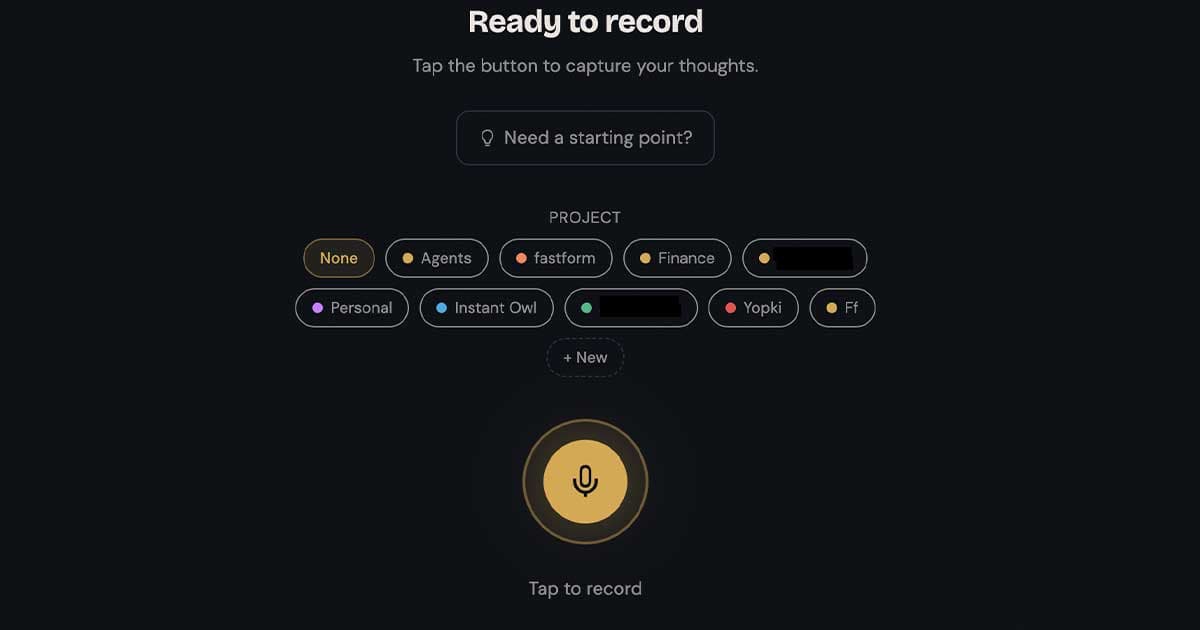
If your job is personal capture that comes back organized, Voicenotes is a reasonable pick on iOS or Mac, where it rates well, though its 30-day history and 100 weekly minutes are real constraints for daily use. Full disclosure: InstantOwl is our product, in that same lane. It is built for the voice note you record about your own thoughts, walking to your car or at your desk mid-idea, not for transcribing other people's conversations, and one recording turns into organized notes and tasks rather than a transcript to sort through later. InstantOwl is currently free to use.
If your job is neither of those, meaning you just have one file sitting on your phone that needs to become text, skip both companies entirely and use a free, on-device transcription app built for that single task instead.
Think about who you actually are in this decision, not just what the label says. Someone running client calls all day, who needs a recap waiting the moment a meeting ends, is Otter's exact customer. Someone whose mind generates ideas faster than they can act on them, who needs a thought caught the second it shows up in a parking lot or a school pickup line, is being underserved by a meeting notetaker no matter how good its transcription is. That second person is who this whole comparison is really for.
The category mismatch that started this whole comparison is the actual answer. "Otter vs Voicenotes" assumes the reader needs one of these two specific products. Often, the honest answer is a third option: a dedicated file transcriber for one-off jobs, or a personal capture tool built around a single voice note rather than a scheduled meeting.
Our wider map of Otter alternatives sorts more options by job if neither pick above fits, and our AudioPen vs Voicenotes comparison covers the other personal-capture matchup worth knowing about.
Our guide to transcribing audio to text covers the file-transcription route in more depth. If you want the basics of what a voice note even is before comparing tools, our voice notes guide covers sending them, keeping them, and what to do after you record one.
Related reading
- Otter review: full pricing, company history, and how to turn off auto-join.
- Otter alternatives by job: meeting notetakers, bulk transcription, and personal capture, sorted by need.
- AudioPen vs Voicenotes: the other personal-capture matchup, compared by a third player.
Frequently asked questions
Is Otter good for personal voice memos?
Not according to the people who have actually tried it that way. On a Reddit thread asking exactly this question, one detailed reply said plainly, I have never heard of Otter.ai, then pointed toward SuperWhisper for live dictation and MacWhisper for transcribing existing files instead. Nobody in that thread recommended Otter for personal memos.
What is the difference between Otter and Voicenotes?
Otter was built for meetings from the start: it joins your calendar, transcribes calls live, and identifies speakers, with a free plan capped at 300 minutes a month. Voicenotes started as a personal capture app but has pivoted its homepage toward meetings too, while keeping a cheaper $9 a month web plan and a much stricter 100 weekly minutes on its free tier.
What are Otter's free plan limits?
300 transcription minutes a month, a 30 minute cap per conversation, and 3 lifetime audio or video file imports, per otter.ai/pricing. Pro raises that to 1,200 minutes a month for $16.99, or $8.33 a month billed annually.
What if I just need one audio file transcribed?
Skip both Otter and Voicenotes. On the same Reddit thread, users pointed to MacWhisper on Mac and its iOS sibling Whisper Transcription for exactly this job, doing on device processing for free, which is a better fit than a meeting notetaker or a per-minute subscription for a single existing file.

Written by
Jim BreeseJim Breese is the founder of InstantOwl. He's spent 15 years building companies, from an Airbnb host community he founded and exited to growth leadership at venture-backed SaaS startups. He built InstantOwl because his best ideas kept arriving mid-walk, out of order, and half-finished.
Stop losing good ideas.
InstantOwl turns a rambling voice note into a clean, organized document in moments. Just talk. We'll organize it.
 Try InstantOwl free