Video Summarizers: How They Work and the Free Caps They Don't Advertise
By Jim Breese · · Updated

How do video summarizers actually work?
Most video summarizers do not watch the video. They read its existing caption or transcript track and summarize that text, the same job a text summarizer does, just fed by subtitles instead of a pasted document. That mechanic explains two things you will see across every tool in this category: the implausibly fast turnaround times, and the separate, smaller limits for videos that have no captions to read.
If a tool can grab captions already sitting on a YouTube video, summarizing an hour of footage takes seconds, because it is really just summarizing a few thousand words of text. Feed the same tool a video with no subtitle track, a phone recording, a Zoom call, a home movie, and it has to run its own transcription first. That is slower, costs more to run, and is exactly where the free caps get tighter.
Knowing this before you upload anything tells you what to expect: a captioned YouTube video should be nearly instant on any of these tools, while an uncaptioned file will hit a real minute limit somewhere. For more on how the transcription step itself works and what it costs across different tools, see our breakdown of audio-to-text options.
Is NoteGPT actually free?
Not fully, and NoteGPT's own pages disagree with each other on this. NoteGPT's YouTube video summarizer landing page states: "There are no restrictions. You can summarize YouTube videos of any length." NoteGPT's own help center says the opposite: every account, including free ones, gets 15 quotas a month shared across all features, and adds plainly, "NoteGPT is not completely free." Both statements come from NoteGPT's own site; the help center is the authoritative number here, since it is the policy page rather than the marketing page.
Every action on NoteGPT consumes quotas, summarizing, transcribing, translating, so a single long video can burn through a free month's allowance fast. Once quotas run out, the choice is waiting for next month or upgrading. Students get one free month of Pro.
Paid tiers, per NoteGPT's pricing page (annual "Save 30%" rate shown first, regular monthly second): Pro is $9 a month annual ($108 a year) or $9.99 a month monthly, with 1,000 basic quotas plus 100 premium credits a month, local files capped at 100MB, and no-subtitle YouTube videos capped at 40 minutes. Unlimited is $19.92 a month annual ($239 a year) or $29 a month monthly, with unlimited basic quotas, 2,800 premium credits, 1GB local files, and a 120-minute no-subtitle cap. Max is $69 a month annual ($829 a year) or $99 a month monthly, with 10,000 premium credits, 5GB files, and a 210-minute no-subtitle cap. Annual plans do not auto-renew, and refunds are honored only within 24 hours of first purchase.
The landing page separately claims uncaptioned videos work up to 150 minutes, a number that does not match any single plan's actual cap of 40, 120, or 210 minutes on the pricing page. Treat the pricing page as the real number, since it is the one tied to what you would actually pay for.
AIVideoSummarizer.io claims to be totally free. Is it?
That is the site's own claim, not an independently verified fact: "Free to use, no sign up" and "all features are completely free, with no usage limits," per the site itself. No company or operator is named anywhere on the page, which is worth factoring into how much you trust the claim.
The site also contradicts itself on a basic spec. One part of the page states a file size limit of "up to 1GB," while a FAQ answer elsewhere says files should "generally be kept within 2GB." Both numbers appear on the same site; neither is confirmed as the real limit.
The speed claim is a 1 to 2 hour video summarized "in just 3 to 5 seconds," which lines up with the transcript-first mechanic covered above: that speed is only possible if the tool is reading an existing caption track rather than transcribing raw audio. An accuracy claim of "99.8%" appears on the page too, with no methodology behind it, so treat it as marketing rather than a verified figure. The tool accepts YouTube, TikTok, Instagram, Zoom recordings, and local video or audio files, and outputs transcripts, summaries, chapters, and mind maps. An anonymous free tool with big claims and no named operator is worth extra caution about how long it stays available and what happens to anything you upload.
What does Mindgrasp's video summarizer cost?
Mindgrasp's video summarizer accepts MP4, AVI, MOV, MKV, and WebM uploads or a public video URL, capped at 100MB per file, according to its own site. That cap sits oddly next to Mindgrasp's separate text summarizer page, which claims no file size restrictions at all, the same site making two different promises about limits depending on which tool you land on. Mindgrasp states there is no duration cap, describing support for anything from "a short 2-minute clip" to "a multi-hour recording," and advertises the tool as 100% free with no sign-up and unlimited use.
We checked live in mid-2026 for a public pricing page across Mindgrasp's main site and app, at /pricing, /plans, and app.mindgrasp.ai/pricing. All three returned 404. No pricing link exists anywhere in the site's navigation or footer. The homepage's own structured data lists a price of "0" with "Free trial available," and every call to action says "Try for Free," which points to a trial-based paid product behind the free-sounding marketing. This is the same product family as the Mindgrasp text summarizer, so the caveat carries over: unlimited claims with no visible way to verify what happens once a limit, if one exists, is reached.
What's the free path that always works?
Pull the transcript yourself, then summarize it with ChatGPT or Claude. Neither step depends on any single company's free-tier quota, file-size cap, or pricing page that might change. YouTube's own transcript panel, or a dedicated transcript tool, gets you the text; a general-purpose AI chat tool summarizes it in whatever format you ask for, a paragraph, bullet points, or a custom prompt. For the exact steps to pull a transcript off YouTube and the free tools available for it, see how to get a YouTube transcript.
This two-step path loses the one-click convenience a dedicated video summarizer offers, but it trades that for no company-specific cap standing between you and the summary. It is also the same underlying approach every "instant" video summarizer already uses, reading text and summarizing it, just without a quota attached. If you want the mechanics of what makes a good AI summary versus a shallow one, our AI summarizer breakdown covers that separately.
Where InstantOwl fits
Full disclosure: InstantOwl is our product, and this blog belongs to it. InstantOwl cannot summarize a YouTube video, and this post is not pretending it does.
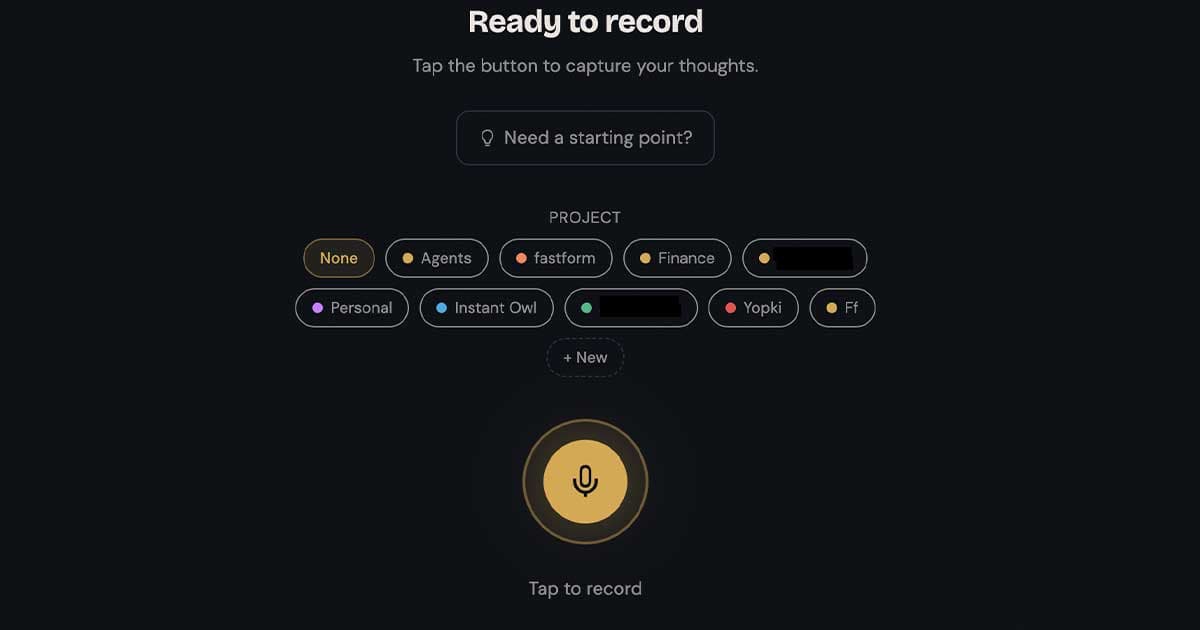
What it does instead: if the "video" you actually want summarized is you, talking through an idea out loud on a walk or in the car, that is a voice note, not a video to process. Turning a rambling recording like that into an organized summary, task list, or note is exactly the job InstantOwl was built for. InstantOwl is currently free to use.
Related reading
- How to get a YouTube transcript: the free, built-in way to pull captions off any YouTube video, plus the tools that go further.
- AI summarizers, with their real free limits: the same self-contradicting free-tier pattern, this time for text and document summarizers.
- How to transcribe audio to text: every real option for turning speech into text, with the fine print on each.
Frequently asked questions
What is the best free video summarizer?
There is no clean free winner, because every option has a real limit somewhere. Mindgrasp advertises 100% free with no sign-up but publishes no pricing page anywhere on its site. AIVideoSummarizer.io claims no usage limits but contradicts itself on file size and names no operator. NoteGPT's own help center caps free accounts at 15 quotas a month, despite its landing page claiming no restrictions. The path with no company-specific cap is pulling the transcript yourself and summarizing it with ChatGPT or Claude.
How do video summarizers work?
Nearly all of them read the video's existing caption or transcript track and summarize that text, not the video itself. That is why some tools claim to summarize an hour of video in 3 to 5 seconds, and why every tool that handles videos without captions publishes a separate, shorter minute cap for that harder job.
Can I summarize a video without captions?
Yes, but expect a lower cap than a captioned video gets. NoteGPT's pricing page lists per-plan limits for no-subtitle YouTube videos: 40 minutes on Pro, 120 minutes on Unlimited, and 210 minutes on Max, even though its landing page separately claims a flat 150-minute limit. A no-caption video has to actually be transcribed instead of just read, which is slower and gets rationed more tightly.
Is NoteGPT free?
Not fully, by NoteGPT's own admission. Its help center states plainly that NoteGPT is not completely free, and caps free accounts at 15 quotas a month shared across every feature, despite the landing page's claim of no restrictions. Paid plans start at Pro, $9 a month billed annually or $9.99 a month monthly, and go up to Max, $69 a month annually or $99 a month monthly.

Written by
Jim BreeseJim Breese is the founder of InstantOwl. He's spent 15 years building companies, from an Airbnb host community he founded and exited to growth leadership at venture-backed SaaS startups. He built InstantOwl because his best ideas kept arriving mid-walk, out of order, and half-finished.
Stop losing good ideas.
InstantOwl turns a rambling voice note into a clean, organized document in moments. Just talk. We'll organize it.
 Try InstantOwl free