AI Summarizers: Free Limits Verified (Including the Self-Contradictions)
By Jim Breese ·

What does an AI summarizer do?
An AI summarizer takes a block of text (an article, a document, pasted paragraphs) and returns a shorter version: a paragraph, a bullet list, or a custom length you choose. Summarizer.org, for example, describes its own approach plainly: an algorithm that first detects the best sentences in the source text, then applies machine learning to tighten the result.
That extractive-first method is also where the weaknesses show up. A summarizer picks sentences it judges important. It does not verify whether the source itself is accurate, and it does not flag when the "best sentence" strips out the nuance or caveat that changed the original meaning. Sourcing is not checked either: a summarizer will compress a well-reported article and a rumor with the same confidence.
The practical upshot: an AI summarizer is a compression tool, not a fact-checker or an editor. It works well on text that is already organized and factually sound. It works badly on anything that needs judgment about what to trust, or anything unorganized to begin with, which matters later in this post.
Most tools in this category offer the same handful of output modes: a paragraph summary, a bullet-point list, and sometimes a custom format with a length slider you drag from short to long. That output choice matters less than the input limit, which is the part every free plan restricts differently and the part worth checking before you paste in anything long.
What are the free AI summarizer limits, actually?
Three tools that show up for "ai summarizer" and "free ai summarizer" each publish a different free tier, and two of them do not agree with their own marketing. Here is what each one states, verified live on 2026-07-16.
| Tool | Stated free limit | Premium price | What to know |
|---|---|---|---|
| Summarizer.org | 1,200 words per task, no sign-up | $7/mo, or $5.60/mo ($67/yr) billed annually | Clearest published number of the three; no stated daily cap on number of tasks |
| QuillBot | 600 words (per its summarize page) or 1,200 words (per its own premium comparison table) | $8.33/mo billed annually, unlocks 6,000 words | The two numbers come from QuillBot's own site and do not match each other |
| Mindgrasp | Claims "100% Free, No Sign-Up," no word or file size limits | Not published anywhere | No pricing page exists on the site; the claim is unverifiable |
Summarizer.org is the most straightforward. It states 1,200 words per task for free, with no sign-up required and no stated cap on how many tasks you can run per day. Inputs include pasted text, article URLs (an "Add URL" option for whole web pages), TXT and DOCX files, and images through OCR text extraction.
Output modes are paragraph, bullet points, or custom, with a length slider defaulting to a 50% medium setting. Premium at $7/mo (or $5.60/mo billed annually, $67/yr, a 33% discount) adds an "Advanced AI" toggle, summary history, and support for languages including Spanish, French, German, Russian, and Arabic, on top of the free summarizer.
QuillBot contradicts itself. Its summarize page states: "Summarize up to 600 words of text for free," with no limit on how many summaries you can run per day. Its own premium comparison table, on a separate page, lists free at 1,200 words and Premium at 6,000 words. Both numbers come directly from quillbot.com; the site simply does not agree with itself about where its free tier ends.
Modes include paragraph, "key sentences" bullet points, and a custom format reserved for Premium, with a four-level length slider. Premium runs $8.33/mo billed annually (framed on the pricing page as "58% off") and bundles the summarizer with QuillBot's paraphrasing, plagiarism checking, and humanizer tools, so you are not paying for summarizing alone; the page reviewed did not show a separate monthly (non-annual) price.
Mindgrasp claims the fewest limits and backs it up the least. Its summarizer page positions the tool for students and academics first, then business professionals, researchers, content creators, lawyers, and healthcare workers, and states "100% Free with No Sign-Up," with no word limits and no file size restrictions. It accepts text, PDFs, Word docs, YouTube videos, video and audio files, and PowerPoint, with output as a one-paragraph overview or a multi-point breakdown, plus a Chrome extension, an iOS app, and integrations with Canvas, Blackboard, and Panopto.
But mindgrasp.ai/pricing returns a 404. So does /plans and app.mindgrasp.ai/pricing, and no pricing link appears anywhere in the site's navigation or footer, all verified live on 2026-07-16. The homepage's structured data lists a price of "0" with "free trial available," and the app's own call to action is "Try for Free," not "Use for Free."
A tool that advertises no limits but hides its pricing behind a signup wall is not the same as a tool that publishes a real, checkable free tier.
Why do free summarizers publish confusing limits?
This is not one bad actor; it is the category norm. Contradictory or missing limits show up across the summarizer space, not just in the three tools above. When a company's own comparison table disagrees with its own product page, or a "100% free" claim has no pricing page behind it anywhere on the site, the marketing and the actual product policy have drifted apart.
You can test any summarizer's real cap yourself in about two minutes: paste in a document of a known word count (a Word doc's word counter makes this easy) that is noticeably over the tool's stated free limit, run the summary, and see whether the tool truncates the input, blocks the request, or quietly summarizes the whole thing anyway. That single test tells you more than any pricing page, because it shows what the software actually does rather than what the marketing claims it does.
Do the same test with a second, shorter document too, comfortably under the stated limit, so you can compare the two outputs side by side. If the "over the limit" summary looks just as complete as the "under the limit" one, the tool is not enforcing the cap it publishes, which is useful to know either way.
Should you summarize a document, or summarize yourself?
Every limit above applies to text you already wrote or found: an article, a report, a document someone else organized. A different problem shows up the moment the source is your own spoken thoughts instead of a finished document.
Twenty minutes of talking works out to roughly 2,500 to 3,000 words, more once filler and repetition are counted. That is an approximation, not a precise conversion, since talking speed varies by person. But even at the low end, 20 minutes of rambling clears every free cap listed above: Summarizer.org's 1,200 words, QuillBot's 600 to 1,200, and whatever Mindgrasp's unpublished limit actually is.
The deeper mismatch is not just length. A document a summarizer compresses is already organized: someone wrote it with a structure, a point, a beginning and an end. Your own spoken thoughts usually are not. Talking out loud produces the actual idea mixed with a task reminder, a stray worry about Thursday, and a half-formed thought about something else entirely, all in one continuous stream.
Say what you actually said out loud is: the deck needs a new opening slide, call the dentist, and the client meeting probably needs to move to Thursday. A document summarizer, fed that as plain text, would shorten it into roughly the same three clauses. It would not turn "call the dentist" into a task, separate the deck note from the meeting note, or notice that only one of the three items has a deadline attached.
Compressing that stream is not the same job as shortening a finished article. It needs to be sorted first, not just made shorter, and word-cap tools built for documents were never built to do that sorting.
Where InstantOwl fits
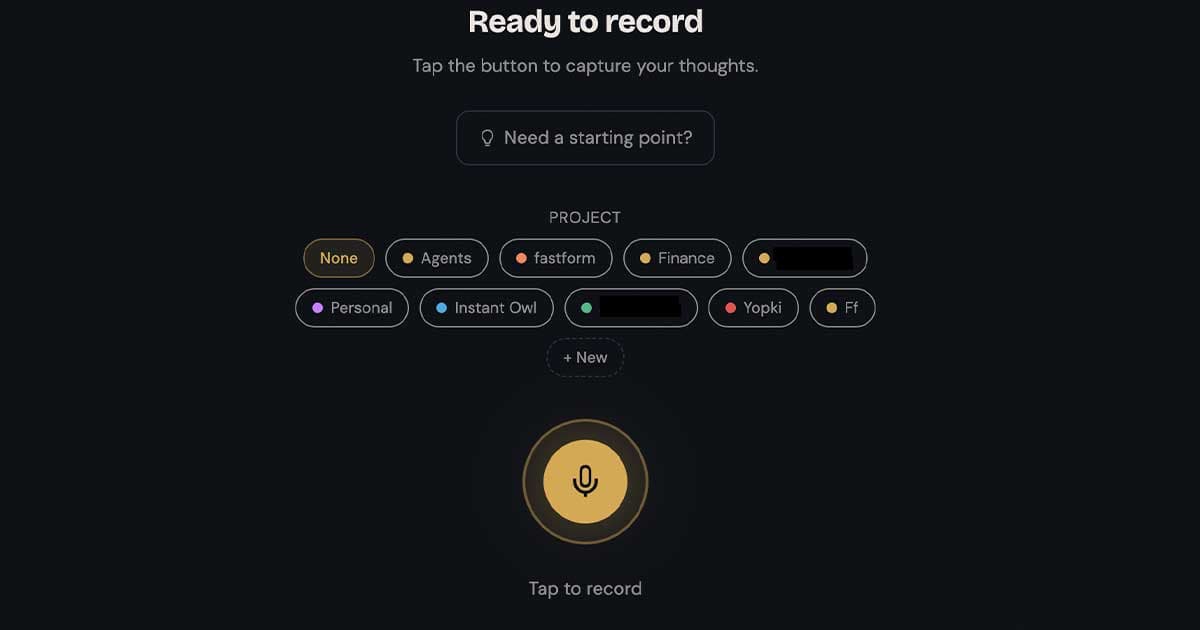
Full disclosure first: InstantOwl is our product, and this blog belongs to it. InstantOwl is currently free to use and takes the opposite input from the tools above: your own rambling voice recordings, not someone else's finished writing.
Two related jobs sit next to this one. If the thing you actually need summarized is a YouTube video someone else made, our YouTube summarizer post covers the free limits on that side of the category. If it is a video file rather than a link, the video summarizer options cover that. And if what you are holding is your own voice memo rather than a document at all, voice memos covers what to actually do with it once it is recorded.
Frequently asked questions
What is the best free AI summarizer?
There is no clean winner. Summarizer.org publishes the clearest free limit (1,200 words per task, no sign-up). QuillBot's free limit depends on which of its own pages you read. Mindgrasp claims no limits but has no public pricing page, so treat that claim with caution and test it yourself first.
How many words can free summarizers handle?
It varies by tool and is often unclear. Summarizer.org states 1,200 words free per task. QuillBot says 600 words free on its summarize page but 1,200 on its own premium comparison table. Mindgrasp claims no word limit at all but does not publish pricing to back that up.
Is QuillBot's summarizer free?
Yes, with a cap that QuillBot itself states two different ways. Its summarize page says 600 words free with no daily limit on the number of summaries. Its premium comparison table says free is 1,200 words and Premium is 6,000 words, at $8.33 a month billed annually.
Can AI summarize audio?
Not directly, in most of the tools built for documents. Summarizer.org and QuillBot take pasted text or uploaded files. Mindgrasp accepts audio and video uploads on its summarizer page. Most audio gets summarized by transcribing it to text first, then running that text through a summarizer.

Written by
Jim BreeseJim Breese is the founder of InstantOwl. He's spent 15 years building companies, from an Airbnb host community he founded and exited to growth leadership at venture-backed SaaS startups. He built InstantOwl because his best ideas kept arriving mid-walk, out of order, and half-finished.
Stop losing good ideas.
InstantOwl turns a rambling voice note into a clean, organized document in moments. Just talk. We'll organize it.
 Try InstantOwl free