MP4 to Text: The Free Paths First, Then the Real Converters
By Jim Breese · · Updated
How do you convert MP4 to text?
MP4 to text comes down to three real paths, and which one is free depends on what you already have. If you pay for Microsoft 365, Word's Transcribe feature accepts .mp4 directly at no extra cost. If you do not, a free-tier upload tool gets you a transcript with its own limit attached. If the file is too large for any of those caps, extracting the audio first turns an oversized video into a small, easy upload.
MP4 is worth starting with because it is the one video format every transcription tool checked for this guide accepts, including Word's own Transcribe feature, which takes .mp4 but not .mov. Transcription only ever reads the audio track anyway, so the video's resolution and codec never affect the result. For the fuller picture of video transcription, including formats beyond MP4, see our wider guide to video transcription.
Can Word transcribe an MP4 file?
Yes. Per Microsoft's own support page, "Transcribe currently supports .wav, .mp4, .m4a, .mp3 formats." If you already pay for Microsoft 365, this is the free path with no new account and no tool to learn.
Open the file in Word for the web, in Edge or Chrome, and use the Transcribe feature to generate a transcript with editable speaker labels ("Speaker 1," "Speaker 2," and so on). Microsoft's documentation includes 300 minutes of uploaded audio a month, or 30,000 minutes with a Microsoft Copilot license. A per-file size cap is not stated in Microsoft's documentation, so do not assume one before trying.
The one gap worth knowing: this same feature does not accept .mov files, only .mp4 among video formats. If your file is a .mov, extract the audio first (see below) or use one of the upload tools instead.
Which MP4 upload tools are free today?
Several tools take an MP4 upload directly, each with a different free limit and price, verified live on their own pages.
| Tool | Free tier | Paid tier | MP4 notes |
|---|---|---|---|
| ElevenLabs | 10,000 credits/month, recurring, signup required | Credit-based; minutes-per-credit not published | Also takes MOV, AVI, and MKV per its own page; exports TXT, DOCX, PDF, JSON, SRT, VTT, HTML; up to 32 speaker labels included free |
| TurboScribe | 3 files/day, 30 minutes each, no card | $10/month billed yearly ($120/year), or $20/month billed monthly, unlimited | 10-hour, 5GB files, 50 at a time; exports SRT and VTT |
| any2text | First 15 minutes free | $0.035/minute pay-per-file, or $19.99/month for 3,000 minutes | No stated length limit; SRT export with subtitle customization; operated by Puget Ross LLC |
| go-transcribe | Free trial, no stated duration | Not published on the site; an account is required to see pricing | Recommends files under 4GB; SRT and VTT export through its editor |
| converter.app | Free, no signup | No paid tier offered | Text output only, no SRT; states it runs on Whisper v3; auto-deletes files 2 hours after conversion |
| Zamzar | Free tier caps a file at 50MB | Paid pricing not shown on its pages | A small cap for video; text output |
| Word Transcribe | Free with a Microsoft 365 subscription | 300 uploaded minutes/month, 30,000 with a Copilot license | Confirmed to accept .mp4; does not accept .mov |
Per its own page, ElevenLabs has the most generous recurring free tier here: 10,000 credits every month, with word-level timestamps and speaker labels for up to 32 people included at no cost. It does not publish how many minutes of audio a credit buys, so no minutes figure is printed here.
Per its own pricing page, TurboScribe's free tier is 3 transcripts a day at 30 minutes each, no card required. Its Unlimited plan costs $10 a month billed yearly ($120 a year), or $20 a month billed monthly, for files up to 10 hours and 5GB, 50 at a time. If you have many files or long ones, that flat rate is worth comparing against a metered tool like any2text before you commit to either.
Per its own page, any2text gives 15 free minutes, then charges $0.035 a minute pay-per-file or $19.99 a month for 3,000 minutes. At full use, that plan works out to roughly $0.007 a minute, cheaper per minute than paying by the file once volume is high enough. Its SRT export includes subtitle customization, useful if captions are the goal.
Per its own page, go-transcribe does not publish pricing anywhere on the page. An account is required just to see a number, so treat it as unpriced until you sign up and check.
If a quick, free, plain transcript with no signup is all you need, converter.app is the honest pick: no account, no card, states it runs on Whisper v3, but text output only, and files are auto-deleted 2 hours after conversion. Zamzar offers the same kind of free text output, but its free tier caps a file at 50MB, a tight ceiling for video.
What format should the exported transcript be?
The right export format depends on what happens to the transcript next, not on which tool offers the longest list. A plain TXT file is the right pick for reading or pasting into another document, nothing more. A DOCX or PDF is the right pick when the transcript itself is the deliverable, a finished page to hand to someone else.
SRT and VTT are the right pick only when the output needs to sync with video playback as captions or subtitles. A TXT file cannot do that without manually re-timing every line. JSON is the right pick for feeding the transcript into another program, since it keeps word-level timing and speaker data that a plain text file drops.
Of the tools above, ElevenLabs exports the widest range from one MP4: TXT, DOCX, PDF, JSON, SRT, VTT, and HTML, per its own page. Most of the others export a narrower set, usually a document format plus SRT and VTT where captions are supported at all. Check a tool's export list before picking one if you already know what the next step needs.
What if the file is too big to upload?
Extract the audio first. A video file over a tool's size cap, whether that is InstantOwl's 150MB, Zamzar's 50MB, or go-transcribe's recommended 4GB, is almost entirely video data. The audio track alone is a small fraction of that size, and transcription only ever uses the audio anyway.
ffmpeg's own documentation describes the -vn option as disabling "automatic selection or mapping of any video stream" when used on the output side. In practice, that means:
ffmpeg -i input.mp4 -vn output.mp3
pulls the audio out and drops the video entirely. Add -c:a copy before an .m4a output instead of .mp3 to copy the audio stream directly, per ffmpeg's documented stream-copy behavior, without re-encoding it.
ffmpeg is not preinstalled on macOS or Windows, so this route needs a one-time install before it works. It is worth that setup step specifically when a file is over a tool's cap or gets rejected outright; for anything already under a tool's limit, uploading the video as-is is simpler.
Do you need subtitles or a plain transcript?
Pick a tool with SRT or VTT export up front if the end goal is captions or subtitles. A plain text transcript cannot become subtitles without re-timing every line by hand, so choosing the wrong tool first means redoing the work later.
Of the tools above, ElevenLabs, TurboScribe, any2text, and go-transcribe all export SRT or VTT from an MP4. Converter.app, Zamzar, and Word Transcribe output plain text or a document, not a captions file, so skip those three if subtitles are the actual job.
Where does InstantOwl fit?
Full disclosure: InstantOwl is our product, and this is our blog. InstantOwl accepts .mp4 files natively, up to 150MB, and processes the audio track the same way any transcription tool does, per how file uploads work in InstantOwl.
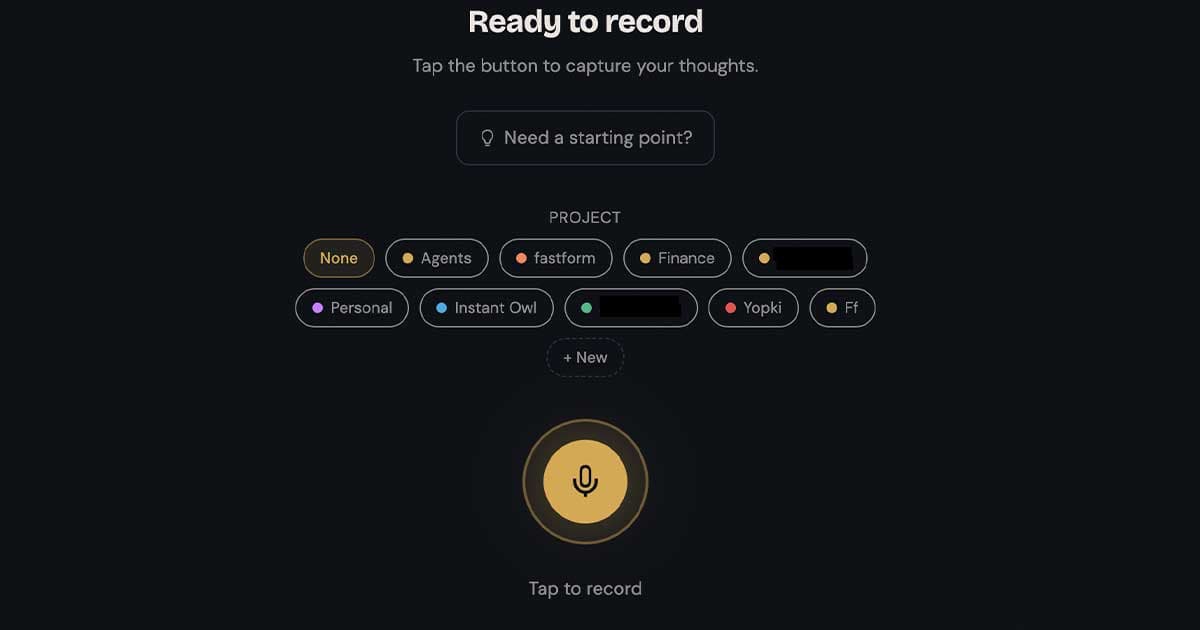
The difference is what comes back. Instead of a raw transcript, InstantOwl returns an organized note: an AI-generated title, a cleaned-up document, tags, and any tasks it finds in what you said. That fits an MP4 that is really a container for your own spoken thinking, a talking-head memo, a recorded brainstorm, a screen-share ramble you narrated out loud.
It is the wrong fit for subtitling someone else's footage. InstantOwl does not export SRT files, so if captions are the goal, use one of the tools in the table above instead. For the format-agnostic version of this same question, see our broader roundup of transcription options. InstantOwl is currently free to use.
Related reading
- Video to text: the fuller guide to video transcription across formats, including built-in paths that need no upload at all.
- Transcribe audio to text: the broader picture of free and paid transcription tools.
- MP3 to text: the same situation for an audio file once you have extracted one from a video.
Frequently asked questions
How do I convert MP4 to text for free?
Converter.app transcribes an MP4 for free with no signup, though the output is plain text only. TurboScribe's free tier allows 3 files a day at 30 minutes each, no card required, per its own pricing page. Either works before you need to pay for anything.
Can Word transcribe MP4 files?
Yes. Per Microsoft's support page, 'Transcribe currently supports .wav, .mp4, .m4a, .mp3 formats,' with 300 minutes of uploaded audio included each month on Microsoft 365, or 30,000 minutes with a Copilot license. Speaker labels are included and editable.
How do I get subtitles from an MP4?
Use a tool with SRT or VTT export, not a plain-text one. ElevenLabs, TurboScribe, any2text, and go-transcribe all export SRT or VTT from an MP4. Converter.app and Word Transcribe output text or a document, not a captions file.
What is the best MP4 to text converter?
It depends on what you need. Converter.app is the honest free pick for a quick plain transcript. TurboScribe fits many or long files. ElevenLabs fits free timestamps and speaker labels. Word Transcribe fits anyone already paying for Microsoft 365.

Written by
Jim BreeseJim Breese is the founder of InstantOwl. He's spent 15 years building companies, from an Airbnb host community he founded and exited to growth leadership at venture-backed SaaS startups. He built InstantOwl because his best ideas kept arriving mid-walk, out of order, and half-finished.
Stop losing good ideas.
InstantOwl turns a rambling voice note into a clean, organized document in moments. Just talk. We'll organize it.
 Try InstantOwl free