Podcast Summarizers: What's Actually Free, by Output Type
By Jim Breese · · Updated
How do you summarize a podcast?
Podcast summarizer tools split into three approaches, not one. Prose tools like NoteGPT and Skimming.ai hand you a paragraph. Mind map tools like Mapify turn the episode into a clickable diagram. And a free ChatGPT custom GPT skips audio entirely, working only from a transcript it can find online.
Which one fits depends on what you want back: a summary you read in ten seconds, a diagram you explore, or a chat you can ask follow-up questions in. None of these tools are free in the way their landing pages suggest. Each one gates the actual audio-to-summary step behind a quota, a one-time credit pool, or a paid plan. Here is exactly where those limits sit, verified in mid-2026.
Prose summaries: NoteGPT and Skimming.ai
NoteGPT's podcast summarizer takes a podcast RSS feed URL or a YouTube Music link, fetches the audio, converts it to text, and returns a concise summary of the key points. There is no transcript or mind map on this particular tool, just the summary itself, and NoteGPT says customization is something it is "actively exploring" rather than something it offers today.
The free allowance is 15 quotas a month, shared across every NoteGPT feature on the account, per NoteGPT's own help center rather than its marketing pages. Audio transcription consumes quotas the same as any other action, and a long episode can burn through most of that monthly allowance in a single summary. NoteGPT's paid plans start at $9 a month billed annually (or $9.99 a month) for 1,000 basic quotas, rising to $19.92 a month annually (or $29 a month) for unlimited basic quotas plus 2,800 premium credits.
Skimming.ai's podcast summarizer works differently: paste a Spotify, Apple Podcasts, or YouTube link, or upload an episode directly, then click Generate Summary. The tool page markets text extraction, near-instant processing, and text-to-speech playback. What it does not do is publish any free usage limit anywhere on that page. There is no stated cap on episodes, length, or monthly use, which makes it impossible to know in advance what "free" actually covers before you try it.
Skimming.ai positions the free tool as an entry point to its paid "chat with anything" platform. That platform starts at $10 a month for the Basic plan ($100 a year if paid yearly), rising to $20 a month for Plus and $35 a month for Premium, with each tier multiplying the credits available. If you need predictable, repeatable podcast summaries, the absence of a published free limit is worth knowing going in.
Mind maps: Mapify turns an episode into a diagram
Mapify takes a different approach from the prose tools above: instead of a paragraph, it produces an interactive mind map of the episode, complete with speaker identification and a chatbot you can ask questions of afterward. It accepts podcast links, including Apple Podcasts URLs, and local audio files like MP3 and WAV.
Here is the catch. Mapify's free plan includes 30 AI credits, given once rather than refreshed monthly, plus five PDF or document conversions and five YouTube videos to mind maps. Audio summarization, the actual feature you would need to summarize a podcast, is listed as a Pro-plan feature on Mapify's pricing page. That means the free tier covers turning documents and YouTube videos into mind maps, but not podcasts or other audio files.
To summarize an actual episode, you need Pro at $19.99 a month, or $11.99 a month billed yearly, which also unlocks 2,000 monthly credits and files up to 10 million words.
In practice, Mapify's "free podcast summarizer" is a demo of the interface using other content types. The feature that matters for podcasts specifically sits behind a paid plan from the start.
Can ChatGPT summarize a podcast you paste a link to?
Not directly, because ChatGPT cannot listen to audio from a pasted podcast link. A custom GPT built for podcast summaries ranks near the top of search results for this exact query, and it is free to use with any ChatGPT account under the usual free-tier usage caps.
What it actually does is work from a transcript or show notes it can locate for that episode, not the audio file itself. If the show publishes a transcript, or the episode has enough coverage elsewhere online, the summary can be solid. If neither exists, the GPT has little to work with, and quality drops fast. This is a real, free option, but it depends entirely on whether someone already wrote down what was said.
The transcript-first path: transcribe, then summarize
Because every tool above transcribes audio before it can summarize it, one honest shortcut is to handle that step yourself (our step-by-step guide to transcribing a podcast walks through the options), then feed the resulting text into whichever summarizer you already trust. Getting your own transcription done first also sidesteps quota limits that specifically apply to audio processing, since text-only summarizers tend to have more generous free tiers than audio-native ones.
Once you have a transcript in hand, a general-purpose AI summarizer can compress it, and the same logic applies if your starting point is a video instead of an audio file: a YouTube summarizer works from captions the same way these tools work from a podcast transcript. The pattern across all of them is the same: transcript first, summary second.
Where InstantOwl fits
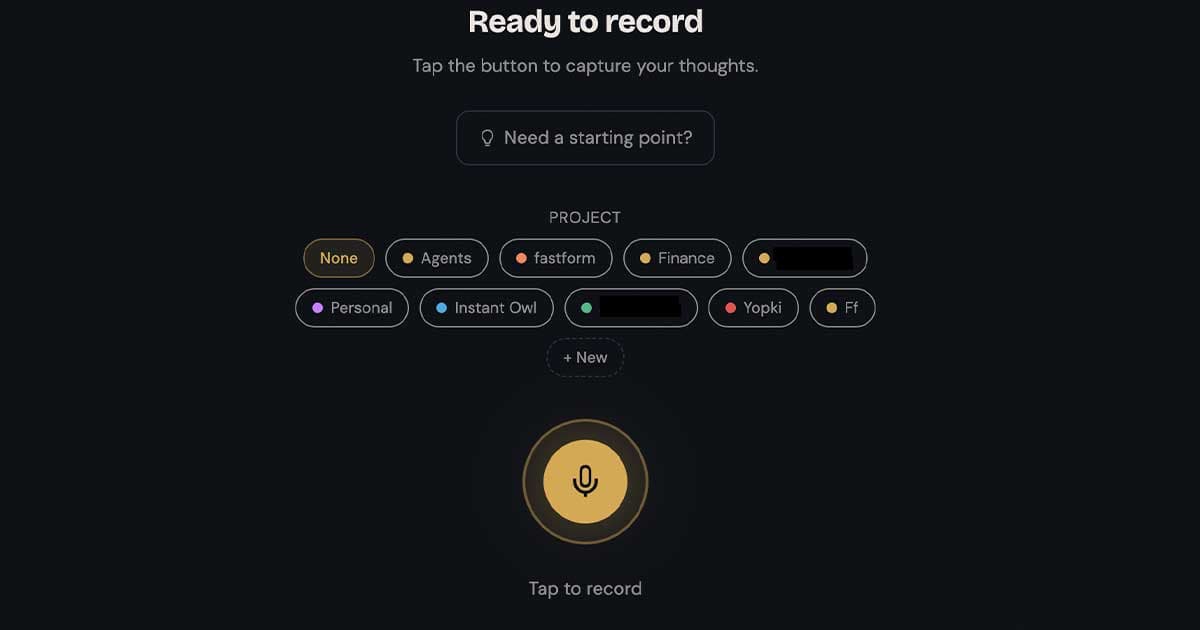
Full disclosure: InstantOwl is our product, and this blog belongs to it. InstantOwl does not summarize other people's podcasts. It summarizes your own voice notes, like the ideas an episode sparks that you dictate right after it ends, and InstantOwl is currently free to use.
Frequently asked questions
Is there a free podcast summarizer? Sort of. NoteGPT gives every account 15 free quotas a month shared across all its features, and transcribing an hour-long episode can use most of that in one summary. Mapify gives 30 one-time credits, but audio summarization needs its $19.99 a month Pro plan, so the free tier only covers documents and YouTube videos. Skimming.ai publishes no free limit at all for its podcast tool.
Can ChatGPT summarize a podcast? Only if it can find a transcript or show notes for that episode, since ChatGPT cannot listen to audio from a pasted podcast link. A custom GPT built for this is free with any ChatGPT account, but results depend on whether a written version of the episode already exists somewhere it can read.
How do I get a podcast transcript? Most podcast apps do not generate one automatically. The fastest paths are a dedicated transcription tool, a summarizer that transcribes as its first step (NoteGPT, Skimming.ai, and Mapify all do this), or checking whether the show's website already publishes one.
What is the best podcast summary app? It depends on the output you want. NoteGPT gives a plain-text summary from a podcast link. Mapify gives a visual mind map with speaker labels instead of prose, once you are on its Pro plan. Skimming.ai leans toward a broader chat-with-anything platform. None of them summarize your own voice notes, only episodes other people recorded.
Related reading
- Transcription: every real way to turn audio into text, with the fine print on cost.
- AI summarizer: what happens once you already have text to condense.
- YouTube summarizer: the same transcript-first pattern applied to video instead of audio.
Frequently asked questions
Is there a free podcast summarizer?
Sort of. NoteGPT gives every account 15 free quotas a month shared across all its features, and audio transcription for an hour-long episode can use up most of that in one summary. Mapify gives 30 one-time credits, but audio summarization is a Pro-only feature at $19.99 a month, so its free tier covers documents and YouTube videos, not podcasts. Skimming.ai does not publish any free limit for its podcast tool at all.
Can ChatGPT summarize a podcast?
Only if it can find a transcript or show notes for that episode first, because ChatGPT cannot listen to audio from a pasted podcast link. A custom GPT built for this ranks near the top of search results and is free to use with any ChatGPT account, but results depend entirely on whether a written version of the episode already exists somewhere ChatGPT can read.
How do I get a podcast transcript?
Most podcast apps do not generate one for you automatically, so the fastest paths are a dedicated transcription tool, a summarizer that transcribes as a first step (NoteGPT, Skimming.ai, Mapify all do this), or checking whether the show's website already publishes one. Once a transcript exists as text, any text summarizer can work with it.
What is the best podcast summary app?
It depends on the output you want. NoteGPT is built specifically for podcast links and gives a plain-text summary. Mapify is the pick if you want a visual mind map with speaker labels instead of prose. Skimming.ai leans toward a broader chat-with-anything platform, with the podcast tool as one entry point. None of them summarize your own voice notes, only episodes other people recorded.

Written by
Jim BreeseJim Breese is the founder of InstantOwl. He's spent 15 years building companies, from an Airbnb host community he founded and exited to growth leadership at venture-backed SaaS startups. He built InstantOwl because his best ideas kept arriving mid-walk, out of order, and half-finished.
Stop losing good ideas.
InstantOwl turns a rambling voice note into a clean, organized document in moments. Just talk. We'll organize it.
 Try InstantOwl free