How to Transcribe a Podcast: You May Already Have a Transcript
By Jim Breese ·
Are you transcribing your own podcast, or looking for someone else's?
These are two different questions with two different answers, and most search results answer only one while pretending to cover both. If you host a podcast and need a transcript of your own episode, the fastest path is downloading one you may already have, not paying for a new tool. If you are a listener who wants a transcript of a show you do not run, your path is reading what the podcast app already gives you, and reaching for a separate tool only if you need an actual file. Find your section below.
Ranking articles for this exact keyword tend to blend the two audiences into one list, mixing creator tools with listener tips as though the same person needs both. That is why the results rarely give a straight answer to either question. Separating the two first, before naming a single tool, is the only way to actually answer the one you came with.
Does Apple Podcasts automatically transcribe your episodes?
Yes, if you publish through Apple Podcasts. Per Apple's official transcripts guide, a transcript generates automatically after each new episode is published, with a short delay while it processes; new episodes need at least 24 hours before a transcript appears. The transcript detects speaker changes, highlights words as the episode plays, and listeners can tap any word to jump playback to that point.
Apple's auto-transcription covers 11 languages: English, Danish, Dutch, Finnish, French, German, Italian, Norwegian, Portuguese, Spanish, and Swedish, per its guide. Transcripts are available in more than 170 countries and regions on iOS 17.4 or later.
The standout answer in a r/Podcasters thread about making podcast transcripts was not a paid tool at all. A podcaster described logging into Apple Podcasts Connect after each episode goes live, opening the episode's transcription section, and copying the auto-generated text straight into their host's transcript field. A reply posted a year later agreed it was still the right call, calling it "the best answer here. quickest. easiest." If you publish through Apple, check there before you pay for anything.
That same file has a second use once you have cleaned it up: deliver it through your RSS feed using the RSS transcript tag, and Spotify can pick it up too. Its creator dashboard has a toggle to include your transcript in your RSS feed so other listening platforms carry it as well, per Spotify's support article.
How do you fix errors in your podcast transcript?
The same way on both platforms: download the file, edit it yourself, and re-upload it. Neither platform lets you correct a transcript in place.
On Apple, transcripts are available to download in Apple Podcasts Connect. Make your changes to the downloaded file, then submit the correction by linking the new file in your RSS feed using the RSS transcript tag, per Apple's guide. You can also upload your own VTT or SRT file directly for subscriber episodes if your hosting provider supports it. Apple applies a quality gate: files that do not meet its standards will not display, so clean audio and accurate host and guest names in your episode description help the auto-transcript get it right the first time, per its guide.
On Spotify, per its creator support article, you cannot edit a transcript directly in Spotify for Creators. The path is Episodes, select the episode, Details, Transcripts, Edit, Download, then edit the downloaded file and upload it back. Spotify only accepts VTT or SRT files, capped at 5MB, and the file must include timestamps or it will not sync during playback. One gotcha worth knowing before you spend time on a correction: upload your own transcript, then later turn on auto-generated transcripts for that show, and your uploaded file gets replaced.
Spotify's transcript toggles apply per episode or show-wide, so you decide once whether every future episode gets the same treatment instead of resetting it each time. A separate "Allow transcript translation" toggle controls whether some shows also get translated transcripts, per its article. Between the two platforms, the correction workflow is identical in spirit even though the file requirements differ: your edited file, not the platform's editor, is always the source of truth.
What are the honest limits of automatic podcast transcripts?
Automatic transcripts skip some episodes and some content inside episodes, and both platforms say so themselves. On Apple, music lyrics are excluded from transcripts, episodes over 10 hours may not be transcribed, and cross-talk or loud music may be "more difficult to transcribe," per its guide. Dynamically inserted ad segments will not display correctly in the transcript if the ad changes after the transcript was generated.
Spotify is upfront that its auto-generated transcripts are not universal. "Transcripts aren't available to all creators or in the Spotify for Creators mobile app," per its support article. If your show does not have one yet, that is expected, not something broken on your end.
These limits explain why the download-and-fix workflow exists in the first place, rather than pointing to a broken feature. A native transcript that garbles a loud musical intro or skips your inserted ad break is still a faster starting point than transcribing an entire episode from scratch by hand.
How do you get a transcript of someone else's podcast?
Check the app you are already listening in before downloading anything. On an iPhone, touch and hold an episode in Apple Podcasts, then tap View Transcript; the transcript is searchable by word or phrase, and a plain-text version is also available from the episode's details page, all free, per Apple's guide. In Spotify, look for the transcript in the Now Playing view or on the episode page; it shows up when the creator has one enabled, which per Spotify is not every show.
A file is worth the extra step when reading in the app is not enough: quoting a line accurately in a newsletter, searching across several episodes at once for one topic, or keeping your own archive of a show. Apple and Spotify's in-app transcripts cover reading and searching a single episode; neither is built to export a clean file for you to keep.
If neither app has one and you need an actual file, download the episode's audio and run it through a transcription tool yourself. TurboScribe's free tier handles 3 files a day at up to 30 minutes each with no card required, which covers most single episodes. A longer episode needs its Unlimited plan, $10 a month billed yearly ($20 a month billed monthly), which raises the cap to 10-hour, 5GB files.
HappyScribe gives you 10 free minutes of transcription once, useful for pulling a single quote rather than a full episode. Our full transcription guide covers both in more depth, along with every other option.
Why is podcast transcription advice online so full of spam?
Because this exact question gets asked constantly in podcasting communities, and it draws vendors along with genuine answers. The original post in the r/Podcasters thread that surfaced the Apple Podcasts Connect workflow came from a budget-conscious podcast editor whose client had asked for transcripts. The editor wanted something cheap or free that could still be corrected by hand, an ordinary request that pulled in a wave of tool pitches anyway.
A striking share of the thread's 46 comments turned out to be self-promotion for small transcription tools, and one of those recommended tools had already gone offline by the time a later reply tried the link. One commenter separately warned that generic AI transcription tools can hallucinate, meaning they can produce confident, wrong text instead of an honest gap.
None of that makes transcription tools untrustworthy as a category. It means the free, native option is worth checking first, and anything you add to your list after that should be a tool you can verify yourself, not one lifted from a random comment. Apple and Spotify's own transcripts, plus TurboScribe and HappyScribe's own published numbers, are the short, verifiable list this post sticks to.
Where InstantOwl fits
Full disclosure: InstantOwl is our product, and this blog belongs to it. InstantOwl is not a podcast transcription service, and it does not transcribe episodes, yours or anyone else's.
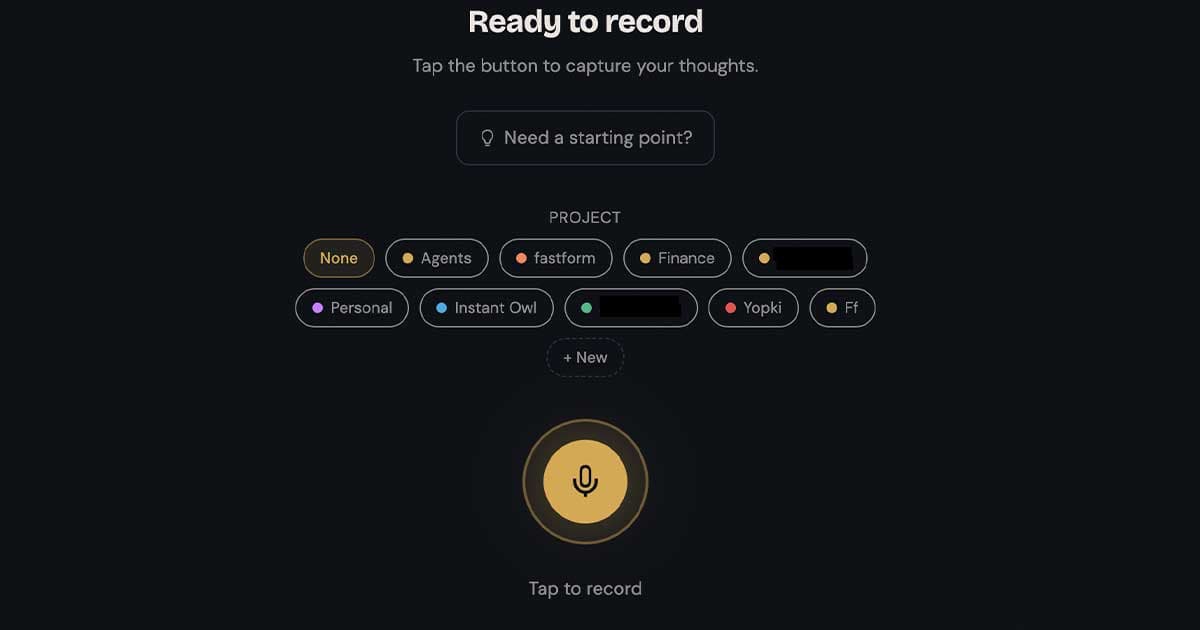
What it does is sit around the podcast, not inside it. Talk out an episode idea before you sit down to record, dictate an outline instead of typing one, or record your reaction notes right after you stop recording, while the thoughts are still fresh. The idea capture happens whether or not you are recording: waiting in line, driving to the studio, right after a guest hangs up. None of that belongs in a podcast transcript, and none of it needs a tool built for one.
InstantOwl turns that talking into an organized note instead of a wall of transcript text, the same job it does with any other rambling voice note. If you want takeaways from an episode rather than a verbatim transcript, our podcast summarizer roundup covers that separate category of tool. InstantOwl is currently free to use.
Related reading
- Podcast summarizers compared: what's actually free if you want takeaways instead of a transcript.
- How to transcribe audio to text: every real option for turning any recording into a transcript file.
- InstantOwl: organized notes and tasks from one recording, currently free to use.
Frequently asked questions
Does Apple Podcasts transcribe episodes automatically?
Yes. Apple automatically generates a transcript after each new episode is published, with new episodes needing at least 24 hours before the transcript appears, per Apple's own transcripts guide, covering 11 languages and available in more than 170 countries and regions on iOS 17.4 or later.
How do I fix errors in my podcast transcript?
Download the transcript, correct it yourself, and re-upload it. On Apple, download from Apple Podcasts Connect and relink the corrected file through the RSS transcript tag. On Spotify, download from Episodes, Details, Transcripts, Edit, fix the VTT or SRT file, and upload it back, keeping the file under 5MB with timestamps included.
How do I get a transcript of someone else's podcast?
In Apple Podcasts, touch and hold the episode and tap View Transcript, which is searchable and free. In Spotify, check the Now Playing view or the episode page, when the creator has transcripts enabled. If neither has one, download the episode audio and run it through a transcription tool like TurboScribe or HappyScribe.
What file format do podcast transcripts use?
Spotify requires a VTT or SRT file, capped at 5MB, and the file must include timestamps or it will not sync during playback. Apple accepts a direct VTT or SRT upload for subscriber episodes too, or a transcript delivered through your RSS feed using the RSS transcript tag.

Written by
Jim BreeseJim Breese is the founder of InstantOwl. He's spent 15 years building companies, from an Airbnb host community he founded and exited to growth leadership at venture-backed SaaS startups. He built InstantOwl because his best ideas kept arriving mid-walk, out of order, and half-finished.
Stop losing good ideas.
InstantOwl turns a rambling voice note into a clean, organized document in moments. Just talk. We'll organize it.
 Try InstantOwl free