Plaud Alternatives: Devices Worth It and the App That Isn't a Device
By Jim Breese ·

Do you need a Plaud device, or does your phone already do the job?
For most people searching "Plaud alternatives," the honest answer has nothing to do with which wearable to buy next. Recording, transcribing, and summarizing a conversation are software jobs. The phone already in your pocket can record; an app can transcribe and organize what it hears. Neither step requires a $159 to $189 device or the monthly plan sold alongside it.
That is not a dodge. A few competing roundups gesture at the same idea, one calling it "you don't need a device" if an app handles the job well. What follows here is the version with verified prices, dated catches, and an honest answer for the smaller group of people who genuinely do need hardware.
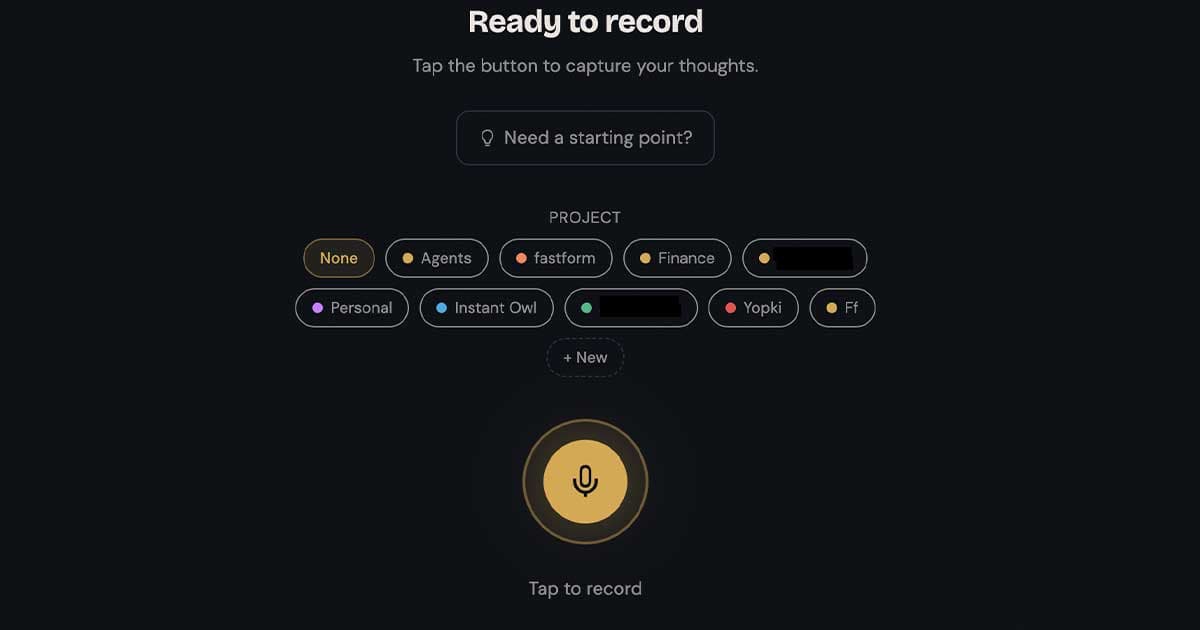
Full disclosure before anything else: InstantOwl is our product, and this is our blog. InstantOwl runs on the phone you already own. Talk into it, and the ramble comes back as an organized note with tasks pulled out automatically, no device to charge or sync. InstantOwl is currently free to use.
For meetings specifically, your phone still isn't the whole answer, since nobody wants to babysit a recorder through a Zoom call. That is what a meeting bot like Otter is for, joining from your calendar and transcribing live with no hardware involved. For polished prose instead of a raw transcript, an app like AudioPen fills that gap. None of these require carrying a second device.
Why do people search for a Plaud alternative in the first place?
The trigger is almost always the same: a shopper who already likes the form factor but does not want to pay twice. On Plaud's own user subreddit, one searcher put it plainly, weighing a "subscription-free" rival against the device they already wanted: "I love the form factor, but I'm really struggling with the idea of another monthly subscription."
That resentment is real, but the common framing of it overstates the problem. Plaud's free Starter plan includes 300 transcription minutes a month, forever, per Plaud's own pricing page. No subscription is required to use the hardware at all. The pain starts once you pass roughly 10 minutes of recording a day, since 300 minutes a month is where the free plan caps out.
Plaud's own users describe what happens past that line. A widely read thread on the Plaud subreddit, titled "Plaud, Should you buy it? (Short Answer: No)," lists "Subscription isn't worth the AI at all" among its complaints, alongside heavy app battery drain. A different commenter in the same community asked the question this whole category exists to answer: "Why isn't it just an app? Since the phone can record, the attachment seems like a gimmick to justify the price tag."
So the actual search intent behind "Plaud alternatives" splits two ways: people who want the two-payment problem gone entirely, and people who want a device that earns its price more honestly than they feel Plaud does. Both groups are covered below.
The devices, verified today
If your recording actually happens on phone calls, in rooms, or all day away from your phone, a device can still be the right call. Here is what is real, priced, and available as of 2026-08-20, including the catches most roundups leave out.
HiDock P1: $169, and sold out today
The HiDock P1 is a $169 portable recorder (marked down to $152.10 on HiDock's store today) whose real trick is capturing both sides of a phone call through Bluetooth earphones, something Plaud's Note cannot do (Plaud's call recording requires the phone's own speaker, no headphones). One catch worth knowing before you shop: the P1 product page is marked "Sold out" on HiDock's own store today, 2026-08-20, more than a month after we first found it sold out in July.
HiDock advertises "unlimited free AI transcription service, no subscription required," a real claim, but the free tier excludes speaker ID, translation, custom templates, integrations, and Auto Transcribe, according to HiDock's own HiNotes page. Paid plans run $12.99 for 1,200 minutes or $99.99 for 12,000 minutes, or $199 a year for Unlimited. Owners on Reddit describe the software as the weak point: "the software is a work in progress and its biggest negative," with to-do extraction still "a manual process today" in beta.
Mobvoi TicNote: $159.99, but the plan pricing isn't published
Mobvoi's TicNote is real and shipping today at $159.99, with free 2-4 business day shipping and a 30-day money-back window. It is a thin card-style recorder with a claimed 25-hour battery life and an agentic app layer built on top of transcription. Launch coverage describes a credit-based Pro plan, but that detail does not appear on Mobvoi's own product page, so we are not going to print a number that TicNote itself has not published.
One owner who tried Plaud, Pocket, and TicNote side by side reported the summaries and app were "lightyears better than the Pocket app currently," but stuck with Plaud anyway because Plaud has a desktop app and "Ticnote has only a Chrome extension."
Pocket: not the subscription-free option it markets itself as
Pocket is the device most often pitched as the "subscription-free" answer to Plaud, and that pitch does not hold up. Its homepage advertises "unlimited minutes for life," but Pocket Pro costs $16.59 a month billed yearly, $199 a year, for higher-accuracy transcription and unlimited Ask Pocket. The free tier's own feature list says summaries are "saved for 30 days," and owners report recordings becoming inaccessible after roughly 90 days without paying. Pricing itself is volatile: Pocket lists at $199, with a $99 launch special on its homepage as of 2026-08-20, and launch pricing that has run roughly $99 to $129 depending on when you land on it.
Owners describe the paywall arriving fast. One reported: "Day one of creating the account and my device arriving they put everything behind the subscription paywall after 14 days," and said it "left a real bad taste in my mouth." Another confirmed the recording-access window directly: "what someone said about the 90 days expiration is true unless you purchase the Pro subscription," though recordings can be exported before they expire.
A third owner said there is "no real way to get my recordings out of their ecosystem," so the device now "sits on the shelf and collects dust." Never take Pocket's "no subscription" framing at face value; it has a real paid tier and a real access limit behind the pitch.
Is the Limitless Pendant a Plaud alternative? No, and here's why that matters
No. Meta acquired Limitless on December 5, 2025, and the Pendant stopped being sold to new customers, confirmed by Limitless's own founder letter and by outside reporting. It still shows up in some "alternatives" lists anyway, months after it stopped being purchasable, which is its own warning about trusting a stale roundup.
The lesson generalizes past one device. Two of the notable AI wearable makers were bought by Big Tech within six months of each other: Bee by Amazon in July 2025, then Limitless by Meta in December 2025. A Tom's Guide review of the Plaud Note raised the same risk eleven months before the Limitless deal happened: "What happens if Plaud decides no longer to support the app? With no internal transcription, you're left with only a voice recorder."
Buying capture hardware means betting on a startup's independence, not just its product. Our full Plaud vs Limitless breakdown covers what happened and what Pendant owners should do now.
Why do plaud alternative roundups get the numbers wrong?
Because most of them are stale, and one widely read roundup shows exactly how much. It prints the Plaud Note at "$135," when the live price on Plaud's own site is $159, and lists an annual plan at "$79," when the live Pro annual plan is $99.99. The same page still describes Plaud's AI models as "ChatGPT 4o and Claude 3.5," while Plaud's current listings name GPT-5.5, Gemini 3.1 Pro, and Claude Sonnet 4.6.
The same pattern shows up around rival hardware. More than one roundup prices HiDock at "$269," a number that does not match any current price on HiDock's own store; the real P1 price is $169. None of these are small typos years old. Most of these pages were updated within the last several months and still got the numbers wrong, which is the actual argument for reading a device's own pricing page before buying anything a "best of" list recommends.
How to pick: wearable, meeting bot, or your own phone
Start with one question: does the recording you need happen on a phone call, in a room with no calendar invite, or on a scheduled video call? Each answer points somewhere different.
- Both-sides phone calls or in-person capture with no internet needed: a wearable earns its price here. Our full Plaud review covers what its Vibration Conduction Sensor actually does and which of its four devices can record calls at all (only the Note and Note Pro can; the NotePins cannot).
- Scheduled video meetings on Zoom, Teams, or Meet: skip hardware entirely. A bot handles this better than any wearable can, joining automatically and transcribing live. Our Plaud vs Otter comparison breaks down why the software cost between the two is nearly identical and the real difference is the device.
- Your own thoughts, walking to your car or at your desk mid-idea: you do not need a device at all. Your phone's built-in recorder, covered in our voice recorder roundup, already handles the capture step for free.
For that last group, capture was never the missing piece. What Voice Memos, Google Recorder, and every dedicated recorder app hand back is a file or a transcript, not an organized note. That is the gap InstantOwl closes: talk, and get back a titled note with tasks pulled out and everything organized into a project, instead of a pile of audio to sort through later. It also ingests files and YouTube links, not just live recordings. InstantOwl is currently free to use, no gadget to buy and nothing to arrive sold out.
Frequently asked questions
Do I need a Plaud device?
Only if you record phone calls or in-person conversations regularly and want that captured without opening an app. If your real need is catching your own thoughts and getting them back organized, your phone plus voice-note software does that job without $159 to $189 of hardware.
Can I use Plaud without a subscription?
Yes. Every Plaud device includes a free Starter plan with 300 transcription minutes a month, forever, per plaud.ai. That is roughly 10 minutes a day. A subscription only becomes necessary once you record more than that.
What is the best Plaud alternative?
It depends on the job. For meetings, a bot like Otter covers video calls with no hardware. For both-sides phone calls or all-day wearable capture, HiDock P1 or Mobvoi TicNote are the closest devices, each with real catches. For your own thoughts, an app like InstantOwl skips the device entirely.
Is the Limitless Pendant still available?
No. Meta acquired Limitless on December 5, 2025, and the Pendant is no longer sold to new customers, per limitless.ai's own founder letter and reporting from TechCrunch and CNBC. Existing owners keep support for at least another year.

Written by
Jim BreeseJim Breese is the founder of InstantOwl. He's spent 15 years building companies, from an Airbnb host community he founded and exited to growth leadership at venture-backed SaaS startups. He built InstantOwl because his best ideas kept arriving mid-walk, out of order, and half-finished.
Stop losing good ideas.
InstantOwl turns a rambling voice note into a clean, organized document in moments. Just talk. We'll organize it.
 Try InstantOwl free