Dictation: What It Means Now (and How to Actually Use It)
By Jim Breese ·
What does dictation mean?
Dictation means saying words aloud so someone, or something, can write them down. Merriam-Webster's dictionary defines the core sense (2a) plainly: "the act or manner of uttering words to be transcribed" and "material that is dictated or transcribed." For most of the word's history, the "someone" on the receiving end was a person.
That has changed, and Merriam-Webster's own dictionary page proves it. The site's dictation entry, updated 7 Jul 2026, includes a "Recent Examples on the Web" section pulled from live news coverage, and every single example is about speech-to-text software, not a person taking notes. PC Magazine, on 5 July 2026, warned that "most dictation tools ship your audio to a server, which adds lag and leaves your voice data on someone else's hardware." The New Yorker, in a 10 June 2026 piece by Katy Waldman, described a novelist whose "writing process consists largely of speech-to-text dictation on an Android phone."
Even the dictionary's own live corpus has flipped. The word that used to mean a boss dictating to a secretary now overwhelmingly means a person dictating to their phone. That shift is not a guess; it is what Merriam-Webster's own citation engine surfaces when you look up the word today.
Where does the word "dictation" come from?
Dictation traces to Late Latin dictare, "to say aloud words to be transcribed by another," and English adopted it in 1624, per Merriam-Webster. For centuries after that, dictation meant one specific working relationship: someone spoke, and another person, usually a secretary or a stenographer, wrote it down word for word.
The tools changed well before the meaning did. Tape recorders let people dictate letters and reports without anyone else in the room, captured in Merriam-Webster's own example sentence: "He used a tape recorder for dictation." Software-based dictation followed: Dragon, once the industry's gold standard for computer dictation, turned a desktop microphone into a working stenographer.
Then phones absorbed the whole job. Every modern smartphone keyboard now ships a microphone icon that does what a secretary, then a tape recorder, then Dragon used to do: turn spoken words into written ones, on demand, for free. That arc, secretary to tape recorder to desktop software to pocket keyboard, is the real story behind a word most people think they already know.
The tools got dramatically better recently, too. Per Wirecutter's own 2026 testing, when it first tested dictation software in 2023, accuracy ranged from 54% to 87%. By its June 2026 retest of 19 tools, every single one scored at least 94% accurate. Dictation did not just move to a new device. It got good enough to trust.
What is dictation in the classroom?
In school, dictation is a teacher or parent writing down a child's spoken words, then reading them back, so the child can see their own thinking turned into print. Reading Rockets, a literacy education resource, defines it directly: "Dictation is the process of writing down what someone else has said. With young children, dictation offers a way for a parent or a teacher to record a child's thoughts or ideas when the writing demands surpass writing skills," per Reading Rockets.
The basic classroom version runs in five steps, per Reading Rockets: a child draws a picture of something familiar, like family or a pet; the teacher asks for one or two sentences about it; the teacher writes those words at the bottom of the picture and reads them back; the teacher models sound-to-letter matching out loud while writing ("I'm going to write the word mmmmmmoon. What sound is at the beginning?"); and the child reads the finished sentence aloud. A group version works the same way with a shared story, built and re-read together.
The point is not the transcript. Reading Rockets frames dictation as a way to show a child that speech can be written down and read back, building phonics, spelling, and writing conventions before a child's hand can keep up with their ideas. Reading Rockets is also candid about the limits of the evidence: "some of the writing research involving dictation comes from a whole language perspective," so treat it as one classroom tool among several, not a proven cure.
Music has its own dictation, worth one line: Merriam-Webster's sense 2b covers "the performing of music to be reproduced by a student," an ear-training exercise where a student writes down notes or rhythms they hear. Same root word, same core idea: something is spoken, or played, and someone else writes it down.
How do you dictate on your phone, computer, or Mac?
Every major device already has dictation built in for free, and it is usually one settings toggle away. The tools differ in what they can hear, how they punctuate, and what happens when you pause to think, which is exactly where most of the frustration lives.
Built into the device you already own
On a Mac, turning on dictation takes a single toggle in Keyboard settings and a shortcut like Option-Z, and it debunks a persistent myth: Apple's own dictation has no length limit at all. The 30-second figure people repeat is a silence cutoff, not a cap on how long you can talk.
On Windows 11, voice typing opens with Windows key+H, but it needs an internet connection because it runs on Azure Speech in the cloud. A separate, on-device feature called Voice Access works offline and controls the whole PC, not just a text box, which is a distinction most people never learn until they go looking for it.
On Android, voice to text runs through Gboard's microphone icon on any phone running Android 7.0 or later, while Pixel 6 and later devices unlock a deeper Advanced voice typing mode with automatic punctuation and voice commands, in six languages only.
Inside a browser, Google Docs' Tools > Voice typing dictates in more than 100 languages, but only on desktop, and only in Chrome, Edge, or Safari; it is not in the Docs mobile app at all.
Dedicated dictation apps
If a built-in tool feels too basic, the best dictation software available in 2026 leans on two standouts: Wispr Flow, which Wirecutter measured at 98% accurate with cloud-based AI cleanup, and Superwhisper, which runs locally on your device by default and offers a one-time lifetime purchase instead of a subscription. Full details on cost, privacy defaults, and honest downsides live in our Wispr Flow and Superwhisper reviews.
What is the difference between dictation, transcription, and voice capture?
Dictation, transcription, and voice capture solve three different problems, even though people use the words interchangeably. Dictation happens live: you speak, and text appears at your cursor as you talk, the way a dictation app or Google Docs voice typing works. Transcription starts with audio that already exists, a recording or a meeting, and turns it into a document afterward. Voice capture is different again: you speak messy, half-formed thoughts, and what comes back is organized notes, not raw text.
Wirecutter draws the first boundary itself, stating plainly that its dictation guide is "focused on turning your speech into text on your computer or phone in real time," and pointing readers elsewhere for already-recorded audio. Dictation and transcription are separate jobs even to the tool that reviews both. Voice capture completes the triangle: it is the right tool when you do not yet know what you want to say, only that you need to say it out loud before it disappears.
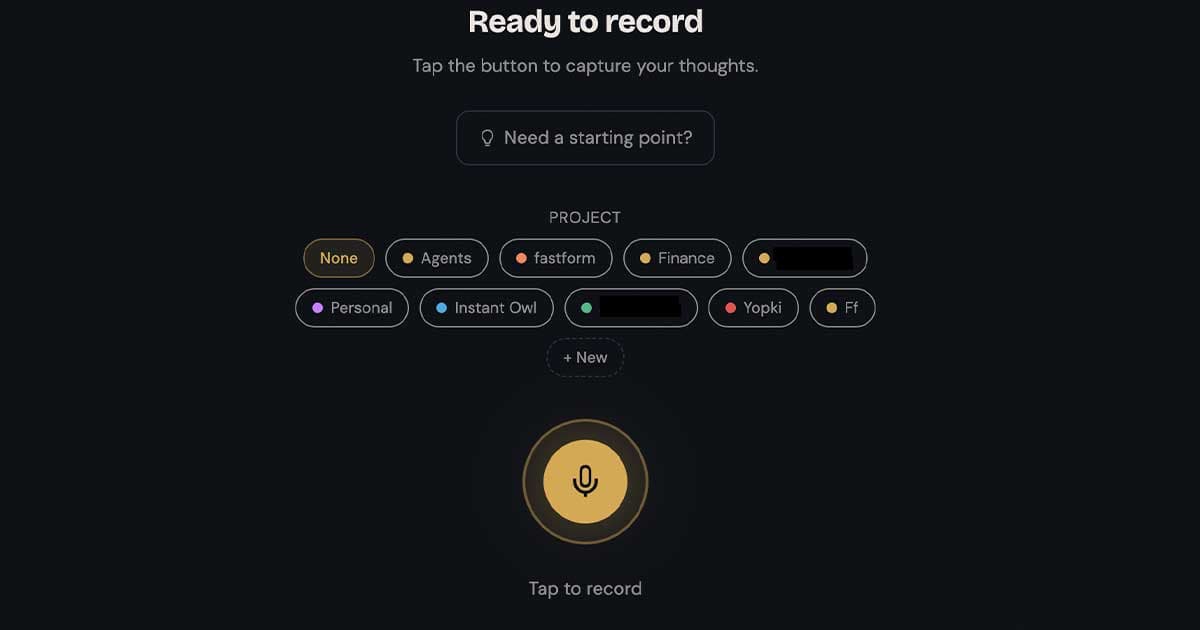
Full disclosure: InstantOwl is our product, and this is our blog. Dictation software has one job, typing your finished sentence into a cursor, which assumes you already know what that sentence is. InstantOwl is built for the moment before that, when what comes out of your mouth is a ramble rather than a finished thought, and what you actually need back is organized notes or a task list instead of a wall of typed text. InstantOwl is currently free to use.
Who does dictation help most?
Writers, people with accessibility needs, anyone managing RSI, and people who think out loud all get outsized value from dictation, each for a different reason. Writers use dictation to draft faster than they can type, at the cost of a real learning curve and an editing pass afterward; our guide to how writers actually use dictation covers what that workflow looks like in practice, tool by tool.
For people with visual, motor, or learning disabilities, dictation removes typing as the bottleneck between a thought and a written word entirely. Windows Voice Access was built with exactly this audience in mind, and Reading Rockets' classroom use of dictation exists for the same underlying reason: writing demands can outrun a person's current writing skill, at any age.
Anyone managing repetitive strain injury gets a direct trade: speaking instead of typing removes the physical motion that causes pain in the first place, without asking them to write less.
People who think out loud, meaning they talk through an idea before they know exactly what they want to say, are the trickiest fit for dictation as built. Dictation tools expect a mostly-formed sentence and can punish pauses, cutting out after seconds of silence exactly when someone stops to think. That gap is real, and it is the reason capture-first tools built around messy, unstructured thinking exist alongside dictation rather than instead of it.
Related reading
- Dictation software: full rankings, pricing, and the story of what happened to Dragon.
- Wispr Flow: pricing, privacy defaults, and real user reviews for the top cloud pick.
- Superwhisper: pricing history and honest downsides for the local, offline-first pick.
- Transcription: what to do with audio that already exists, instead of live speech.
Frequently asked questions
What does dictation mean?
Dictation is the act of saying words aloud for someone, or something, to write down, per Merriam-Webster. The someone used to be a person, like a secretary or a teacher. Today, per Merriam-Webster's own 2026 usage citations, the someone is almost always speech-to-text software.
Is dictation the same as transcription?
No. Dictation happens live: you speak, and text appears at your cursor in real time. Transcription starts with audio that already exists, like a recording or a meeting, and turns it into a document afterward. They solve different problems, even though people use the words loosely.
What is dictation in school?
In school, dictation is a teacher or parent writing down a child's spoken words, then reading them back, per Reading Rockets. It models letter formation, punctuation, and sound-to-letter matching for children whose ideas move faster than their writing skills. It is mostly used in kindergarten and early elementary classrooms.
How accurate is dictation now?
Very. Wirecutter's June 2026 testing of 19 dictation tools found every single one at least 94% accurate, up from a range of 54% to 87% when it first tested tools in 2023. Wirecutter's top pick, Wispr Flow, scored 98% accurate in that same testing.

Written by
Jim BreeseJim Breese is the founder of InstantOwl. He's spent 15 years building companies, from an Airbnb host community he founded and exited to growth leadership at venture-backed SaaS startups. He built InstantOwl because his best ideas kept arriving mid-walk, out of order, and half-finished.
Stop losing good ideas.
InstantOwl turns a rambling voice note into a clean, organized document in moments. Just talk. We'll organize it.
 Try InstantOwl free