Voice Notes for Contractors: Capture Is Easy, the After-Work Isn't
By Jim Breese ·

Why capture was never the hard part
Capturing a voice note on a jobsite costs nothing and takes no skill. Every phone already has a recorder, and talk-to-text is built into iPhone and Android. That is not where contractors say they struggle.
On r/ConstructionManagers, a project manager asked how everyone else takes notes, and one construction manager described exactly this split: "I'll use talk to text on notes for my iPhone. And copy and paste from that later for vendor follow ups." The recording happens instantly. The copy-and-paste happens later, by hand, every time.
The same person named the cost of skipping that step: "You will wake up freaking out in the middle of the night if you don't record your lists somewhere. The 2 a.m. horrors suck." That is not a productivity complaint. It is what it feels like to carry a job's details in your head because nothing downstream of capture is doing the organizing for you.
On r/Construction, a site manager described the same gap from the photo-and-scrap side: random photos in the camera roll, a few voice notes sent over WhatsApp, tasks scribbled on paper or half-written in the Notes app. One reply pushed back hard on the idea that this needs a dedicated app at all: "Literally every phone has all you need... Why would anyone pay for apps that already exist in a product you've already purchased?" That skepticism is fair on its face. Your phone really does record, transcribe, and store notes for free.
The rebuttal came from inside the same thread, and it names the actual cost: "how long does organising the photos and writing up a report take you?" Nobody was arguing that capture is hard. The argument was always about what happens after you stop talking.
The phone-versus-notebook problem, from the person who lives it
The project manager who started the r/ConstructionManagers thread described a dilemma most field notes advice skips: "The phone is effective for quick notes but you look like a jerk when you're on it while meeting with other people. The notebook is hard to write on while walking and impossible to organize."
Two paper users in the same thread pushed back in the notebook's favor, describing a leather portfolio that "looks professional" because clients "would rather see you care vs. not." That is a real point. A notebook signals attention during a walkthrough in a way a phone screen does not.
The fix does not have to be picking a side. Talk to your phone after the walkthrough, in the truck or back at the tailgate, instead of during it. You get the notebook's in-person courtesy and the phone's speed, without typing anything twice.
There is also a memory camp, and the thread settled that argument itself. One top comment argued for going without any notes at all: "You just gotta be a steel trap bud." Another reply answered it directly: "This method works great until you have to prove anything." Memory is fine until a client disputes what was said on-site, and at that point an unwritten conversation is worth nothing.
What to capture on a site visit
A walkthrough generates more useful detail than most contractors write down in the moment, because writing it down in the moment is slow. Talking it out as you walk captures the same detail at the speed you actually move through a job.
Walkthrough debriefs. Right after a walkthrough, before the next site erases it, talk through what you saw room by room: condition notes, measurements before they slip your mind, and anything you told the client you would look into.
Punch-list items. Walk the job talking through everything that needs fixing: "master bath caulk, touch up paint on stair stringer, order two more sheets of cement board." Said out loud, that is just a list of observations. Run it through an app that extracts tasks, and it becomes an actual checklist instead of a paragraph you have to reread and split apart yourself, the same idea covered in full in voice to-do lists.
Change-order conversations. Capture the scope, materials, and dollar figures a client agreed to while the conversation is still fresh in your head. A voice note is not a signed change order. Get the agreement into your contract paperwork; the recording just makes sure you write it down accurately instead of from memory a day later.
Safety observations. A tripping hazard, a missing guardrail, a sub working without the right PPE: say it the moment you see it, so it exists somewhere before you forget it existed at all.
Client promises. Anything you committed to on-site (a callback, a sourcing question, a date) belongs in the same debrief. This is the exact detail that turns into a dispute later if neither side wrote it down.
Where Raken and KYRO fit, and where they do not
Raken and KYRO are real, org-level software that companies buy to run compliance and dispute-defense paperwork. That is a different job from the one this post is about, and worth naming honestly instead of pretending it does not exist.
Raken builds the official daily report: work logs, photos, safety checklists, cost codes, and weather, submitted by field supervisors and foremen and rolled up for general contractors. Raken's own page on daily reports frames the purpose plainly: daily reports "protect firms from litigation and prevent delays." That is compliance software, bought at the company level, not a personal capture tool.
KYRO, on its construction page, markets more than 50 customizable digital forms (site inspections, safety audits, daily logs), photo uploads, voice notes with AI translation, and GPS-verified timesheets, under the headline "Say goodbye to communication gaps." The page lists pricing at $500 a month for unlimited users, no implementation fees. That is a platform a company deploys across a crew, not a note-to-self tool.
This need is not new. In 2014, For Construction Pros covered NoteVault, a service that had a person, not software, type up your jobsite voice notes overnight. Its pitch, from co-founder Derick Downs, was "you just talk, hit send and you're done," with each note "transcribed and automatically emailed the next day in text as a PDF Daily Report to project stakeholders."
It cost $20 a month per user, or $199 a month for unlimited use. Contractors have been paying to turn spoken jobsite notes into organized text for over a decade. What changed is the wait and the price, not the need itself.
If your company needs the official daily log a general contractor collects across a crew, that is Raken or KYRO's category, not this post's. What follows is the layer underneath that: your own walkthrough notes, punch lists, and client debriefs, upstream of whatever ends up in the official report.
The driving-between-sites rule
If a thought hits you between jobsites, wait until it is safe to capture. That means hands-free and eyes-up: a voice assistant you trigger without touching the phone, or a recording you start with one tap before you pull out and stop with one tap after you park. Never scroll, type, or fiddle with an app while the truck is moving.
A punch-list item can wait ninety seconds. Nothing you would record from a truck is worth glancing down for. The full driving-safety rule, with the toolkit that respects it, is in hands-free note taking.
Multilingual crews, briefly
Multilingual crews are the norm on plenty of U.S. jobsites, and it shows up in how contractors talk about giving instructions across a language gap. On r/Construction, one contractor described the workaround crews already use: Google Translate "with a lot of finger-pointing, walking and hand gestures," while distrusting the app for anything technical, like describing a reveal. Vertical tools including KYRO now market voice capture with native-language translation for field crews. InstantOwl does not currently offer translation; if your crew needs it, that is a feature to look for in the compliance-category tools above.
Where InstantOwl fits
Full disclosure: InstantOwl is our product, and this blog belongs to it. We are not trying to be Raken or KYRO, and we do not do compliance reporting, litigation-defense documentation, or crew-wide daily logs. What InstantOwl does is take the walkthrough you just talked through and turn it into something usable before you get back in the truck.
Say your punch list out loud and task extraction turns it into a checklist, not a paragraph you have to reread and break apart yourself. That is the direct answer to the talk-to-text-then-copy-paste problem czechmixing described above: the retyping step goes away.
Client-walkthrough debriefs work the same way. Speak everything the client said, decided, and waffled on right after the walkthrough, and get back an organized, dated note instead of a memory you are trusting to hold until you write it up that night.
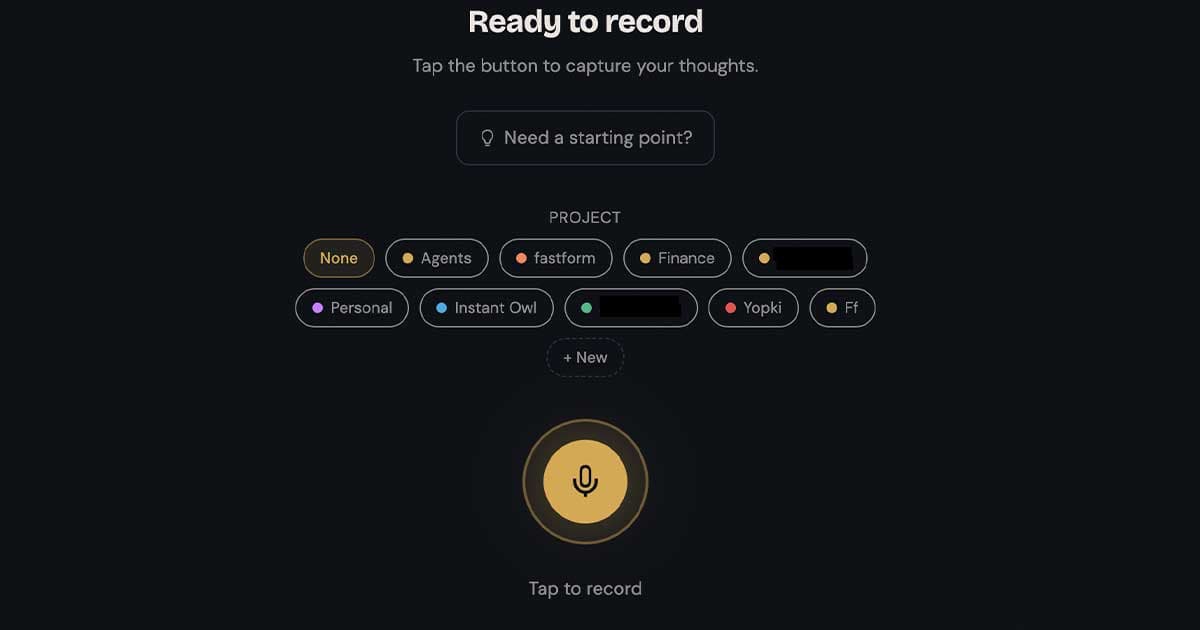
Change-order details get the same treatment: capture the scope and numbers while they are fresh, then carry them into your actual contract paperwork, per the guardrail above. Recordings organize by project too, so a punch list from Tuesday's walkthrough does not end up mixed in with Thursday's bid notes. InstantOwl is currently free to use.
The honest answer to "my phone already records for free" is: yes, it does. The paid-for part was never recording. It is turning what you said into a checklist, a dated note, and something you can find again next week, so the evening write-up stops eating your evening. The same capture-versus-after-work gap shows up in other fast-moving jobs too, like the call debriefs covered in voice notes for sales.
Related reading
- Voice notes for sales: the same capture-versus-after-work split, for the sales call debrief instead of the jobsite walkthrough.
- Voice to-do lists: every real way to turn a spoken list into an actual task list, punch lists included.
- Hands-free note taking: the full driving-safety rule and toolkit for capturing while your hands are busy.
Frequently asked questions
What is the best voice notes app for contractors?
It depends on what you need it to do. For the official daily report your company files for compliance and dispute protection, Raken or KYRO are purpose-built. For your own walkthrough notes, punch lists, and client debriefs, a capture-and-organize app like InstantOwl fits better, since it turns a rambled recording into a task list instead of leaving you a transcript to sort through.
Can I do daily logs by voice?
You can capture the raw material by voice, but a true daily log is an org-level record: crew counts, hours, weather, safety checklists, and photos filed against a project for compliance. Tools like Raken build that structured report from field input, voice included. A personal voice note app captures your own account of the day; it does not replace the official log your company files.
Is a voice note a legal record on a construction project?
No. A voice note is how you capture the details of a conversation accurately while they are fresh, not a substitute for signed paperwork. If a client agrees to a change on a walkthrough, that agreement still needs to land in a written change order. Treat the recording as your memory aid for writing the real document, not as the document itself.
How do I take notes hands free on a jobsite?
Talk into your phone's voice recorder or a capture app while you walk the site, since your hands are already full with a tape measure, a clipboard, or tools. Save any notes for the truck if you are driving between sites; open the recording after you park, not while the vehicle is moving.

Written by
Jim BreeseJim Breese is the founder of InstantOwl. He's spent 15 years building companies, from an Airbnb host community he founded and exited to growth leadership at venture-backed SaaS startups. He built InstantOwl because his best ideas kept arriving mid-walk, out of order, and half-finished.
Stop losing good ideas.
InstantOwl turns a rambling voice note into a clean, organized document in moments. Just talk. We'll organize it.
 Try InstantOwl free