Bullet Journal: How the Method Actually Works (and Who It's For)
By Jim Breese ·
What is a bullet journal, exactly?
A bullet journal is a mindfulness practice that works like a productivity system, built entirely around a plain notebook. The official definition, from Ryder Carroll's Bullet Journal FAQ, states it directly: "The Bullet Journal method is a mindfulness practice that works like a productivity system." That single sentence is doing two jobs at once, and separating them is the fastest way to understand the method.
The method splits into the System and the Practice. The FAQ describes the difference this way: "The System focuses on What you're doing, providing tools to capture and organize your thoughts. The Practice focuses on Why you're doing what you're doing, providing rituals to help you shed distractions and keep your actions aligned with your values." The System is the mechanics covered below: rapid logging, bullets, collections, migration. The Practice is the reflection those mechanics create room for.
You do not need art supplies, washi tape, or a dot-grid notebook to start. The official requirement is one sentence long: "A notebook and something to write with." The same page adds, "Bujo isn't about what notebook to use but how to use your notebook." If Pinterest spreads have made bullet journaling look like a craft project, that is a decoration layer some people add later, not the method itself.
That distinction matters most for anyone who has already tried bullet journaling once and quietly given up. If what stopped you was the pressure to make each page look like an Instagram spread, the problem was never the method. It was mistaking the decoration for the requirement.
How to bullet journal: the four moving parts
Bullet journaling is built from four parts: rapid logging, bullets (also called signifiers), a small set of collections, and migration. Each one is a specific technique from the official method, not a style choice, and together they are the entire System.
Each part solves one piece of the same problem: capture something quickly now, and be able to make sense of it later without rereading pages of prose. Rapid logging handles the "quickly" half. Signifiers, collections, and migration handle the "make sense of it later" half.
Rapid logging
Rapid logging is the language the method is written in. The FAQ calls it "a cornerstone of the Bullet Journal method," describing it as "quickly jotting down information in a concise and structured manner with the use of Bullets." The official example strips a full sentence down to its essentials: "I bought cake at the local bakery today and went home" becomes "Bought cake and went home."
That brevity is intentional. Short entries let you "record our thoughts and lives without falling into rumination," per the same source. You are not writing a diary entry about buying cake. You are logging that it happened, in about as many words as it takes to say it.
Bullets, or signifiers
Every rapid-logged entry starts with a signifier that marks what kind of entry it is. The official method defines three, plus three additional marks for tracking a task's status:
| Signifier | Meaning | What it's for |
|---|---|---|
| • | Task | An actionable item you need to do |
| O | Event | A date-related entry, scheduled ahead or logged after it happens |
| – | Note | Facts, ideas, or observations worth remembering but not immediately actionable |
| X | Task complete | The task is done |
| > | Task migrated | The task moved forward into the next Monthly Log or a Collection |
| < | Task scheduled | The task moved backward into the Future Log |
That is the whole vocabulary. Three base marks and three task states are all you need to log a full day.
Collections, and the Index
Collections are, in the official FAQ's own words, "collections of information and events." The method builds on four core ones:
- Index. Leave the first couple of pages of your notebook blank and label them "Index." As you fill the notebook, add each new topic and its page number so you can find it again later.
- Future Log. An overview of the year ahead. You graph the pages by number of months, for example two equally spaced horizontal lines across facing pages to lay out a six-month calendar.
- Monthly Log. An overview of the month, split across two facing pages: a Calendar Page on the left and a Task Page on the right.
- Daily Log. The page you actually use day to day. Record the date as your topic at the top, then rapid log your tasks, events, and notes throughout the day as they happen.
The Index is the piece most beginners skip and most regret skipping. Without it, a notebook that has been in use for three months turns into a search problem every time you want to find something you wrote in week two.
The Index also compounds. Two entries in it are not worth much, but twenty are, once a single topic, say a recurring project or a running list of gift ideas, has scattered itself across a dozen Daily Logs. The Index is what turns that scatter back into something you can find in seconds instead of flipping pages.
Migration
Migration is the ritual that keeps the notebook honest, usually done around the start of your second month. The FAQ is explicit that it is not busywork: "Migration is more than just rewriting your to-dos, it's about taking time to ask what is important to keep." In practice, you go through your open tasks, mark completed ones X, strike through anything no longer relevant, and turn the bullet of anything still worth carrying forward into a > before rewriting it in the new Monthly Log or a Collection.
The rule that makes migration work is a filter, not a chore: "If an entry isn't worth the effort to rewrite, then it's probably not that important." The point, per the same source, is "to distill the things that are truly worth the effort... and to separate the signal from the noise." A task you have now rewritten three months running without doing it is telling you something.
Why the method works, and where people bounce off
The bullet journal method works because it is deliberately plain, and it fails for the same reason most journaling habits fail: people try to make it look good before they have made it a habit at all. Kendra Adachi of The Lazy Genius captures the plainness with a memorable comparison: a bullet journal "is like a potato," bland on its own but capable of becoming whatever you actually need. She also makes a practical claim worth taking at face value: it "can be set up in the next five minutes."
Adachi's most useful advice is a warning, not a tip: she encourages beginners not to go looking at other examples of bullet journaling yet, because so many of them are pages dolled up with washi tape, calligraphy, and intricate doodles. Looking at someone else's finished, decorated notebook before you have filled even one page of your own sets an impossible bar and makes the blank first page feel like a failure before you have started.
That warning matches the exact insight our guide to journaling already covers: friction, not motivation, is usually what kills a habit, not lack of willpower. A bullet journal with hand-lettered headers and color-coded washi tape is more friction, not less, for someone who has not yet built the daily habit of opening the notebook at all.
Ryder Carroll's own reassurance for the days the habit slips is worth keeping close: "there's no such thing as falling off the wagon. It's only an opportunity to begin again." Migration, described above, is built for exactly this. You are never supposed to have a perfect unbroken streak. You are supposed to have a system that makes restarting easy.
Is bullet journaling still a thing? And is it good for ADHD?
Yes, bullet journaling is still widely practiced. It has an active dedicated community, including a large r/bulletjournal community on Reddit, still building on Ryder Carroll's original System years after he introduced it, and the official bulletjournal.com FAQ referenced throughout this guide is still maintained as the method's canonical reference.
Part of why it has held up is what it does not depend on. It needs no subscription, no app that might shut down, and no feature update that changes how it works. A notebook you filled five years ago still opens exactly the way it did the day you wrote in it, which is a different kind of durability than most productivity trends get to claim.
For ADHD or racing-mind readers, the appeal is specific: rapid logging gives you one place for tasks, events, and notes, with almost no ceremony before you can write. You do not have to decide in advance whether something is a task or a thought worth keeping. You write a bullet, pick a signifier, and move on. That low-ceremony capture is close to what a journal app tries to offer digitally, just done with a pen instead of a screen.
The honest caveat matters here. The same analog friction that makes bullet journaling mindful, the deliberate act of finding the notebook and picking up a pen, is exactly what loses a fast thinker in the ten seconds an idea takes to arrive and disappear. If you have ADHD and a thought only stays available for a few seconds, a notebook that is not already open and in hand is, for that moment, as good as not existing. That gap is real, and it is the honest bridge to the next section.
Paper method, fast mind: where voice fits
Bullet journaling is a paper method by design. Ryder Carroll's whole point is analog: the deliberate act of picking a signifier and writing a few words is part of what makes rapid logging work, and nothing here is a suggestion to trade the notebook for a screen. If the paper practice already works for you, keep it exactly as it is.
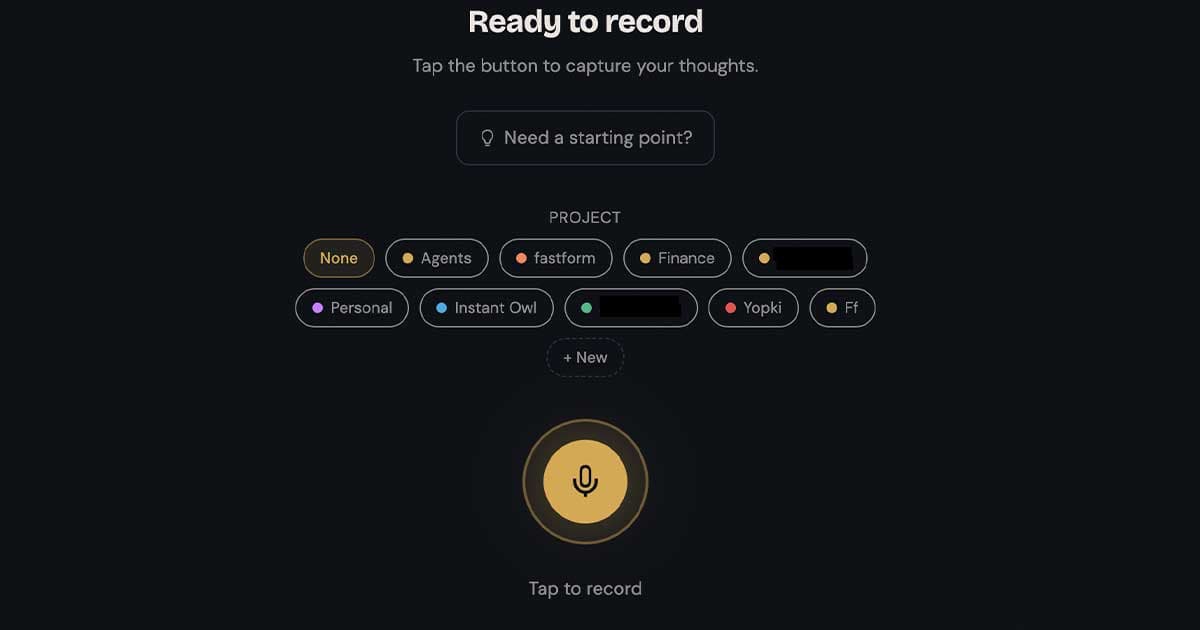
Where a gap actually shows up is capture speed for entries you cannot get to a notebook fast enough to catch: driving, walking, mid-task, or lying in bed after the light is already off. In those moments, saying a task, event, or note out loud into InstantOwl is faster than reaching for a pen, and it gives you a transcript to rapid log or migrate into the notebook once you are back at it. The Practice, the reflection that happens when you actually write the bullet down, stays intact. Voice only removes the bottleneck of capturing the raw thought before it is gone.
In practice, that looks like saying something close to what you would have rapid logged anyway: "Task, call the dentist. Note, the pitch idea from the drive home was about pricing, not features." You are not narrating a diary entry into the void. You are speaking the same short, structured fragments the method already asks for, just before the pen is available instead of after.
This is the same relationship a written journal has with speaking instead of writing, covered in our guide to keeping a voice journal: the format that captures fastest is not always the format you reflect in, and the two can work together instead of competing. InstantOwl is currently free to use, and this is a light complement to the notebook, not a pitch to replace it.
Related reading
- How to journal: the beginner's guide to what to write and how to stay consistent, whatever format you use.
- Journal apps: how digital journaling compares to a paper bullet journal.
- Voice journal: keeping a journal by speaking instead of writing.
- ADHD: why standard productivity advice backfires for ADHD, and what actually works.
Frequently asked questions
What is a bullet journal exactly?
A bullet journal, or BuJo, is Ryder Carroll's mindfulness practice that works like a productivity system. It has two halves: the System, which is how you capture and organize tasks, events, and notes, and the Practice, which is why you are doing it. All it requires is a notebook and something to write with.
How do you start a bullet journal for beginners?
Open any notebook, leave the first couple of pages blank for an Index, then start a Daily Log by writing today's date and rapid logging your tasks, events, and notes as they happen. Skip decorating it first. Kendra Adachi of The Lazy Genius recommends setting one up in the next five minutes rather than researching the perfect layout.
Is bullet journaling good for ADHD?
It can be, because rapid logging gives a racing mind one low-ceremony place to dump tasks, events, and notes without deciding where each one belongs first. The honest tradeoff is that the same analog friction that makes the method mindful, finding the notebook and picking up a pen, is what loses fast thinkers in the moment an idea actually arrives.
Do you need a special notebook or app for bullet journaling?
No. The official method states plainly that a bullet journal is not about what notebook to use but how to use your notebook. Any plain notebook and a pen are the whole method. Dot-grid notebooks and bullet journal apps are optional conveniences, not requirements.

Written by
Jim BreeseJim Breese is the founder of InstantOwl. He's spent 15 years building companies, from an Airbnb host community he founded and exited to growth leadership at venture-backed SaaS startups. He built InstantOwl because his best ideas kept arriving mid-walk, out of order, and half-finished.
Stop losing good ideas.
InstantOwl turns a rambling voice note into a clean, organized document in moments. Just talk. We'll organize it.
 Try InstantOwl free