Note-Taking for ADHD Students: What a Real Study Found (and Didn't)
By Jim Breese ·

Do ADHD students struggle with taking notes?
Yes, commonly, and it is mechanical, not a motivation problem. Note-taking asks you to listen, decide what matters, hold the words in working memory, and write, all at the same time, and an ADHD brain is already spending extra effort just regulating attention. An occupational therapist writing about classroom accommodations puts it plainly: for some students, the brain can write or listen, but not both at the same time.
That tradeoff shows up in the research too. A 2025 study of 152 college students found that higher ADHD symptoms correlated with slower handwriting speed and lower recall on a quiz taken right after a lecture. Students describe the same thing in their own words: one Reddit poster, describing her own note-taking struggles, said she used to end up "just zoning out and mindlessly copying" instead of actually listening.
Here is the kind part, and it is not a consolation prize: the same study found that students with higher ADHD symptoms who took notes, in any format, learned more than similarly high-symptom students who took no notes at all. Skipping notes was the costliest choice, especially for the students who find note-taking hardest. The fix is not more willpower. It is a format that fits how your brain actually works.
What does the research actually say about ADHD and note-taking?
The most useful answer comes from an actual randomized study, not a blog post repeating a stereotype. Researchers Shimko and James at Indiana University ran a controlled experiment, published in Educational Psychology in 2025 and available to read in full. It is worth citing precisely, because a lot of coverage blurs what it actually found.
The setup: 152 college students (73% women, average age 19.2, with 46 of them, about 30%, self-reporting an ADHD diagnosis) were split into three groups. One group handwrote notes, one typed notes, and one took no notes at all, while all three watched the same 15-minute TED Talk about astronomy. Afterward, everyone took a 20-question recall quiz with no chance to review their notes first.
The headline result: both note-taking groups significantly beat the no-notes group. Handwritten notes averaged 66.3% on the quiz, typed notes averaged 64.7%, and no notes averaged 57.9%. The gap between taking notes and not taking notes was larger than the gap between handwriting and typing.
The ADHD-specific finding matters more than the overall average. Students with higher ADHD symptoms who actively took notes, in either format, learned more than students with similarly high symptoms who took no notes. Put differently, skipping notes was the most costly choice for exactly the students who often find note-taking the hardest to sustain.
One honest caveat from the researchers themselves, worth repeating rather than glossing over: higher ADHD symptoms still predicted lower recall in every condition, even after controlling for stimulant medication use. Notes help. They do not close the whole gap by themselves.
Does typing beat handwriting for ADHD students?
No, and this is the part search results tend to get wrong. The researchers actually expected typing to win, since it removes some of the physical demands of handwriting. When they ran the direct comparison, there was no significant difference between typed and handwritten notes for students with higher ADHD symptoms.
What did correlate with ADHD symptoms was individual handwriting speed, not typing speed. Slower handwriting tracked with higher symptom scores, while typing speed showed no such relationship. The researchers' own interpretation is useful here: typing may remove a transcription-speed bottleneck for students whose handwriting lags, so, in their words, "the optimal modality may depend on individual transcription abilities." ADDitude's coverage of the study reaches the same conclusion: pick the format that lets you actually keep pace, because neither one wins on its own.
Two limits worth naming honestly. The sample was a mostly non-clinical group of college students, self-reporting ADHD symptoms rather than a clinically diagnosed cohort, and the lecture was a single 15-minute lab video, not a real class session with slides, discussion, and interruptions. Treat this as a strong, useful signal rather than the final word on every classroom.
What note-taking strategies actually fit this research?
The strategies that hold up are the ones that reduce how much you have to build from a blank page in real time, not the ones that pick a "winning" pen or app. An occupational therapist writing about ADHD and classroom accommodations describes three layers that work together: give access to the information itself (slides or reading in advance, printed or digital copies, photographing the board), reduce how much copying is required (chunking, highlighting, built-in pauses), and structure the note-taking itself (guided notes, fill-in-the-blank templates, doodle notes). Each layer removes friction before the pen or keyboard even gets involved.
Inside the notes themselves, ADDitude's Susan Kruger, M.Ed., lays out concrete, low-effort tactics: date every page, fold the left third of the page into a column for summary questions later, mark anything the teacher flags as test material with an asterisk, use personal shorthand, leave blank space instead of cramming, and review within 24 hours while the lecture is still fresh. Her rule of thumb is worth keeping in your head: "your notes have to make sense only to you," so paraphrase in your own words instead of chasing every sentence verbatim.
A few smaller habits round this out. If a distraction pulls you away mid-lecture, expect refocusing to cost real time, roughly 23 minutes on average according to research from Gloria Mark at UC Irvine, which is one more reason a structured template beats starting from nothing after a break. An unfinished thought from a lecture that keeps nagging at you afterward is a familiar pattern too, sometimes described as the Zeigarnik effect, a general tendency for unfinished things to stick in memory more than finished ones. Jotting even a half-formed note is often enough to let it go.
Time estimates for ADHD tend to run both directions, a task looking smaller than it is until it eats an hour, or looking impossible until a timer proves it only takes ten minutes, so a short timer for review sessions can do real work. For longer study blocks, studying alongside another person, even silently, is a tactic both Georgia Behavioral Health (in tips from Dr. Neha Khurana, MD) and ADDA list among practical ADHD strategies, sometimes called body doubling.
Should you record your lectures?
Recording can genuinely help, but only with permission, and only if you will actually use what you recorded. Students describe both sides of this honestly. In one note-taking thread, a student wrote: "For live classes, record the lectures on a voice memo!" She said the recording let her pause, process, and write more accurately, and that she never fully trusts her own written notes without something to check them against.
The cost is just as real. That same student estimated she "often spent an hour (or more) on a 20 minute lesson" reviewing what she recorded, even though she said it saved her more study time overall. A recording is not free capture. It moves work to later instead of removing it, so it only pays off if you actually block time to listen back.
Permission comes before any of this. Check your syllabus and your university's recording policy first. Many schools already run official lecture capture that covers what you need without you recording anything yourself. If nothing is stated, ask the professor directly rather than assuming. Recording permission is also commonly available as a disability accommodation through the disability services office, which is worth knowing if attention or processing speed is part of why note-taking is hard for you. None of this is legal advice, and policies vary by school, so when in doubt, ask first.
For the fuller mechanics of building a lecture workflow, our guide to taking lecture notes and our closer look at voice notes for students cover the recording rules and the tools in more depth.
Can talking work better than writing for ADHD note-taking?
Sometimes, but only for one specific moment: capturing your own thinking after the fact, not recording someone else's lecture word for word. Talking is faster than writing for almost everyone, and it removes the blank page, but that is a different job than transcription.
Right after class, while the lecture is still fresh, speaking a two-minute recap in your own words is a form of active processing many students find easier than writing one out cold. That is a reasonable extension of the study's finding that actively working with the material helps, but the study itself never tested spoken recaps, so treat this as a sensible strategy, not a proven one.
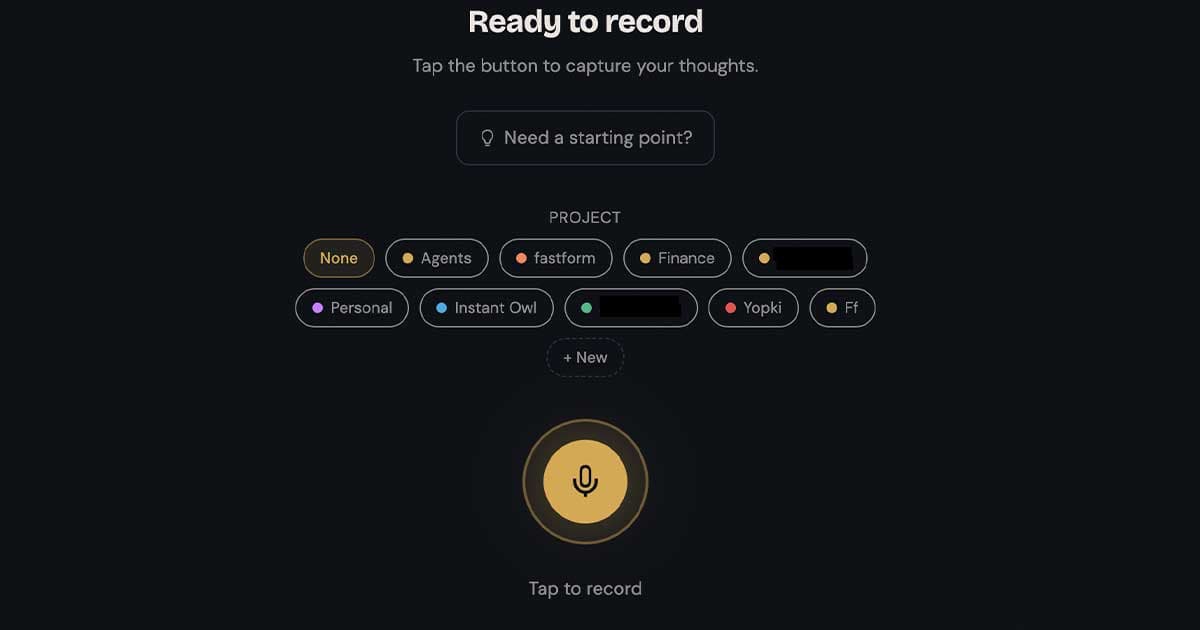
Before a study session, the same idea works in reverse: talk through everything swirling in your head about the material instead of staring at a blank document, and let the sorting happen after you have said it. That gap, a fast spoken ramble that still needs to become something usable, is what InstantOwl is built for, and it is worth being upfront that this is our product.
It is not a lecture recorder, and we are not pitching it as one. It fits the after-class debrief and the pre-study brain dump: you talk, and it comes back as organized notes or a summary instead of a transcript you still have to sort through by hand. It is currently free to use. For capturing the actual lecture in the room, handwritten or typed notes, per the study above, or a permitted recording, are still the right tools.
What about note-taking apps?
Choosing an app is a separate decision from choosing a strategy, and this post is deliberately about the strategy, not a product roundup. If you want a tool-by-tool comparison instead, our guide to ADHD note-taking apps covers that ground honestly, including the free options.
The takeaway
Notes help, especially if your ADHD symptoms run higher, and the format war between typing and handwriting is mostly a distraction from the real question, which is whether the format you pick lets your hands keep pace with your thinking. Scaffolds (slides in advance, guided templates, less copying) do more work than picking the "right" pen or app.
Recording is a legitimate tool when it is permitted and you actually plan to listen back, and talking works best for capturing your own thinking, not for replacing the notes you take in the room. None of this requires a diagnosis or a perfect system. It requires a format that matches how you actually process what you hear.
Related reading
- ADHD note-taking apps: tool-by-tool picks for capture, once you have a strategy in place.
- How to take lecture notes: the before, during, and after structure for any student, ADHD or not.
- Voice notes for students: the fuller rules on recording lectures, plus free tools that already do it.
- InstantOwl: talk through a debrief or a study session and get back organized notes instead of a transcript.
Frequently asked questions
Do ADHD students struggle with taking notes?
Yes, commonly, and it is mechanical rather than a lack of effort. Note-taking asks you to listen, prioritize, hold words in working memory, and write, all at the same time, and ADHD brains are already spending extra effort just regulating attention. A 2025 study found higher ADHD symptoms correlated with slower handwriting and lower recall, but it also found that students with higher symptoms who took notes in any format learned more than those who skipped notes entirely, so the fix is a format that fits your brain, not giving up on notes.
Is typing or handwriting better for ADHD note-taking?
Neither, according to the study that actually tested it. Researchers expected typing to win but found no significant difference between typed and handwritten notes for students with higher ADHD symptoms. What did matter was individual transcription speed: slower handwriting correlated with higher ADHD symptoms, while typing speed did not, so the better choice is whichever format your hands can keep up with, not whichever format a headline claims is superior.
Should I record my lectures if I have ADHD?
Only with permission, and only if you will actually use the recording. Check your syllabus and university recording policy first, ask the professor directly if nothing is stated, and know that recording permission is often available as a disability accommodation through the disability services office. Recording also has a real cost: some students report spending an hour or more replaying a 20-minute lecture, so treat it as a backup for the parts you missed, not a replacement for taking notes in the room.
What is the best note-taking strategy for ADHD?
The best strategy is a scaffold that reduces how much you have to build from scratch during the lecture: slides or reading provided in advance, guided notes or fill-in-the-blank templates, and a simple structure like a folded summary column you fill in after class. Research on ADHD and note-taking points to the same idea from a different angle: active note-taking helps the most when it is not built entirely from a blank page in real time.

Written by
Jim BreeseJim Breese is the founder of InstantOwl. He's spent 15 years building companies, from an Airbnb host community he founded and exited to growth leadership at venture-backed SaaS startups. He built InstantOwl because his best ideas kept arriving mid-walk, out of order, and half-finished.
Stop losing good ideas.
InstantOwl turns a rambling voice note into a clean, organized document in moments. Just talk. We'll organize it.
 Try InstantOwl free