Voice Notes for Product Managers: The 15-Minute Debrief Rule
By Jim Breese · · Updated
Why do PM interview notes turn into an unusable pile of transcript?
Because a transcript is not a note, and rereading one does not produce a theme. One product manager described doing 20-plus customer calls, recording and transcribing every one, then facing hundreds of pages of text with no way to find common patterns without reading it all again. That question landed in a widely read r/ProductManagement thread, and the replies are the real answer.
The thread's top-voted reply is blunt: "You summarize. You make notes. You take classes on qualitative research." A close second put it just as directly, asking whether the OP had a clear learning goal going into the calls at all. The community's diagnosis was consistent: the failure happens at capture time, not analysis time. By the time you are staring at a transcript pile, the moment to fix it has already passed.
One practitioner's account of the alternative at scale: a project spanning 72 experts and 50 users produced roughly 580 interview notes, and theme analysis still took three weeks, with the hardest part being defending why those themes mattered. Notes, not raw transcript, were the unit that made that possible.
What is the 15-minute debrief rule?
The debrief rule is simple: right after each interview, before the next meeting overwrites your memory, spend about 15 minutes summarizing what you observed, learned, and heard. Three PMs gave this advice independently, in separate replies, in the same thread, without echoing each other.
One PM's version: "Always schedule 15 minutes to synthesize after each interview. Just a quick summary of what you observed, learned, and heard." A second, replying separately: "Don't wait until after you've done them. Do it each time, right after each call. Summarize top learnings, things you need to dig into." A third added a nuance worth keeping: debrief daily while doing interviews, synthesizing during the process and not only after, since the first time you hear something, "it wasn't a theme yet."
That last point matters. A theme only becomes visible once it repeats across debriefs, and a debrief only exists if you make it. A raw transcript preserves every word and surfaces nothing. Talking for two or three minutes right after the call, surprises first, quotes to remember, hypothesis updates, and open follow-ups, is what actually survives to the next interview.
What is Voice of the Customer, and where does a debrief fit?
Voice of the Customer, or VoC, is "the in-depth process of capturing customer's expectations, preferences, and aversions," per Productside, a product-management training firm, in a guide by senior consultant Tom Evans. The definition names the discipline; it does not, by itself, produce it.
Productside lists the raw material a VoC program draws from: direct customer interviews, customer observation, surveys, focus groups, customer forums, and social media monitoring. Interviews are one input among several, and they are also the one that produces the most unstructured audio and transcript.
A post-interview debrief is the connective tissue between raw VoC input and a usable insight. It is where a single interview's expectations, preferences, and aversions get named in your own words while they are still fresh, instead of waiting to be rediscovered inside a transcript weeks later.
How do you capture a product decision by voice?
Right after the decision gets made, not during the meeting where it happened. A roadmap call, a scope debate, or a stakeholder review is where the reasoning actually forms, and that reasoning is usually gone by the time anyone writes it down. A voice-dictation tool built for PMs frames the underlying problem well: product decisions move faster than typing speed, and product context gets lost between meetings and documentation.
The fix is a short solo debrief immediately after: what was decided, what alternatives were considered and rejected, why, and what would change your mind later. That is a Decision Log, one of InstantOwl's built-in output types: talk through the decision once, and the recording becomes a structured entry instead of a Slack message that scrolls out of view.
This is the same habit our meeting notes guide recommends for any meeting: capture something messy during the call if you must, then talk through the real substance, decisions and owners, right after it ends. A roadmap meeting is just a specific case of that pattern, with higher stakes for getting the "why" right.
How do you turn a ramble into a spec instead of a transcript?
Start with the user, not the feature name. That sequencing, from a dictation tool built for product work, is worth borrowing directly: describe who has the problem, explain their current workarounds, speak the constraints and the non-goals out loud, and mark where you are guessing so you can research it later. Only then does it get rewritten into structured product language.
The same source puts the underlying discipline in one line: "The transcript is not the spec." Turning spoken thinking into a document means organizing it into problem, scope, acceptance criteria, and open questions, not shipping the ramble as-is.
That reorganizing step is exactly what InstantOwl's Product Spec format automates from a single recording. You still do the thinking, and you still edit the scope and acceptance criteria before anyone else sees it. What changes is that the raw material arrives already sorted into sections instead of as one long paragraph you have to restructure by hand. The same recording can also become a Status Update for stakeholders who need the short version instead of the spec.
Do you need consent to record a user interview?
Yes, if you are recording the other person. A user interview involves someone else's voice, so ask on the call and check the recording rules where you and the participant are, the same baseline our interview transcription guide covers. This is not legal advice, and rules genuinely vary by place and by company policy.
Some interview programs, fintech and enterprise research in particular, prohibit recording customer calls outright. A solo debrief spoken after the call has no consent question attached, because you are the only voice on it, which makes it the one capture method that survives that constraint. It also sidesteps a separate discomfort some PMs raise about sensitive customer calls: nothing about the client's own words leaves the room, only your summary of what mattered.
Can AI actually do the synthesis for you?
Partly, and the same r/ProductManagement thread argued this out honestly. One side was skeptical: "You're literally outsourcing the thinking to something that categorically can't think." Another commenter, describing 15 years doing qualitative research professionally, disagreed on the mechanics: AI tools "basically eliminate the coding step," making it faster to pull patterns and categorize them, while adding that "forming good insights is still better done by humans."
That second framing is the honest one to build around. InstantOwl structures a single conversation's debrief into a document and a task list. Finding the theme that spans 20 different interviews is still a human judgment call, and dedicated research tools like Dovetail or NotebookLM exist specifically for that corpus-level work. Naming the difference matters more than blurring it.
Where does InstantOwl fit for a PM?
Full disclosure: InstantOwl is our product, and this blog belongs to it. The tools PMs already use for voice fall into a few honest lanes. Some dictate directly into Notion, Slack, or a roadmap tool as you talk. Some turn a rambled voice memo into a project brief. Some run local, Mac-only dictation for careful spec writing. Meeting bots capture the whole call as a transcript. None of them structure a solo debrief into a filed, PM-shaped document.
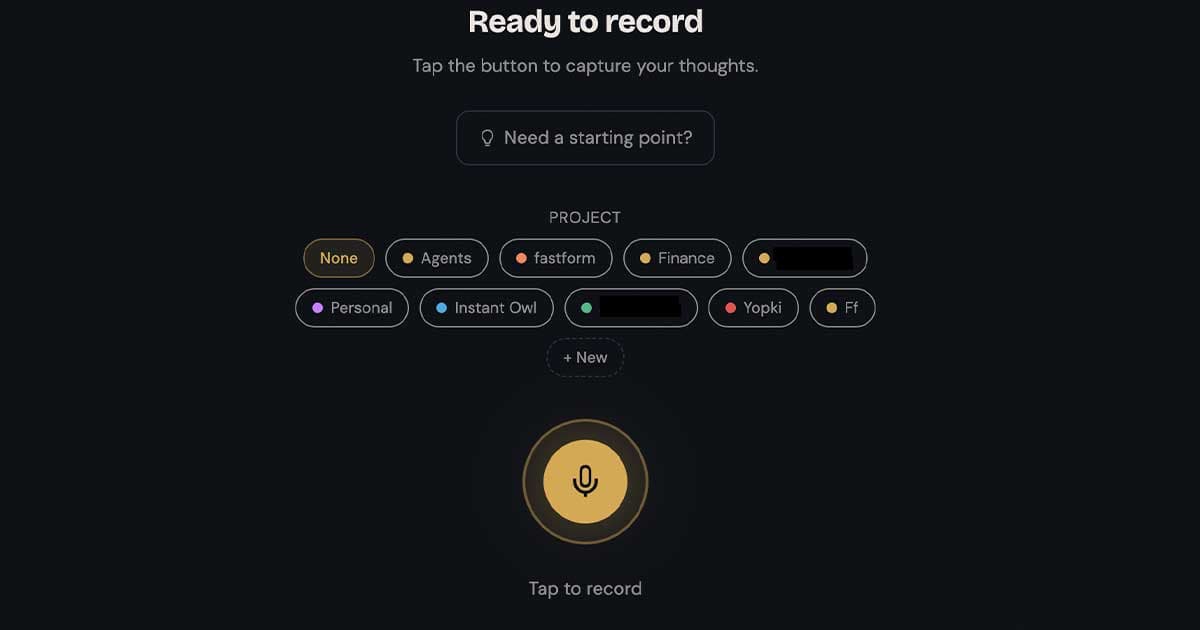
That is InstantOwl's lane: one recording becomes Meeting Notes, a Decision Log, a Product Spec, or a Status Update, whichever the moment calls for. Action items get pulled out automatically, including due dates you say out loud like "by Friday." Projects let you file a debrief under the right initiative by hand, so a decision made in March is still findable when you need to defend it in June. InstantOwl is currently free to use.
This is the same pattern behind a founder's after-decision debrief, covered in voice notes for founders: talk right after the moment that matters, while the reasoning is still intact, and let the structure come from the recording instead of from an hour of typing later.
Related reading
- How to transcribe an interview: consent, transcription conventions, and real costs when the transcript itself is the deliverable.
- How to take meeting notes: the prep, capture, and cleanup pattern behind any recorded meeting, PM or otherwise.
- Voice notes for founders: the same after-decision debrief habit, applied to co-founder and investor conversations.
Frequently asked questions
How do product managers take user interview notes?
The common advice from practicing PMs is to stop relying on transcripts and debrief instead: right after each interview, spend about 15 minutes summarizing what you observed, learned, and heard, plus anything to dig into next, before the details blur into the next call.
What is Voice of the Customer (VoC)?
Voice of the Customer is the in-depth process of capturing a customer's expectations, preferences, and aversions, per Productside, a product-management training firm. Sources include direct interviews, observation, surveys, focus groups, customer forums, and social media monitoring.
Can a voice note turn into a product spec?
Yes. Talk through the user, their current workarounds, the constraints, the non-goals, and what you still do not know, then turn that recording into a structured document. InstantOwl's Product Spec format does this from one recording, though a human still edits scope and acceptance criteria.
Can you keep a product decision log by voice?
Yes. Right after a roadmap or scope decision, record a short debrief covering what was decided, the alternatives considered, why they were rejected, and what would change your mind. InstantOwl's Decision Log format turns that into a structured, filed entry.

Written by
Jim BreeseJim Breese is the founder of InstantOwl. He's spent 15 years building companies, from an Airbnb host community he founded and exited to growth leadership at venture-backed SaaS startups. He built InstantOwl because his best ideas kept arriving mid-walk, out of order, and half-finished.
Stop losing good ideas.
InstantOwl turns a rambling voice note into a clean, organized document in moments. Just talk. We'll organize it.
 Try InstantOwl free