How to Dictate Email in Gmail (the Honest Answer) and Everywhere Else
By Jim Breese ·
Can you dictate an email in Gmail?
Not with a built-in feature on desktop, no. Gmail has never shipped a microphone button for composing email in a browser, and Google's own support community says so directly. Two separate threads on the Gmail Community, five years apart, both end the same way: nobody from Google ever points to a native dictation feature, because there is not one.
In February 2024, someone asked exactly this question, plainly: "Is there a way to use voice to dictate emails in Gmail? ... I don't mean 'smart compose.' Using Windows PC. Cannot use keyboard." The reply on the thread was just as plain: "nope google an extension." The person who asked closed the thread with the line that sums up the whole problem better than we could: "Thank you. It saves me from searching for something that doesn't exist in Gmail."
That is not a one-off. A second Gmail Community thread, started back in 2019, asked the identical question and ran for months without a native answer either. Between the two threads, the honest paths people actually land on are the same: a third-party extension, or dictating somewhere else and pasting the result into Gmail. The rest of this post covers both, plus the platforms where dictation genuinely does work inside Gmail already.
The microphone you remember is your keyboard, not Gmail
If you have used voice to write an email before, on your phone, that microphone belonged to your keyboard, not to Gmail. This single mix-up is the exact confusion running through both community threads: people remember a working mic "in Gmail," then go looking for it on a laptop and cannot find it, because it was never Gmail's feature to begin with.
On Android, that microphone is Gboard. Google's own instructions name Gmail directly as a host app: install Gboard, "open any app that you can type with, like Gmail or Keep," tap a text field, then tap the microphone icon at the top of the keyboard and speak. This is official and native to the keyboard, and it has always worked inside the Gmail app for exactly that reason: Gboard doesn't care which app it's typing into.
On iPhone, the same logic applies through Apple's own Dictation, which Apple describes plainly: "With Dictation on iPhone, you can dictate text anywhere you can type it," processed on your device in many languages, with no internet connection required. Gmail's compose box is a standard text field like any other, so tapping the dictation key while writing in the Gmail app works the same way it does in Messages or Notes. Neither Gboard nor iOS Dictation is a Gmail feature. Both work in Gmail simply because Gmail is one app among many they can type into.
The desktop paths that actually work
Desktop is where the confusion turns real, because none of the paths above exist on a laptop. Three options do work, and all three dictate into whatever text box has your cursor, Gmail's compose window included.
On a Mac, system Dictation works in any text field in any browser, Gmail included, once you turn it on in System Settings > Keyboard > Dictation and start it with a shortcut like Option-Z. Apple states plainly that "you can dictate text of any length without a timeout," so a long email will not get cut off mid-sentence. The real limit is silence, not length: "Dictation stops automatically when no speech is detected for 30 seconds," so a long thinking pause ends the session, not a long sentence.
On Windows, press Windows key+H with your cursor already in the Gmail compose box, wait for the "Listening..." alert, and start talking. This requires an internet connection, since voice typing runs on Azure Speech services rather than on your device, and it is built for short bursts rather than long, uninterrupted dictation.
The third path is the one the 2019 Gmail Community thread landed on itself, and it still holds up. A commenter walked through it step by step: "Open a blank Google Doc. Select 'Tools' from the toolbar... select 'Voice Typing'... Click the microphone button and dictate. Then just copy/paste into your email." That is now Google Docs voice typing, the official version of the same workaround. It covers 100+ languages for dictation itself, though voice commands only work in English.
It is a real fix for long dictation, just an extra step compared to typing straight into Gmail. For the exact shortcuts, settings, and honest limits of the Mac and Windows options, see our full guides to Mac dictation and Windows voice typing.
The extension option
A Chrome extension called Dictation for Gmail adds a microphone icon directly next to the Send button, so you dictate without leaving Gmail or switching to Docs. Per its own Chrome Web Store listing, it has more than 100,000 users, supports 54 languages, and carries a Featured badge, with version 1.0.14 last updated January 1, 2025.
The reviews are mixed: 3.5 out of 5 stars from 275 ratings, on the low end compared to similar voice extensions on the store, which run 4.0 to 4.9. The listing also discloses that the extension collects personally identifiable information, while stating that data is not sold to third parties outside approved use cases, not used for unrelated purposes, and not used for creditworthiness or lending decisions. The developer has a clean record with no history of store violations, per the listing.
Whether that is worth it is a real judgment call, not ours to make for you. One commenter on the 2019 Gmail Community thread put the hesitation plainly, unprompted: "I don't want to install third party extension and give it permissions." That instinct is reasonable. You would be granting an extension access to the exact box where you write private email, so weigh the convenience against that before installing anything.
Who this is really for
Both Gmail Community threads, the honest source for everything above, were started by people for whom this was not a convenience question. The 2024 asker said it directly: "Cannot use keyboard." The 2019 thread carries the same weight from a different angle: "I am having a hard time typing due to my arthritis and this feature SHOULD be available - it took me more than ten minutes to type this!"
That is the real center of this topic. Voice-to-email is a nice shortcut for some people and a necessity for others, and the necessity should come first. If you are the person this fits, the paths above, Gboard, iOS Dictation, Mac, Windows, Docs, or the extension, are not shortcuts. They are the way you write an email at all.
The other path: speak the gist, not the sentence
Every path above does the same basic thing: it types your spoken words into the compose box more or less verbatim, in order, exactly as you said them. That is what dictation software is built to do, and it does it well. It works less well when what you actually have is a messy, half-formed idea of what you want to say, spoken out of order, with false starts and backtracking.
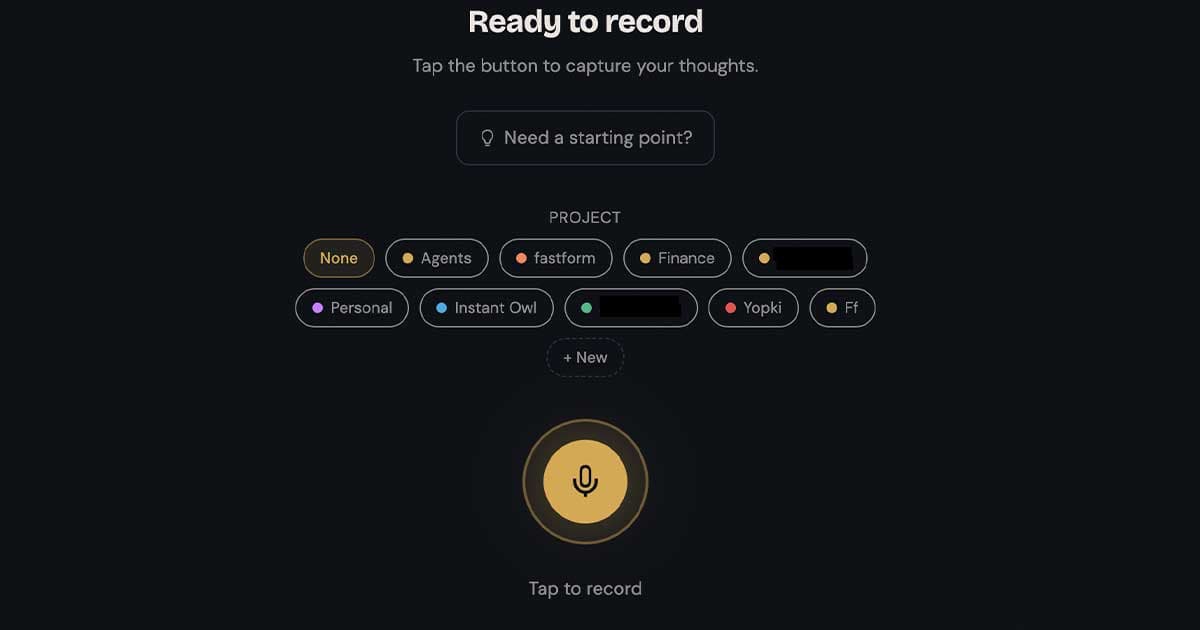
Full disclosure: InstantOwl is our product, and this blog belongs to it. Instead of dictating a finished sentence, you say the gist while walking to your car or waiting in the pickup line: who the email is for, what you need, how it should sound. InstantOwl takes that rambling recording and reformats it into a structured email draft you paste into Gmail, rather than a transcript of everything you said in the order you said it. It is the same idea covered in our AI email writer guide, applied to speaking instead of typing a prompt.
That draft still needs your eyes on it before it goes anywhere. Any AI output, InstantOwl's included, can misstate a name, a date, or a detail you said quickly and unclearly, so proofread before you send, the same rule that applies to every path in this post. InstantOwl is currently free to use, and it solves one narrow problem: getting the loose version of an email out of your head, not replacing the judgment call of reading it back before you hit send.
Related reading
- The best dictation software in 2026: what dictation is built to do well, and where it stops short of a finished draft.
- AI email writers, honestly reviewed: the free tools that write an email from a description, and when a chatbot beats them.
- How to use dictation on Mac and voice typing in Windows 11: the exact steps, shortcuts, and honest limits for each desktop platform.
Frequently asked questions
How do I dictate an email in Gmail?
On a phone, use your keyboard's dictation: Gboard's microphone icon on Android or Dictation on iPhone, both of which work inside the Gmail app because they work in any text field. On desktop, Gmail itself has no microphone button, so use your operating system's dictation (Mac Dictation or Windows Win+H) while your cursor is in the compose box, or write in Google Docs with Voice typing and paste the result into Gmail.
Why is there no microphone button in Gmail on desktop?
Google has never built one. Two threads on Google's own Gmail Community, one from 2019 and one from 2024, both end without anyone from Google pointing to a native dictation feature. The official answer on the 2024 thread is blunt: use a browser extension, or dictate somewhere else and paste the text in.
Is the Gmail dictation extension safe?
Dictation for Gmail discloses on its own Chrome Web Store listing that it collects personally identifiable information, while also stating that data is not sold to third parties outside approved use cases, not used for unrelated purposes, and not used for creditworthiness or lending decisions. The developer has a clean record with no history of Chrome Web Store violations. Whether that is an acceptable tradeoff is a judgment call, since you would be granting an extension access to the same box where you write private email.
Can I dictate an email on my iPhone?
Yes. Apple's own guide states that with Dictation on iPhone, you can dictate text anywhere you can type it, and requests are processed on your device in many languages with no internet connection required. Gmail's compose box is a standard text field, so tapping the dictation key on your iPhone keyboard while writing in the Gmail app works the same way it does in Notes or Messages.

Written by
Jim BreeseJim Breese is the founder of InstantOwl. He's spent 15 years building companies, from an Airbnb host community he founded and exited to growth leadership at venture-backed SaaS startups. He built InstantOwl because his best ideas kept arriving mid-walk, out of order, and half-finished.
Stop losing good ideas.
InstantOwl turns a rambling voice note into a clean, organized document in moments. Just talk. We'll organize it.
 Try InstantOwl free