Online Journals: Privacy, Permanence, and Export (Before You Pick One)
By Jim Breese ·

What is an online journal?
An online journal is any journal you keep through the internet, but that phrase actually covers three different setups, and mixing them up is where most of the privacy worry starts. The first is a web journal, a website you write directly in, like Penzu, where your entries live on the company's server the moment you save them.
The second is an app that syncs your entries through the cloud but also runs in a browser, like Journey, so the same journal opens on your phone, your laptop, or the web. The third is files you keep yourself, in Word, Google Docs, or a plain-text app, where you decide where they live and who else can see them.
A member of r/digitaljournaling summed up why the distinction matters. They were switching away from a paper journal, said their diary was "VERY private," and admitted "i really dont know how online diaries/journals work, sorry." That is the actual person behind a search for "online journal": someone worried about privacy who has not yet worked out which of the three setups above they are even choosing between.
Whichever setup you are weighing, judge it on the same three questions that keep coming up among people who actually journal this way: privacy (where your entries live, and who can read them), permanence (will this service still exist in ten years), and export (can you get your own words back out). The rest of this guide applies those three questions to the two most visible online journals, Penzu and Journey, plus the honest alternative neither of them sells.
Is Penzu private, and what do you have to pay for?
Penzu's privacy marketing is stronger than its free plan. The free Basic plan is genuinely free forever, no credit card required, and includes unlimited entries, mobile apps, basic journal covers and fonts, and autosave as you type. That much is a real, usable online journal with no catch on entry count.
The catch shows up once privacy becomes the point. Penzu describes itself as "Your private 100% customizable online journal" and says "Privacy is our #1 concern," pointing to "double password protection and military strength encryption" in what it calls the Penzu Vault. Those are Penzu's own claims, not independently verified here, and the strongest version of them is not on the free plan. Encryption locking is part of Penzu Pro, priced at $19.99 a year, not Basic. Penzu Pro+, at $49.99 a year, upgrades that further to what Penzu calls "Military grade encryption locking."
Two more things matter before you commit. Penzu Pro also adds PDF export, entry tagging, custom covers and fonts, writing prompts, and writing an entry by email. And nowhere on Penzu's site does it claim end-to-end encryption, the stronger standard where not even the company itself can read your entries. Penzu is also entirely typed text, in a browser or its mobile apps; there is no voice or audio journaling anywhere in the product.
Does Journey's encryption claim hold up?
Journey is a real web app, not just a mobile one. It lists itself as available on "Android, iOS, Mac, Windows, Web, and Chrome OS," and says it has "millions of Journey users." Its Membership plan costs $4.17 a month billed annually, roughly $50 a year, cancel anytime. A lifetime purchase option exists too, but Journey does not show that price anywhere on its own site, so this guide is not going to guess at a number it never published.
Membership includes Odyssey AI, a feature that lets you "pose a question" to a GPT-powered assistant that "sifts through your past journal entries to provide a response." Journey also claims full privacy protection: "Enjoy unparalleled peace of mind with end-to-end encryption... ensure your privacy remains intact throughout its Journey to the cloud."
Those two claims sit in real tension. End-to-end encryption, in the strict sense, means only you can read your entries, not even the company running the service. An AI feature that reads across your past entries to answer questions needs access to that same content to work at all. This guide is not resolving that tension for Journey, and neither does its own site; both claims are Journey's, stated as is. It is worth asking Journey directly how the two fit together before trusting it with anything you would not want anyone else reading.
Is an online journal ever really private?
If privacy is your top priority, you may not want an online diary at all. That is not this guide's line, it is a community member's, posted in a r/digitaljournaling thread from someone asking specifically about online diary options: "If privacy is your most important consideration, you don't want an online diary or website." Their advice for anyone weighing cloud storage generally, including something like Google Docs, was to read its privacy policy in full first, and to add your own password protection or extra encryption on top rather than trust a vendor's marketing claim alone.
Other members of that same thread made the case for skipping the cloud entirely. One keeps journal archives as plain files, stored locally on their own devices. Another put it more bluntly: "It's interesting, if frustrating, to me how often this option just seems to be ignored or forgotten, as if the only options are paper or internet. Offline files rule!" A word processor file or a plain text note, kept on your own device with your own backup, sidesteps every question in this guide about a vendor's servers, because there are no vendor servers involved.
None of this is a knock on Penzu or Journey specifically. It is the honest shape of the tradeoff: the moment your journal touches someone else's server, your privacy depends partly on that company's claims, its security practices, and its business staying the same for as long as you want to keep writing. If that tradeoff bothers you, local files are a real answer, and the best journal apps roundup covers Diarium and Obsidian, two options built around keeping your own data on your own storage.
Can you export what you write?
Before committing to any online journal, ask one practical question: if you decided to leave tomorrow, could you get your entries out, in a usable format, without paying extra first? Apply that test to each option here rather than trust the sales page.
Penzu fails the test on its free plan. PDF export exists, but it sits behind Penzu Pro, the $19.99-a-year tier, so a free Basic user cannot get a clean export of their own writing without upgrading. Journey's export path is murkier from its own site, but one r/digitaljournaling member reported backing their Journey entries up to their own Google Drive account, which at least means the entries are not only sitting on Journey's servers.
Diarium, a smaller name that came up in the same discussion, passes the test cleanly: one community member described using it with a one-time payment per platform and backups through their own cloud storage, no ongoing account with the vendor required to keep a copy of what they wrote.
The pattern across all three: the more a journal treats your entries as data it owns, the more export becomes a paid feature or an afterthought. The more it treats your entries as yours, moving through your own cloud account, the more export is simply how the product already works.
Is there an online journal you can talk to?
Yes, and every online journal covered so far assumes you will type. Penzu is typed text in a browser by design. Journey's entries are typed too, with audio only as something you can upload, not a built-in way to create a whole entry by speaking. That gap, an online journal built around talking instead of typing, is where InstantOwl fits, and full disclosure: InstantOwl is our product, and this blog belongs to it.
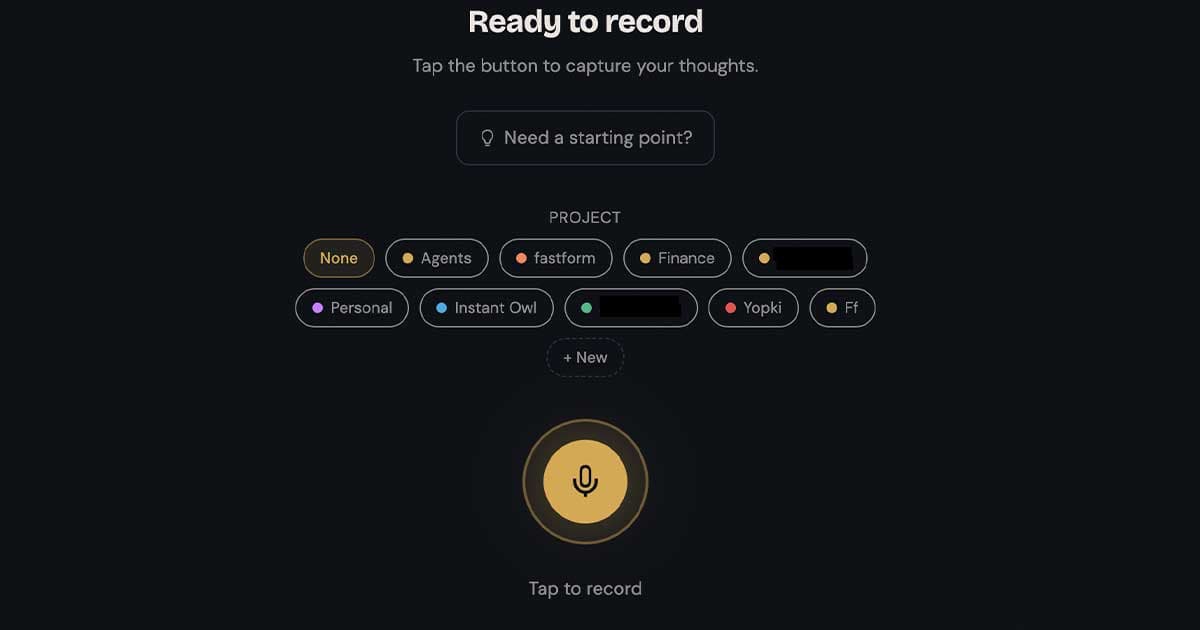
InstantOwl turns a spoken ramble into an organized, written journal entry, so getting an entry down does not require sitting still and typing it out. It is worth being just as honest about InstantOwl as this guide has been about Penzu and Journey: InstantOwl is a web-based product too, so the same privacy question, where your entries actually live, applies to us the same way it applies to the other two.
InstantOwl does not claim end-to-end encryption or "military grade" security, because that has not been built yet; recordings are private to your account and are not sold. If you want a stronger guarantee than that today, the local-files route in the privacy section above is the honest answer, not us. InstantOwl is currently free to use.
If talking instead of typing is genuinely the friction point keeping you from journaling at all, see our deeper guide to voice journaling for what a spoken daily practice looks like once you get past the first entry.
Related reading
- Voice journaling: what a spoken daily practice looks like, and what usually goes wrong with audio-only entries.
- The best journal apps: Apple Journal, Day One, Diarium, and where a local-storage option beats an online one outright.
- Journal prompts: what to write about once you have picked where you are writing it.
Frequently asked questions
Is an online journal private?
It depends on which one and which tier. Penzu's encryption locking is a paid feature under Penzu Pro, not part of its free plan, and Penzu makes no end-to-end encryption claim. Journey claims end-to-end encryption while also offering an AI that reads across your past entries to answer questions, a tension it does not resolve. If privacy is your top priority, some online journalers recommend skipping the cloud and keeping files locally instead.
What is the best free online journal?
There is no single best free online journal for everyone, but Penzu's free Basic plan is a real option: no credit card required, unlimited entries, mobile apps, and autosave, with no time limit. Its tradeoff is that encryption locking and PDF export both require upgrading to a paid Pro plan.
Can I export my journal from Penzu?
Not on the free Basic plan. PDF export is a Penzu Pro feature, priced at $19.99 a year, so a free tier user cannot get a formatted export of their own entries without upgrading first.
Is there an online journal you can talk to?
Yes. InstantOwl turns a spoken recording into an organized, written journal entry instead of requiring you to type it, and it is currently free to use. It is a web-based product like Penzu and Journey, so the same questions about where your data lives apply to it too.

Written by
Jim BreeseJim Breese is the founder of InstantOwl. He's spent 15 years building companies, from an Airbnb host community he founded and exited to growth leadership at venture-backed SaaS startups. He built InstantOwl because his best ideas kept arriving mid-walk, out of order, and half-finished.
Stop losing good ideas.
InstantOwl turns a rambling voice note into a clean, organized document in moments. Just talk. We'll organize it.
 Try InstantOwl free