FLAC to Text: Transcribing Lossless Audio Without the Runaround
By Jim Breese ·
How do you convert FLAC to text?
Upload the FLAC file directly to a tool that lists FLAC among its accepted formats, or convert it to MP3 first if the tool you want to use does not. That is the entire process. The friction is knowing which tools actually accept FLAC, since it gets left off far more format lists than MP3 or WAV do.
FLAC stands for Free Lossless Audio Codec, "an audio format similar to MP3, but lossless, meaning that audio is compressed in FLAC without any loss in quality," per the Xiph.Org Foundation's own FLAC project page. Xiph.Org describes it as "the fastest and most widely supported lossless audio codec," open source and free of patent licensing. Created by Josh Coalson in 2000 and now maintained by Xiph.Org, FLAC was formally standardized as RFC 9639 in December 2024, an authority detail most FLAC guides skip entirely.
A FLAC file rarely shows up by accident, and two verified sources cover most searches for this keyword. Bandcamp offers FLAC as one of its download formats, alongside MP3, ALAC, AAC, Ogg Vorbis, WAV, and AIFF, describing the high-fidelity options as being for "audiophiles and nerds," per Bandcamp's own help article. Windows 11's built-in Sound Recorder app can also record straight to FLAC, alongside AAC, MP3, WMA, and WAV, per Windows Central's walkthrough of the app.
If you flipped that Windows setting to lossless and now have a FLAC file of your own voice, you are not chasing audiophile quality. You are a Windows user who picked an option and now needs it transcribed, and almost nothing ranking for "flac to text" is written with you in mind.
Which tools actually take FLAC files?
Four answers, verified directly on each tool's own page, and they split cleanly. TurboScribe accepts FLAC: its own site lists FLAC among more than twenty supported formats, alongside MP3, WAV, OGG, and OPUS, per TurboScribe's own page. Its free tier gives 3 transcripts a day, no card required.
InstantOwl also accepts FLAC natively. Its documented format list runs .mp3, .mp4, .m4a, .wav, .ogg, .webm, .mov, .aac, and .flac, capped at 150MB per file, with anything over 24MB automatically split behind the scenes for transcription, per its own upload documentation. More on where InstantOwl fits below.
One free tool is worth ruling out rather than recommending here. A well-known free transcription tool lists FLAC among its supported formats but caps free files at 5MB. That number sounds generous until you do the FLAC-specific math: 5MB of FLAC holds roughly a minute of music-quality audio, which makes the free tier close to useless for anything but the shortest clip. It is fine for a short voice memo. It does nothing for a ripped album track or a full Bandcamp download.
Word Transcribe, built into Microsoft 365, is the clean no. Microsoft's own support page states plainly, "Transcribe currently supports .wav, .mp4, .m4a, .mp3 formats," per Microsoft's support documentation. No FLAC, no exception. If you already pay for Microsoft 365 and hoped to use what you are already paying for, you will need to convert first.
Does lossless audio actually transcribe more accurately?
No, not in any way that matters for a normal voice recording. Some tools market FLAC's lack of compression artifacts as an accuracy edge for transcription, the idea being that nothing gets thrown away before the speech model hears it. That claim is reasoning dressed up as a fact, and the reasoning does not hold up.
Speech transcription models process audio at far lower resolution than FLAC preserves. Word accuracy tracks the conditions of the recording itself, a quiet room, a close microphone, clear speech, far more than it tracks the codec the file happens to be saved in. A pristine FLAC recording made in a noisy kitchen still transcribes like a noisy recording. A compressed MP3 recorded quietly a foot from the microphone still transcribes cleanly.
Losslessness is a real property and a real reason to keep FLAC around for music, archiving, or editing. It is not a reason to expect a better transcript. If accuracy is the goal, fix the recording environment before worrying about the file format.
Should you convert FLAC to MP3 first?
Often, yes, especially if the tool you want to use caps files by size rather than by length. FLAC files run large because nothing is compressed away, so converting to MP3 first can shrink a file roughly 5 to 10 times before upload, clearing a size cap in one step with no real cost to transcription accuracy.
The command is one line with ffmpeg, the open-source tool most conversions like this run on: ffmpeg -i recording.flac recording.mp3. Per ffmpeg's own documentation, "the format is normally auto detected for input files and guessed from the file extension for output files," so naming the output file .mp3 is the only instruction ffmpeg needs.
One honest note: ffmpeg is not preinstalled on macOS or Windows, and the project itself ships only source code. On a Mac, brew install ffmpeg through Homebrew is the simplest path. On Windows, the official ffmpeg site points to community builds rather than shipping its own installer. If a terminal is not appealing, a FLAC-accepting tool from above skips the install step entirely.
Why do ranking pages skip all of this?
Because most of them are running the same template across every audio format, FLAC included. Across several pages that separately rank for "aac to text," "flac to text," "ogg to text," and "opus to text," the exact same file-size recommendation sentence appears, word for word, with only the format name swapped in. None of them explain what FLAC actually is, where it comes from, or why a Bandcamp download and a Windows recording both end up needing this page.
One page ranking specifically for "flac to text" gives the clearest evidence of the pattern. Its own step-by-step walkthrough, written for FLAC uploaders, tells them to "Download your MP3 to transcript." It is a template built for a different format that nobody proofread before publishing it under the FLAC keyword. That single line captures the whole problem: format-specific pages that were never actually written about the format.
Where does InstantOwl fit?
Full disclosure: InstantOwl is our product, and this is our blog. Most FLAC searches are music, archival audio, or someone else's file, exactly what the tools above are built for. InstantOwl is not trying to be a lossless-audio specialist.
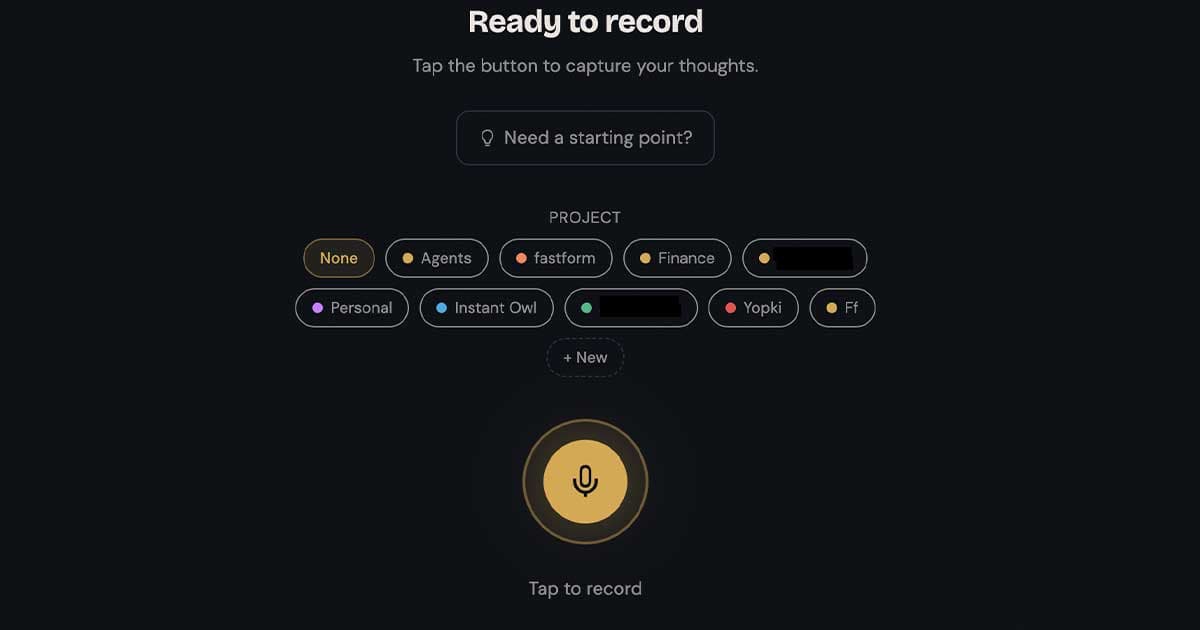
The exception is the Windows Sound Recorder case above: someone who set their own recorder to FLAC out of habit, then needs their own rambling voice memo turned into something usable, not just a wall of transcript text. FLAC's size problem shows up in music and archival files, not a few minutes of talking, so InstantOwl's 150MB cap comfortably covers a FLAC file of normal speaking length, and it accepts the format without a conversion step first. InstantOwl is currently free to use.
Related reading
- WAV to text: the other large-file format, where uncompressed size is the whole story.
- M4A to text: the compressed sibling format most Voice Memos exports actually use.
- Transcribe audio to text: the full landscape of free and paid transcription tools across every format.
- InstantOwl: organized notes and tasks from one recording, currently free to use.
Frequently asked questions
How do I transcribe a FLAC file?
Upload it to a tool that lists FLAC among its accepted formats, such as InstantOwl or TurboScribe, or convert it to MP3 first with ffmpeg if the tool you want to use does not accept FLAC directly.
What creates FLAC files?
Bandcamp offers FLAC as a download format for its 'audiophiles and nerds' fans, per Bandcamp's own help article, and Windows 11's built-in Sound Recorder app can record straight to FLAC as one of its format options, per Windows Central's guide to the app.
Does FLAC improve transcription accuracy?
No. Speech transcription accuracy tracks the conditions of the recording itself, a quiet room and a clear voice, far more than the codec the file is saved in. A lossless FLAC recording made in a noisy room still transcribes like a noisy recording.
How do I convert FLAC to MP3?
Install ffmpeg (brew install ffmpeg on a Mac) and run ffmpeg -i recording.flac recording.mp3 in a terminal. Per ffmpeg's own documentation, the output format is guessed from the file extension, so naming the output file .mp3 is the only instruction it needs.

Written by
Jim BreeseJim Breese is the founder of InstantOwl. He's spent 15 years building companies, from an Airbnb host community he founded and exited to growth leadership at venture-backed SaaS startups. He built InstantOwl because his best ideas kept arriving mid-walk, out of order, and half-finished.
Stop losing good ideas.
InstantOwl turns a rambling voice note into a clean, organized document in moments. Just talk. We'll organize it.
 Try InstantOwl free