Dragon vs Wispr Flow: Two Eras of Dictation, One Honest Comparison
By Jim Breese ·

Dragon vs Wispr Flow, the short answer
Dragon and Wispr Flow are not fighting for the same buyer anymore. Dragon NaturallySpeaking is a 25-year-old, fully on-device dictation engine you train to your voice over time. Wispr Flow is a modern cloud AI that works instantly, out of the box, in whatever app you already have open. That gap alone reframes the whole question, because the consumer and professional Dragon line most people remember is winding down while Wispr Flow is the product actively being built for how people dictate today.
Dragon Anywhere Mobile stopped selling on July 1, 2026, and Nuance's own site no longer lists a price for the desktop version. Dragon Professional v16 is still buyable, just not from Nuance directly. If you are weighing the wider field beyond just these two, our map of Dragon alternatives by what you used it for breaks the category down by job: general dictation, medical, open source, and accessibility.
Dragon today: still around, just not where you'd expect
Dragon still exists, but the way you buy it has changed completely. Dragon Anywhere Mobile, the phone app, is dead: subscriptions ended July 1, 2026, on both the App Store and Google Play, with no path to renew. Nuance's own product page for Dragon Professional prints no price at all and routes every visitor to a contact-sales form instead of a checkout button. Nuance is now part of Microsoft, and the consumer dictation line has been contracting for years.
Dragon Professional v16 is still a real, purchasable product. It just sells through authorized resellers rather than Nuance itself. One such reseller lists it live, in stock, for $699.99 as a one-time Windows license, no subscription attached. That is the number a buyer actually pays today, not the older $500 or $700-plus figures some outdated comparison pages still print.
What you get for that price is fully on-device speech recognition: Dragon Professional processes your voice entirely on your own PC, with no internet connection required to transcribe a word. This gets missed more often than you'd think, including by people building competing dictation apps. One developer pitching a rival tool recently framed the choice as "Dragon? Cloud." against their own on-device product. That is backwards. Dragon is the one running locally; it is Wispr Flow that needs the cloud.
Dragon Professional has also been Windows-only since macOS support ended in 2018, which left a gap Mac users still route around. In one online discussion about Mac dictation tools, that same rival developer conceded as much to a user working on custom vocabulary and pronunciation training: "Dragon running in Parallels is still the best implementation of what you're describing, which is annoying but true." Another commenter in the same thread asked for exactly what does not exist yet: "a Mac dictation app to replace Dragon Professional for Windows... local... live transcription." Nobody has filled that hole.
Wispr Flow today: instant, cross-app, and cloud only
Wispr Flow types cleaned-up text into your cursor the moment you stop talking, in any app on Mac, Windows, iPhone, or Android, with no voice training required. The free tier caps you at 2,000 words a week on Mac or Windows and 1,000 words a week on iPhone; Android currently gets unlimited use, per Wispr Flow's own pricing page. Pro removes the caps for $15 a month, or $12 a month billed annually, which works out to $144 a year.
That cross-app, cross-device reach is the actual sell, and users notice. In one online discussion of Mac dictation tools, a non-native English speaker wrote that Apple's built-in dictation "barely understands me in English and it's totally impossible... in my native language," adding: "There's a reason why Whisper Flow charges 180$+ / year for this service and people pay for it." That $180 figure is the monthly-billed annual total; paying annually up front brings the same year down to $144.
The tradeoff for that instant, no-training convenience is that everything happens in the cloud. Transcription always runs on Wispr's servers, and AI training on your dictation is on by default until you turn on Privacy Mode. A feature called Context Awareness sends screenshots and on-screen text along with each dictation request unless Privacy Mode is enabled.
Turn Privacy Mode on and also switch off Private Cloud Sync, and Wispr states dictation data gets zero retention: not stored, not used for model training, by Wispr or any third party. The privacy question follows Wispr Flow everywhere it goes; even a Dragon Medical One user, dropping into the same forum thread discussed below, asked about the screenshot behavior unprompted.
That privacy tradeoff is real, but it is also a one-toggle fix, not a dealbreaker baked into the product. The bigger, structural difference is simpler: Dragon lives on your machine, Wispr Flow lives on someone else's.
The user who runs both, with a $16 foot pedal
The clearest verdict on this comparison did not come from a review site. It came from a Dragon Professional Individual 16.1 user on the KnowBrainer forum, the long-running home for Dragon power users, describing many years of daily dictation as a professional writer. They now run both tools every day, switching between them with a $16 USB foot pedal that toggles the Dragon microphone and the Wispr hotkey.
Their accuracy verdict, from someone with no reason to favor the newer tool: "Wispr, in my experience, has definitively better accuracy than Dragon. And it is also very good with punctuation or judging from context which word to include. It's shocking actually." That is a longtime Dragon loyalist saying Wispr wins, on a forum built for Dragon loyalists.
Yet they still keep Dragon running. "I still need the control and command aspects of Dragon," they wrote. Wispr Flow has no select-and-say, the feature that lets you point at a word or phrase by voice and correct or move it. So they dictate into Word or a Dragon box first, then use Dragon's voice-driven editing to clean up and rearrange text, and lean on Dragon for fine punctuation control on a late draft. Wispr still handles plenty on its own: spoken punctuation alongside auto-punctuation, a custom dictionary, and text snippets for boilerplate.
Their employer's IT department approved Wispr Flow for work use after they enabled the setting quoted directly in the thread: "none of your dictation data will be stored or used for model training by us or any third party (zero data retention)." Two eras of dictation, coexisting on one desk, chosen by the job rather than by loyalty.
The money math: is Dragon actually cheaper?
Not unless you keep it for close to five years. Dragon Professional v16 costs $699.99 once. Wispr Flow Pro costs $144 a year billed annually. Divide the one-time Dragon price by Wispr's annual price and you get 699.99 divided by 144, which comes out to about 4.86, or roughly 4.9 years. Only past that point does Dragon's one-time cost fall below what you would have paid Wispr Flow in cumulative subscription fees.
That math assumes a lot in Dragon's favor: one Windows PC, no upgrade in five years, and software Microsoft is not meaningfully developing further. It also assumes you never need select-and-say or command-and-control, the two capabilities the KnowBrainer user still pays for Dragon to keep. If you dictate on a Mac or a phone at all, the math does not apply, because Dragon Professional has had no macOS version since 2018 and no mobile app since July 2026.
Some older comparison pages get this wrong in both directions. A few still price Wispr Flow's free tier by the minute instead of by the word, still quote a Wispr Pro price higher than what it actually charges, and still list a Dragon Home edition that has not been purchasable in some time. Neither reflects what a buyer actually finds on either company's site today. Even a rival dictation vendor's own cost comparison, despite scoring its own product highest, lands on a similar multi-year breakeven using its own numbers, which is a useful sanity check on the arithmetic above.
Who should pick which
Stay with Dragon if you are on Windows, need offline processing for a regulated industry, rely on command-and-control to run your whole PC by voice, or use deep custom vocabulary with pronunciation training that took years to build. A five-year-plus horizon is what makes the $699.99 one-time cost pay off. Dragon Medical One users are not affected by any of this either way, since it is a separate clinical product still sold and supported today; our separate guide to medical dictation software covers that market on its own terms.
Move to Wispr Flow if you work on a Mac or a phone, want to start dictating in minutes with zero training, and are fine paying $144 a year for a more polished, faster-improving tool. That covers most people asking this question in 2026, since Dragon's mobile and Mac stories have both quietly ended.
Where dictation tools stop and InstantOwl starts
Full disclosure: InstantOwl is our product, and this blog belongs to it. Both Dragon and Wispr Flow do the same core job well: they put your spoken words into a text box, fast and accurately, wherever your cursor happens to be. Neither one organizes what you said once it lands there.
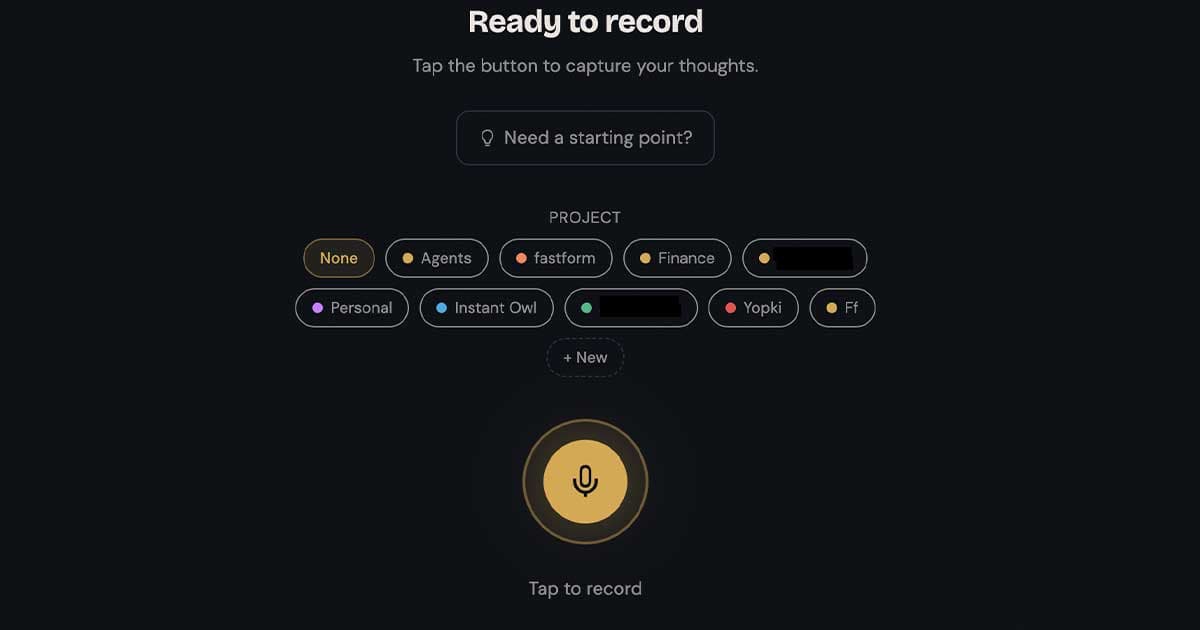
InstantOwl does a different job. Instead of typing words at a cursor, it takes a rambling voice recording, the kind of unstructured thinking-out-loud you would never dictate cleanly into a document, and turns it into organized notes, tasks, and documents on its own. If your problem is getting words onto a screen, Wispr Flow's full pricing and privacy rundown or the wider 2026 dictation software field will point you to the right tool.
If your problem is a head full of half-formed thoughts that need sorting, not just typing, that is InstantOwl's lane. InstantOwl is currently free to use.
Frequently asked questions
Is Dragon NaturallySpeaking still available?
Dragon Anywhere Mobile subscriptions ended July 1, 2026, and Nuance's own site no longer lists a public price, routing shoppers to contact sales instead. Dragon Professional v16 is still purchasable as a one-time Windows license, at $699.99 from an authorized reseller.
Is Wispr Flow better than Dragon?
It depends on the job. A Dragon Professional user of many years who runs both tools daily put it this way on a Dragon forum: Wispr has definitively better accuracy than Dragon and is shockingly good at judging punctuation from context, but Dragon still wins for select-and-say editing and full command-and-control.
Does Wispr Flow work offline?
No. Wispr Flow's transcription always happens in the cloud, so it needs an internet connection to work. Dragon Professional is the opposite: it processes speech entirely on your device, which is why regulated industries and offline workers still choose it.
How much does Dragon cost now?
Nuance no longer publishes a price on its own site. Dragon Professional v16 sells for $699.99 as a one-time Windows license through authorized resellers, compared with Wispr Flow's $144 a year billed annually.

Written by
Jim BreeseJim Breese is the founder of InstantOwl. He's spent 15 years building companies, from an Airbnb host community he founded and exited to growth leadership at venture-backed SaaS startups. He built InstantOwl because his best ideas kept arriving mid-walk, out of order, and half-finished.
Stop losing good ideas.
InstantOwl turns a rambling voice note into a clean, organized document in moments. Just talk. We'll organize it.
 Try InstantOwl free