Descript vs Otter: An Editor and a Note-Taker Walk Into a Meeting
By Jim Breese ·
Descript vs Otter: what's the actual difference?
Descript is an audio and video editor. The transcript is the editing interface: delete a sentence from the text and it deletes the matching clip from the recording. Otter is a meeting bot. It joins your calls from your calendar, transcribes them live, and hands you a summary with action items afterward.
People search "Descript vs Otter" because both companies use the word transcription on their homepage. That is nearly the only thing they share. One is built to produce a finished podcast episode or video. The other is built to remember what got said in a meeting you were also in. Picking between them depends entirely on which of those two jobs you actually have.
What is Descript, and what does it cost?
Descript is built around one idea: edit your video by editing the text. Cut a filler word from the transcript, and the audio and video cut with it, no timeline scrubbing required. It is not a meeting bot. It does not join calls, does not sit on your calendar, and has no auto-join setting to fight with.
Descript's current plans, per descript.com/pricing, verified 2026-08-11:
| Plan | Price | Media minutes/mo | AI credits/mo | Storage | Notes |
|---|---|---|---|---|---|
| Free | $0 | 60 min (1 hr) | 100, one-time | 5GB | Watermarked export |
| Hobbyist | $24/mo, or $16/mo billed annually | 600 min (10 hrs) | 400 | 100GB | Watermark-free, 1080p, files up to 10GB |
| Creator | $35/mo, or $24/mo billed annually | 1,800 min (30 hrs) | 800 | 1TB | 4K export, files up to 20GB, Generate Video |
| Business | $65/mo, or $50/mo billed annually | 2,400 min (40 hrs) | 1,500 | 2TB | 4K export, files up to 50GB, priority support with SLA |
| Enterprise | Custom | Custom | Custom | Custom |
The plan levers say the quiet part out loud: Descript sells media minutes, AI credits, export resolution, and storage, not per-minute transcripts. That is what an editor charges for. Descript says it supports 25 languages on its pricing page and "30+ languages" on its transcription page, an internal mismatch worth knowing before you plan around a specific one.
One thing worth clearing up: older comparison posts around the web cite a "$2 a minute White Glove human transcription" service from Descript. It is not on Descript's pricing page or transcription page today, checked live 2026-08-11. If you need human-verified transcription, look elsewhere; Descript does not currently sell it.
Descript is not without complaints. On a Reddit thread in r/podcasting, one user wrote it "has filled me with white hot rage since December," and another said "you can't edit offline is crazy" and is "looking for an alternative after being a long time user." A separate complaint described recordings from Descript's own Squadcast integration "imported out of sync" or lost entirely, and a plan change that removed features that were previously free.
Other users in the same thread were happy: one said Descript is "probably the best" of the options under discussion, "since that's what they've done from day one," and another described editing mid-flight without connectivity. Not everyone's experience matches, which is normal for any tool this widely used.
What is Otter, and what does it cost?
Otter is a meeting notetaker. It connects to your calendar, joins Zoom, Google Meet, or Microsoft Teams calls automatically, transcribes them in real time, and turns the transcript into a summary with action items, per otter.ai (which now bills itself as a "Conversational Knowledge Engine"). It is not an editor. There is no timeline, no export resolution, no media file to render.
Otter's current plans, per otter.ai/pricing, verified 2026-08-11:
| Plan | Price | Minutes | Per-meeting cap | Imports |
|---|---|---|---|---|
| Basic (free) | $0 | 300/month | 30 minutes | 3 lifetime |
| Pro | $16.99/mo, or $8.33/mo billed annually | 1,200/month | 90 minutes | 10/month |
| Business | $30/mo, or $19.99/mo billed annually | Unlimited meetings | 4 hours | Unlimited |
| Enterprise | Custom | Custom | Custom | Custom |
Otter's biggest complaint is not accuracy, it is the auto-join default. Real users on Reddit describe it joining a job interview uninvited, emailing meeting participants a link they never asked for, and clearing the live transcript window the moment a meeting ends. Our full Otter review walks through every documented complaint plus the exact steps to turn auto-join off or delete an account.
Otter also faces an active legal question. In August 2025, it was hit with a proposed class action, now consolidated as In re Otter.AI Privacy Litigation in the Northern District of California, alleging its Notetaker records meeting participants without their consent and uses the audio to train its AI. Otter points to its privacy policy and says training data is de-identified, per NPR. As of mid-2026, no court has ruled either way.
Is Otter or Descript better for podcasts?
The most trustworthy page comparing these two directly is not a vendor listicle, it is an academic review. AMT Lab, affiliated with Carnegie Mellon, tested both for podcast production and concluded plainly: "Descript is far more complicated if all you need or want is a transcript." Its Descript verdict is just as direct: "edit your video by editing the text. It's that simple." On Otter, AMT Lab notes "high confidence (in the 90+%) and near real-time transcription," but says the AI "is not always good at separating speakers in faster conversations or with similar voices."
That split matches what the two products are actually built for. Descript wins for anyone producing a finished episode or video, because trimming filler words, tightening pacing, and exporting a polished file all happen inside the same transcript-as-editor workflow. Otter wins for capturing what got said during a live recorded interview, in real time, without touching an edit later.
A professional video editor on Reddit's r/editors put the category divide in one line: "Descript is great." The community texture in r/podcasting backs this up too, most complaints there are about Descript's reliability (sync issues, offline editing) rather than about whether it is the right tool for the job. AMT Lab's own conclusion is the fairest summary: "Both Descript and Otter.ai can be part of anyone's podcasting process," because they solve different steps, not the same one.
Can you use Descript and Otter together?
Yes, and plenty of podcasters and video creators effectively do, just not through any built-in integration. Otter handles the live capture: it sits in on an interview or a planning call and hands back a transcript with action items while the conversation is still fresh. Descript picks up after that, once you have a raw audio or video file that needs to become a finished, publishable piece.
There is no direct pipeline between them. The handoff is a manual file export and import, not an automated sync. If your workflow is record the conversation, then produce the episode, that two-step split is honest and works fine. If you were hoping one subscription would cover both jobs, it will not: buy Otter for the meeting, buy Descript for the edit.
What if you're not editing a podcast or running a meeting?
Full disclosure: InstantOwl is our product, and this is our blog. Neither Descript nor Otter is built for the job of capturing your own spoken thoughts. Descript needs an existing recording to edit. Otter needs a meeting on your calendar to join. Neither one is designed for the moment an idea shows up while you are walking to your car or sitting at your desk with nothing recorded yet.
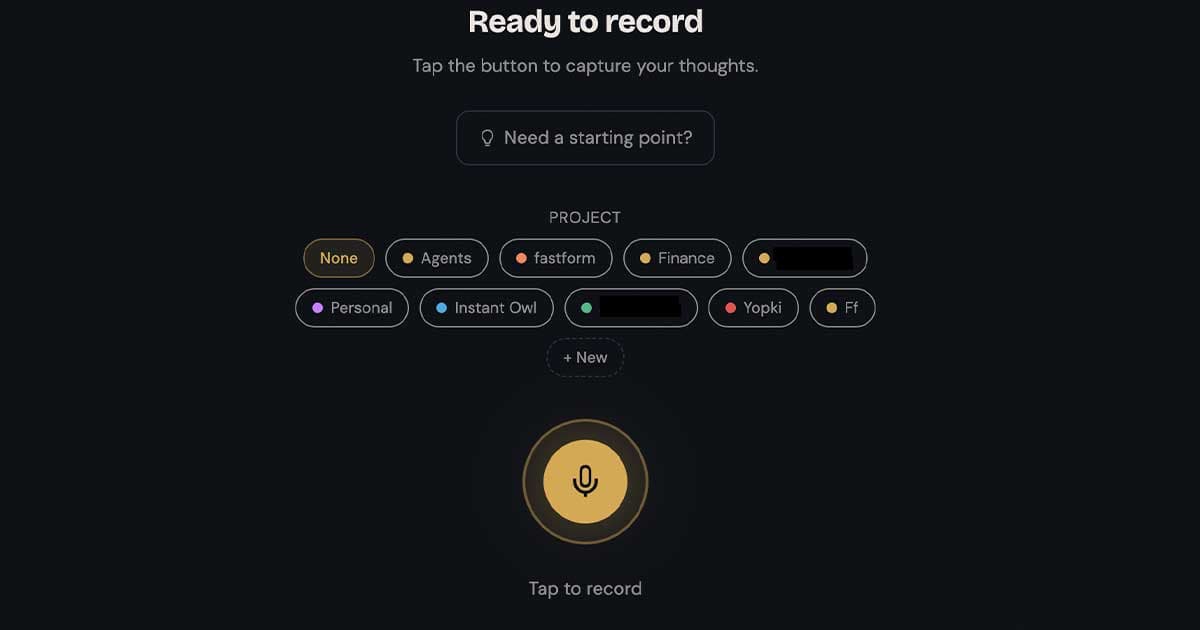
InstantOwl is built for exactly that gap: talk out loud, and one recording turns into organized notes, tasks, or a document, instead of a transcript or a meeting recap to sort through later. InstantOwl is currently free to use.
If you are producing a podcast and want the editing side covered in more depth, our guide to transcribing a podcast and our breakdown of podcast summarizer tools cover that workflow directly. If you want a wider list of options split out by job rather than by brand name, our alternatives roundup covers meeting notetakers, transcription services, and personal capture tools side by side.
Related reading
- Otter.ai: what it is, what it costs, and how to turn it off: the full pricing table, the auto-join complaints, and the official removal steps.
- How to transcribe a podcast: the editing-side workflow once you have a recording in hand.
- Podcast summarizer tools compared: options for turning a finished episode into show notes.
Frequently asked questions
What is better than Descript?
Depends on the job. For live meeting notes and action items, Otter is more purpose-built. For pure transcription with a human option, a dedicated transcription service fits better than either. For editing audio or video by editing text, Descript is still the strongest pick in its category.
Is Descript good for transcription only?
It works, but it is overkill. Descript prices itself around media editing (minutes bought as media hours, AI credits, export resolution, storage), not around per-minute transcripts. If you only need a text file from an audio recording, a transcription-first tool is a better fit for the price.
Is Otter or Descript better for podcasts?
Descript, if you are editing and producing the episode, since the transcript is the edit interface. Otter, if you just want live notes or action items during a recorded interview. Many podcasters end up using both for different steps of the same process, not one instead of the other.
What is the most accurate transcription software?
Nobody can honestly answer that with a single number. Descript, Otter, and their competitors all publish their own accuracy claims with no shared methodology or independent testing behind them, so the percentages are not comparable. Pick based on the job the tool is built for, then check the transcript against your own audio.

Written by
Jim BreeseJim Breese is the founder of InstantOwl. He's spent 15 years building companies, from an Airbnb host community he founded and exited to growth leadership at venture-backed SaaS startups. He built InstantOwl because his best ideas kept arriving mid-walk, out of order, and half-finished.
Stop losing good ideas.
InstantOwl turns a rambling voice note into a clean, organized document in moments. Just talk. We'll organize it.
 Try InstantOwl free