Day One vs Apple Journal: The 2024 Answers Are All Wrong Now
By Jim Breese ·

Which is better, Day One or Apple Journal?
Apple Journal grew up. It launched in December 2023 as an iPhone-only app with no way to get your entries out, and most of the comparisons still ranking today were written against that version. As of iPadOS 26 and macOS 26, Journal syncs across iPhone, iPad, and Mac, exports a full ZIP archive, prints or saves entries as PDF, and is end-to-end encrypted in iCloud.
That single change flips a lot of old advice, including advice Day One is still giving. Day One's own comparison page has not caught up to Apple Journal's current feature set, and neither have most ranking comparisons from 2024 and 2025. If you last compared these two apps before this year, the picture has moved.
The short version: Apple Journal is now a real, free, multi-device option for anyone starting a journal on an Apple device. Day One still wins on cross-platform reach, structure, and the ability to move your entries elsewhere later. The rest of this guide covers what changed and how to decide.
What can Apple Journal do in 2026?
Apple Journal now runs on iPhone, iPad, and Mac, exports your entries as a ZIP file, and encrypts everything end to end in iCloud. None of that was true when most current comparisons were written.
Platforms. Journal shipped as an iPhone-only app in iOS 17.2 and stayed that way for almost two years. Apple's iPad guide confirms iPadOS 26 brought Journal to iPad, and Day One's own importer documentation lists "macOS 26 with the Journal app" as a prerequisite, confirming Journal now ships on Mac too. Entries sync across all three devices.
Export. According to Apple's support guide on backing up, exporting, and printing Journal entries, "the exported entries are collected into a single ZIP file," including photos, locations, and other media attached to each entry. Go to Settings > Apps > Journal > Export All Journal Entries; the file lands in Files, named "AppleJournalEntries," in iCloud Drive by default.
Printing and PDF. The same guide states: "In iOS 18 or later, you can save copies of your journal entries as PDFs in the Files app, or you can print them." You can select all entries or a date range, then save as PDF using the Share button on the print screen.
The backup gotcha worth knowing. Per Apple's guide, Journal entries are not included in a regular unencrypted iPhone backup by default, "so even if you back up your iPhone to iCloud regularly, the backups won't include your Journal entries" unless you create an encrypted backup with a password, through Finder or the Apple Devices app. Entries are still stored and synced through iCloud itself if Saved to iCloud is on. That distinction, backup versus sync, trips people up.
Encryption. Apple's iCloud data security documentation lists "Journal data" as "End-to-end" in its data category table, under both standard data protection and Advanced Data Protection, the same class as Health data and Passwords. You do not need to turn on Advanced Data Protection to get that coverage for Journal specifically.
Journaling Suggestions and lock. Suggestions are generated on-device from things like workouts, photos, and locations, with per-category controls in Settings > Privacy & Security > Journaling Suggestions. Entries lock behind a passcode, Face ID, or Touch ID.
What can Day One do in 2026?
Day One remains the deeper, more cross-platform app, and its price reflects that. It offers a free tier, with paid tiers at Silver, $49.99 a year, and Gold, $74.99 a year. Audio recording and its transcription live behind those paid tiers rather than the free one.
Day One offers end-to-end encryption across every tier, including free, and runs on iPhone, iPad, Mac, Apple Watch, Android, Windows, and the web, a spread Apple Journal still does not match. Entries sync through Day One's own servers rather than iCloud, which is a meaningfully different trust model than Apple's platform-level encryption, covered more below.
Day One's recent price increase, paired with a newer AI push, has some longtime users looking around. On a Day One subreddit thread about the price change, one longtime user wrote: "I'll probably move too. Nothing really new in years apart shared journals and now this AI thing to do like everyone? I don't like the direction it's headed." That sentiment is real but not universal; another user on the same thread said they are staying "until there is book printing (as good as, or better than Day One's) in another app," pointing at the one feature that still keeps loyalists in place.
Can you move your entries between Day One and Apple Journal?
Moving into Day One from Apple Journal is a guided, one-tool process. Moving the other way is not possible without copying entries by hand.
Per Day One's own import guide, you can import Apple Journal entries directly, on iPhone and iPad through Settings > Import/Export > Import from Apple Journal, or on Mac through File > Import > Import from Apple Journal. You export from Apple Journal first, then point Day One at that exported folder, and Day One shows you a count of imported entries when it finishes. The guide says the import captures text, titles, dates, photos, videos, audio recordings, location data, and more.
Apple offers no equivalent tool. There is no documented way to import entries into Journal from Day One or any other app. On a Day One subreddit thread, one user put it plainly: "I can't really see Apple will ever implement a way to do an import of entries from another app."
That asymmetry has a real cost. One Day One subreddit user described copy-pasting more than 1,000 entries from Day One into Apple Journal by hand and reported that "Apple Journal became slow and buggy after I entered over 1,000 entries." Treat that as one person's experience, not a documented limit, but a reasonable warning if you are weighing the same move with a large archive.
The takeaway for your decision: trying Apple Journal first carries almost no risk, since Day One's importer means you can always bring those entries back over later. Starting in Day One and later wanting to leave for Apple Journal is the direction with no safety net.
Where Day One still wins
Day One still beats Apple Journal on reach and structure, three specific ways.
Platforms beyond Apple. If you use Android, Windows, or a browser-based web app for journaling, Apple Journal is not an option at all. Day One covers all three, plus every Apple device.
Structure. Day One supports multiple named journals, templates, tagging, calendar and map views, and book printing, none of which Apple Journal offers. For anyone who wants a journal organized into distinct projects, or printed as a keepsake, that structure is the reason to pay.
Voice entries, imperfectly. Both apps let you attach or record audio to an entry, but neither is built voice-first, and Day One gates transcription behind its paid tiers. If talking through your day is actually how you want to journal, that is a different problem than either app solves well. Our guide to voice journaling covers what makes an audio journal habit stick, and why transcription decides whether you ever revisit what you said.
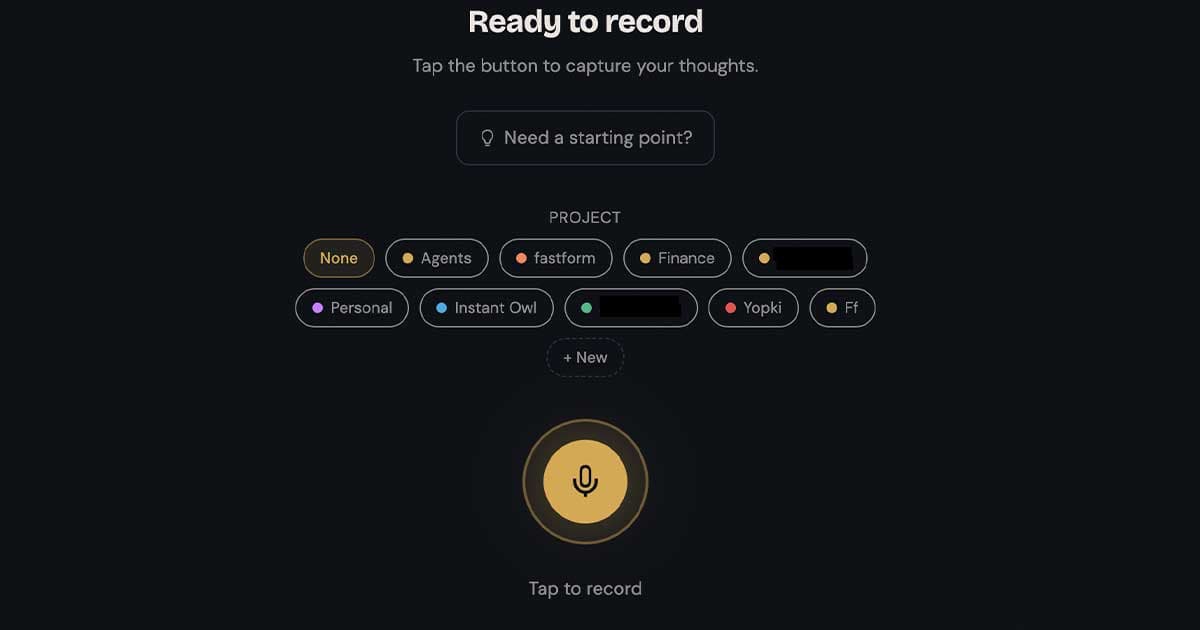
Full disclosure: InstantOwl is our product, and this blog belongs to it. InstantOwl is not a Day One or Apple Journal competitor exactly; it is built for the moment before either app opens, when you want to talk and have it organized afterward instead of typed into a template. InstantOwl is currently free to use.
Why is Day One's own comparison page wrong?
Because it has not been updated since Apple Journal was still iPhone-only with no export option, and that version of Apple Journal no longer exists.
Day One's comparison page concedes real ground to Apple Journal, including its encryption, biometric lock, and reminders. But it still frames Apple Journal overall as a single-device app with limited ability to get entries back out, a description that predates iPadOS 26, macOS 26, and the ZIP export and PDF printing covered above. A 2024 Medium essay this guide reviewed made the identical export complaint, true when it was written, false today.
That is worth naming plainly, without treating it as a scandal. Apple Journal changed faster than the comparison content around it did, and even a company's own marketing page is not exempt from that drift. If you read any Day One vs Apple Journal comparison, including this one, check when it was last updated before trusting a specific claim about either app's current limits.
Who should pick Apple Journal, and who should stick with Day One?
Pick Apple Journal if you are starting fresh on Apple devices. Stick with Day One if you already have an archive there, or need Android, Windows, or web access.
That split matches what actual Day One users say when a new journaler asks for advice. On a subreddit thread titled "Day One or Apple Journal for new user," one reply framed it in one line: "New user, go Apple Journal. I'm old user, stick with DayOne." Other replies favored Day One for its weather metadata, its multiple journals and calendar view, and access from Windows through its web app.
If you are all-Apple and have never kept a digital journal before, Apple Journal costs nothing, is genuinely encrypted, and now syncs across every device you own. If you already have hundreds of entries in Day One, the case to switch is weaker, and the missing import tool means switching later is harder than switching now.
If Day One and Apple Journal both feel like the wrong shape for what you actually want, Day One vs Journey covers a third established option, and our full roundup of journal apps compares more of the field, including the voice-journaling gap most of these apps still leave open.
Frequently asked questions
Can Apple Journal replace Day One?
For a lot of people, yes, now that it runs on iPhone, iPad, and Mac with sync and has real export. It still cannot replace Day One for anyone on Android or Windows, or anyone with years of entries already in Day One and no reason to start over.
Can I import Day One into Apple Journal?
No. Apple has no documented way to import entries into Journal from another app. The migration tool runs the other direction: Day One built an official importer for bringing Apple Journal entries into Day One, not the reverse.
Is Apple Journal end-to-end encrypted?
Yes. Apple's iCloud data security documentation lists Journal data as end-to-end encrypted, in the same protection class as Health data and Passwords, under both standard and Advanced Data Protection.
Does Apple Journal work on iPad or Mac?
Yes, as of iPadOS 26 and macOS 26, with sync across iPhone, iPad, and Mac. Before that, Journal launched in iOS 17.2 in December 2023 and stayed iPhone-only for almost two years.
Related reading
- Voice journaling: what makes an audio journaling habit stick, and why transcription decides whether you ever revisit an entry.
- Day One vs Journey: how the other established paid journal compares on price, encryption, and platform reach.
- Journal apps compared: a broader roundup, including the voice-journaling gap every ranking list skips.
Frequently asked questions
Can Apple Journal replace Day One?
For a lot of people, yes, now that it runs on iPhone, iPad, and Mac with sync and has real export. It still cannot replace Day One for anyone on Android or Windows, or anyone with years of entries already in Day One and no reason to start over.
Can I import Day One into Apple Journal?
No. Apple has no documented way to import entries into Journal from another app. The migration tool runs the other direction: Day One built an official importer for bringing Apple Journal entries into Day One, not the reverse.
Is Apple Journal end-to-end encrypted?
Yes. Apple's iCloud data security documentation lists Journal data as end-to-end encrypted, in the same protection class as Health data and Passwords, under both standard and Advanced Data Protection.
Does Apple Journal work on iPad or Mac?
Yes, as of iPadOS 26 and macOS 26, with sync across iPhone, iPad, and Mac. Before that, Journal launched in iOS 17.2 in December 2023 and stayed iPhone-only for almost two years.

Written by
Jim BreeseJim Breese is the founder of InstantOwl. He's spent 15 years building companies, from an Airbnb host community he founded and exited to growth leadership at venture-backed SaaS startups. He built InstantOwl because his best ideas kept arriving mid-walk, out of order, and half-finished.
Stop losing good ideas.
InstantOwl turns a rambling voice note into a clean, organized document in moments. Just talk. We'll organize it.
 Try InstantOwl free