AI To-Do Lists: Schedulers, Coaches, and the Third Kind Nobody Ships
By Jim Breese ·

What is an AI to do list?
An AI to do list is any task app that uses AI for one of three different jobs: auto-scheduling your calendar, coaching you through a task you already wrote down, or turning spoken words into a task list. Most apps that market themselves as "AI" only do one of these three things, not all of them, so the label hides more than it explains.
That vagueness has a cost. On a Reddit thread in r/ProductivityApps asking about AI to do list apps, the top-voted comment is not a recommendation, it is skepticism: "Why do you need LLMs plugged into a todo list? How is an LLM supposed to know what you want to do? Set your own goals and objectives." The commenter later clarifies he uses AI daily elsewhere, he just does not see the point of bolting an LLM onto a task list specifically.
That skepticism is fair, and worth taking seriously before buying anything in this category. An LLM genuinely cannot know your priorities. It does not know that the client call matters more than the grocery list, or that Thursday's deadline is the one keeping you up at night. The honest answer is not to defend every AI to do list against that objection, it is to separate the three real jobs and be clear about which one, if any, actually needs AI.
The highest-voted concrete answer to the skeptic's question, in that same thread, was not a scheduling feature or a coaching feature. It was "interacting and updating todo list using voice interface." That is the third kind, the one this post spends the most time on, because it is the one closest to what an LLM is actually good at: turning what you said into something structured, not deciding what you should do.
The schedulers: what does Motion actually do?
Motion is an AI scheduler, not an AI to do list in the capture sense. Its own guide to AI task managers defines the category entirely in terms of scheduling: analyzing your work patterns, deadlines, and priorities to automatically plan your calendar. Capture, meaning getting a new task out of your head and into the app, does not appear anywhere in its own feature checklist.
Motion's pricing page lists two plans: Pro AI at $19 per seat monthly and Business AI at $29 per seat monthly, both billed annually. A billing toggle reads "Pay monthly / Pay annually (Save 33%)," confirming annual billing is cheaper. The exact monthly-billed figure is rendered by JavaScript and did not load in a live fetch, so do not trust a monthly figure quoted elsewhere. Motion's own blog post about AI task managers lists $34 a month for its Individual plan, but that figure is stale next to the current pricing page.
Both Motion plans meter their AI use with credits rather than offering it as unlimited. Pro AI includes 7,500 credits per seat monthly, Business AI includes 15,000, and extra credits cost 25 cents per 100 on Pro or 19 cents per 100 on Business. That detail matters more than it sounds: "AI" on a scheduler like Motion is not a flat feature, it is a metered cost that can grow with how much you use it. There is no free plan, only a free trial.
If your actual problem is that your calendar is a mess and tasks keep colliding with meetings, a scheduler like Motion is solving the right problem for you. If your actual problem is that thoughts and tasks never make it out of your head fast enough to schedule in the first place, a scheduler cannot help, because scheduling starts after capture, not before it.
The light-AI incumbents: what does Todoist's AI actually do?
Todoist's AI is a small, opt-in extension called Task Assist, not a built-in assistant running through the whole app. Per Todoist's own help article, Task Assist has four functions: suggest new tasks toward a goal, offer tips when a task is stuck, rewrite a vague task name into something more actionable, and break one task into sub-tasks.
Task Assist is scoped narrowly in three ways worth knowing before you go looking for it. First, it requires a Pro or Business plan, it is not on the free Beginner tier. Second, it only works on desktop and web, Todoist says explicitly it is not available on iOS or Android. Third, it is off by default, you have to turn it on yourself under Settings, Integrations, Browse, Task Assist. It runs on OpenAI's models, and Todoist notes that OpenAI may use your input to improve its own models.
Todoist's main features page, separate from that help article, does not use AI branding at all. Its headline features are natural language Quick Add and what it calls "unrivaled date recognition," both genuinely useful, and neither one marketed as AI. That is a useful signal on its own: the feature people actually rely on Todoist for, fast natural-language capture, predates and does not depend on its AI extension.
Task Assist's real value is task breakdown and rewriting a task into something more actionable, both of which Reddit commenters name as legitimate uses of AI in this category. The gap is that Task Assist still requires you to type the task in first. It coaches a task you have already written down, it does not help you get the task out of your head and into the app in the first place.
A caution about the AI to do list category
The AI to do list space is visibly full of self-promoting founders and semi-abandoned apps, and it is worth saying so plainly before you pick one. On the same r/ProductivityApps thread, the founder of one such app, Fluidwave, wrote: "Due to current lack of sales so far, even lifetime deals, I've been focusing my efforts elsewhere." Another user in the thread, considering recommending that same app, asked in reply whether he should point people toward a product that might not be supported much longer.
That thread is dominated by founders naming their own apps rather than independent recommendations, a pattern worth noticing in any AI to do list search. Users in the same thread reported bugs and a broken sign-up flow in at least one of the apps being promoted.
A few questions help you spot a maintained product before you commit time to it. Does the app have a visible changelog or recent release notes, not just a marketing page. Does the company publish its pricing and limits directly, rather than routing everyone through a sales call. Can you find independent user reviews outside of the app's own subreddit thread or App Store page. And does the founder show up answering support questions, or only show up promoting the product.
None of this means every small AI to do list app is a bad bet. It means treat "AI-powered" as a marketing label first, and verify the app is actively maintained before you build a workflow around it.
The third kind: voice-to-tasks
Voice-to-tasks apps solve a different problem than either schedulers or task coaches: getting the task out of your head and into a list in the first place, by talking instead of typing. This is the use case Reddit itself named as the strongest answer to "why would you want AI in a to do list," and it is a use case almost nothing in the category actually ships well.
One commenter in the thread, describing an audience of over a million social followers, said they were holding off recommending an AI todo app at all "until the voice feature is added," calling it a big deal for people who already use AI heavily in their own workflow.
The mechanics are simple: speak a ramble the way you would talk to a friend, out loud, unstructured, and get back a structured task list instead of a wall of transcript text. Say something like "call the dentist, follow up with Sam about the proposal, the Thursday deadline is stressing me out, look into that new coffee grinder," and the output is four separate tasks, not one paragraph you have to re-read and split up yourself.
This is exactly where the skeptic's objection from the top of this post gets answered honestly rather than argued away. An LLM cannot know your priorities, and it should not pretend to. What it can do well is transcribe and structure what you already said, turning a ramble into tasks without deciding which ones matter most. That is a narrower, more honest claim than "AI plans your day for you," and it happens to be the one Reddit's own thread asked for by name.
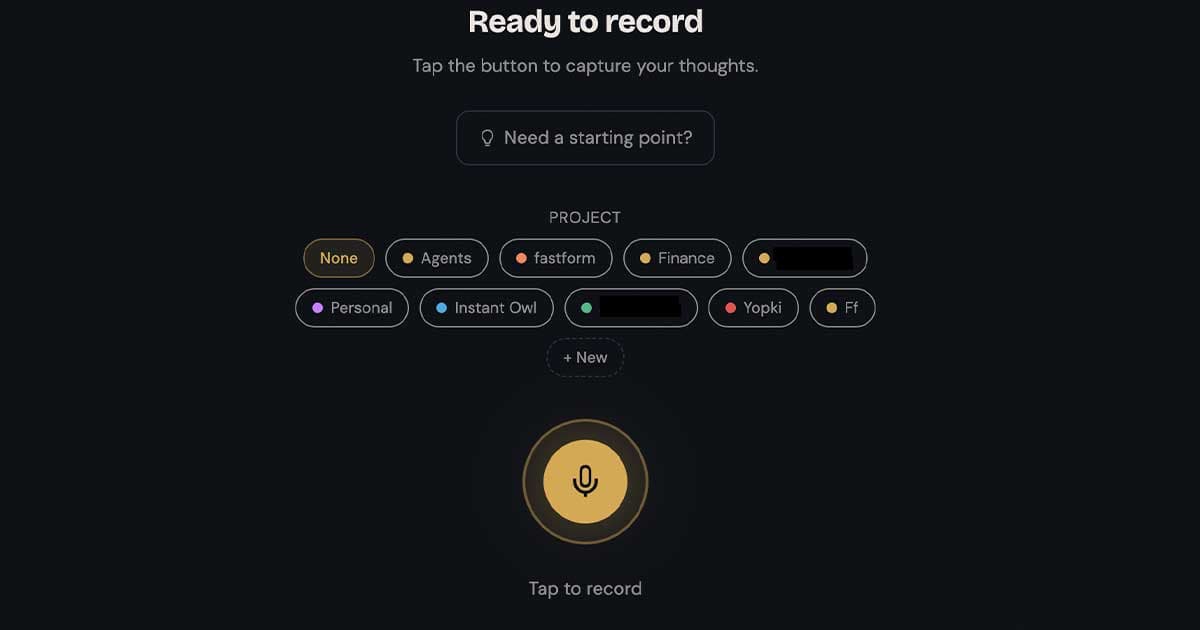
Full disclosure: this is InstantOwl's core feature, and this blog belongs to InstantOwl. InstantOwl takes a spoken ramble and extracts a task list from it automatically, alongside other output types like notes and summaries, and it is currently free to use. It is not a scheduler and it does not compete with Motion on calendar planning, and it is not a replacement for Todoist's project structure if you already like classic list-based task management. It solves the step before either of those: getting the thought said and turned into tasks before it disappears.
If your mind moves faster than your hands can type, the method that has worked for capturing that speed even before AI existed is the plain brain dump, and the same speed problem shows up hardest for people managing a racing or distractible mind, covered in the best apps for ADHD. If you have already decided a classic task list is the right shape for you and just need to pick between two of the biggest ones, Todoist vs TickTick verifies current prices and free-tier limits for both.
Related reading
- What is a brain dump: why speaking is the fastest way to get a thought out of your head.
- The best apps for ADHD: why capture speed matters most for a racing or distractible mind.
- Todoist vs TickTick: verified prices and free-tier limits if a classic task list is what you actually want.
Frequently asked questions
What is the best AI to do list?
There is no single best one, because AI to do list apps split into three different jobs. Motion is the strongest AI scheduler if you want your calendar auto-planned. Todoist's Task Assist is the strongest light-AI add-on if you already like a classic task list. Voice-to-tasks apps like InstantOwl are the strongest option if your real problem is getting the task out of your head in the first place.
Is Motion worth it?
Motion is worth it if what you actually want is an AI scheduler, not an AI to do list. It is built to auto-plan your calendar around deadlines and priorities, not to help you capture new tasks. At $19 per seat monthly for Pro AI or $29 for Business AI, billed annually, it is a real cost for a real feature, as long as scheduling is the problem you have.
Does Todoist have AI?
Yes, in a limited form. Todoist's AI is an opt-in extension called Task Assist, available only on Pro and Business plans, only on desktop and web, not on iOS or Android. It runs on OpenAI models and can suggest tasks, break a task into sub-tasks, and rewrite a vague task into something more actionable, per Todoist's own help article.
Can I make a to do list by talking?
Yes. Voice-to-tasks apps let you speak a rambling update out loud and turn it into a structured task list, instead of typing each task in one at a time. This is the use case Reddit's own AI-todo threads ask for most directly, and it is the core feature InstantOwl is built around.

Written by
Jim BreeseJim Breese is the founder of InstantOwl. He's spent 15 years building companies, from an Airbnb host community he founded and exited to growth leadership at venture-backed SaaS startups. He built InstantOwl because his best ideas kept arriving mid-walk, out of order, and half-finished.
Stop losing good ideas.
InstantOwl turns a rambling voice note into a clean, organized document in moments. Just talk. We'll organize it.
 Try InstantOwl free