Linux Speech to Text: The Projects the Roundups Keep Missing
By Jim Breese ·
Does Linux have good speech to text software?
Yes, once you look past the three guides that currently rank for the question. Linux has no built-in system-wide dictation the way macOS does, so every option here is a separate install, whether it types into a text field, a note-taking app, or a command line. That part is not in dispute.
The gap is which install. The three highest-ranking Linux speech to text roundups in mid-2026 are each published by a company selling its own dictation app, and each one ranks its own product as the top pick before covering five or six others around it. None of the three mentions the two most actively developed open source projects on Linux right now.
Those two are Handy and Vocalinux. Both shipped fresh releases within days of this being published, one day apart from each other. Neither shows up in the roundups, which is the reason this page exists.
Two of the best known cross-platform dictation apps do not help here either. Wispr Flow's supported platforms are Mac, Windows, iOS, and Android; Superwhisper's platform list covers Mac, Windows, and iOS. Neither includes Linux. That gap is part of why the open source projects below carry more weight for Linux users than they would anywhere else.
The two most active open source projects: Handy and Vocalinux
Handy
Handy is a free, open source speech to text app that works completely offline, per its GitHub repository. It is MIT licensed, written in Rust, and had 30,428 GitHub stars as of late August 2026. Its latest release, version 0.9.6, published August 24, 2026, with further code pushes to the repository in the days after: an actively maintained project, not an abandoned one.
Handy runs on macOS, Windows, and Linux, with the Linux build packaged as an AppImage, a .deb, and an .rpm, according to Handy's site. It works push to talk by default: hold a key, speak, release, and the text appears, with a toggle mode and a customizable keybinding also available. One honest catch: Handy's own download page still lists version 0.9.4, a step behind GitHub's 0.9.6 release. GitHub is the more current source for version numbers.
Vocalinux
Vocalinux is a free, open source, 100% offline voice dictation tool built specifically for Linux, per its GitHub repository. It is AGPL-3.0 licensed, had 783 GitHub stars, and its most recent release, version 0.16.0, published August 23, 2026.
Vocalinux works through three local speech engines you can choose between: whisper.cpp by default, OpenAI's own Whisper model, or VOSK, plus an optional remote API mode for OpenAI-compatible or whisper.cpp servers, per Vocalinux's site. It supports both the X11 and Wayland display protocols, a distinction that matters on Linux because several other tools work reliably on only one of the two.
Vocalinux auto-detects your hardware and downloads a model to match, roughly 74MB for the default whisper.cpp tiny model or about 40MB for VOSK, which the project notes runs on systems with as little as 4GB of RAM, per its GitHub repository. Installation runs through a single interactive command.
The rest of the field, verified
Speech Note
Speech Note is a Linux note-taking app with local speech to text, text to speech, and machine translation built in, distributed through Flathub. Flathub states plainly that "text and voice processing take place entirely offline, locally on your computer," with no data sent to the internet. It is roughly a 1GB download, free to use, and supported by donations, with more than 8,000 downloads a month per Flathub's own numbers.
Speech Note does a different job than Handy or Vocalinux. It is a note-taking app with speech built in, not a tool that types into whatever app you already have open. If you want speech to text everywhere on your desktop, Handy or Vocalinux fit better. If you want one dedicated app for notes with offline transcription inside it, Speech Note does.
nerd-dictation
nerd-dictation is a hackable, offline speech to text script for Linux built on the VOSK engine, per its GitHub repository. It is GPL-3.0 licensed and has 1,913 GitHub stars. It is also honestly dated: its last code push was October 10, 2025, and the project has never published a single tagged release, so you install it straight from the repository rather than downloading a packaged build.
That does not mean nerd-dictation stopped working. It is still installable, still widely referenced, and still a reasonable pick if you want a script you can read and modify rather than a polished app. It does mean development has been quiet for months, which is worth knowing before you build a daily workflow around it. At least one July 2026 vendor roundup calls nerd-dictation "actively maintained" without citing a date for that claim. The commit history says otherwise.
Whisper itself: a model, not an app
Whisper is the name people use loosely, and that causes confusion. OpenAI's Whisper is a speech recognition model, not something you install and open like an app. What you actually run on Linux is one of several implementations built on top of it, and they are not interchangeable.
Vocalinux makes the distinction concrete, since it lets you pick between whisper.cpp (a lightweight rewrite of Whisper built for local, offline use), the original OpenAI Whisper model, or VOSK, an entirely separate offline engine, as three separate choices in the same app. Choosing "Whisper" on Linux usually means choosing one of these implementations, not downloading something literally called Whisper. For more on the gap between a raw transcript and something you can actually use, see our guide to transcribing audio to text.
Where InstantOwl fits on Linux
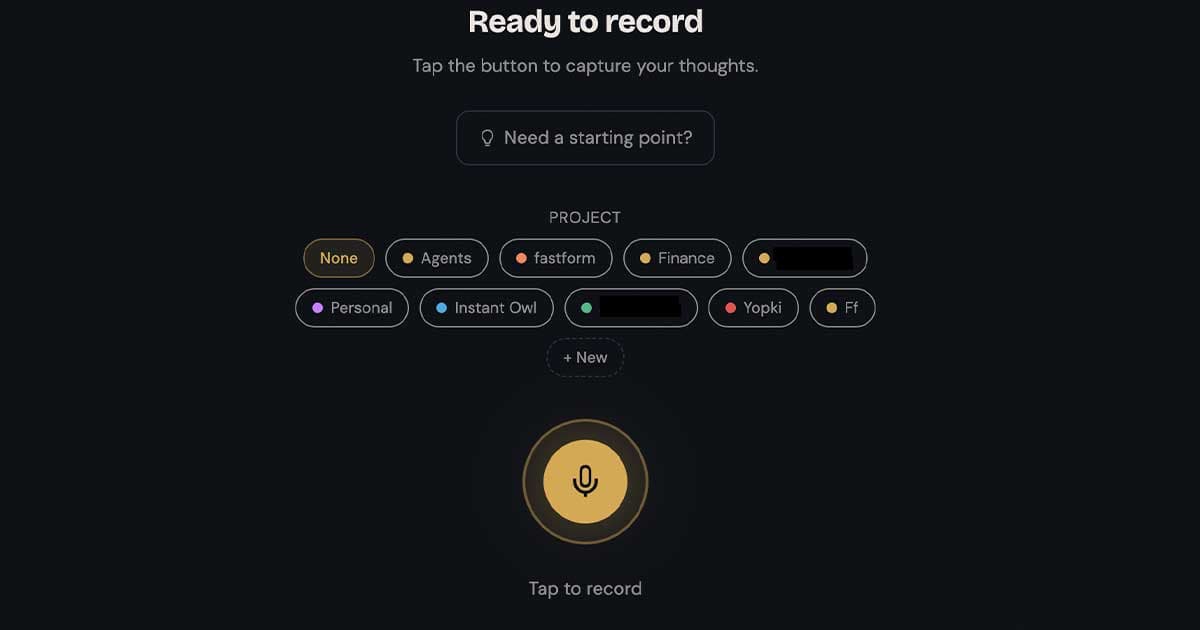
Full disclosure: InstantOwl is our product, and this blog belongs to it. There is no native Linux app, and there will not be a compiled binary to download. InstantOwl runs entirely in a regular browser tab, so Firefox or Chrome on any Linux distribution opens the full product with nothing to compile and no GPU required. It also installs like an app straight from the browser's menu, with no Linux package involved at all.
That is a real trade-off, not a workaround. Every tool above processes your voice on your own machine. InstantOwl needs an internet connection to transcribe and process what you say. If your connection drops mid-recording, the audio buffers locally and syncs once you are back online, but it is not an offline tool, and we are not going to describe it as one.
The two approaches solve different problems. Handy, Vocalinux, and the rest above turn your voice into text, locally, inside whatever app your cursor is already in; the wider dictation software field covers that same job across every platform, not just Linux. InstantOwl takes a messy, rambling recording and turns it into an organized document, a task list, or a note, which is a different job than dictation.
None of the offline tools above are built for that second job, and InstantOwl is not built to replace push-to-talk dictation into a text field. It is currently free to use, needs no install beyond a browser you already have, and works the same in a browser tab whether you are running Ubuntu, Fedora, or anything else with a modern browser.
If your voice notes are already organized thoughts you just need typed, use one of the open source tools above. If what you actually have is a rambling ten-minute recording that needs to become a document, a plan, or a list of next steps, that is the gap InstantOwl was built to close, on Linux the same as anywhere else.
Frequently asked questions
What is the best free speech to text tool for Linux?
Handy and Vocalinux are both free, open source, and actively maintained as of August 2026, with new releases within days of each other. Speech Note is also free, supported by donations, and distributed through Flathub. All three run entirely offline.
Does Ubuntu have built-in speech to text?
No. Ubuntu, like every major Linux distribution, does not ship with system-wide dictation built in. You install a separate tool such as Handy, Vocalinux, or Speech Note to get speech to text on Ubuntu.
What are the best offline speech to text options for Linux?
Handy and Vocalinux both process speech entirely on your own machine, with Vocalinux letting you choose between whisper.cpp, OpenAI's Whisper model, and VOSK as the local engine. Speech Note is also fully offline, per Flathub's listing, which states no data is sent to the internet.
Is nerd-dictation still maintained?
Its last code push to GitHub was October 10, 2025, and the project has never published a single tagged release, so you install it straight from the repository. It is still usable and widely referenced, but development activity has been quiet since late 2025, whatever a given roundup claims.

Written by
Jim BreeseJim Breese is the founder of InstantOwl. He's spent 15 years building companies, from an Airbnb host community he founded and exited to growth leadership at venture-backed SaaS startups. He built InstantOwl because his best ideas kept arriving mid-walk, out of order, and half-finished.
Stop losing good ideas.
InstantOwl turns a rambling voice note into a clean, organized document in moments. Just talk. We'll organize it.
 Try InstantOwl free