Dictation on iPad: The Keyboard Shortcut Nobody Gets Right
By Jim Breese · · Updated
How do you turn on and use dictation on iPad?
Turn on dictation once, then use it from any text field. Go to Settings, tap General, tap Keyboard, and turn on Enable Dictation. If a prompt appears, tap Enable Dictation again to confirm.
To dictate, tap in a text field to place the insertion point, then tap the microphone on the onscreen keyboard, or in any text field where it appears. Wait for the mic icon to show near your cursor, then speak. Tap the stop control, or say "stop dictation," to end.
Per Apple's iPad support guide, dictation "stops automatically when you stop speaking for 30 seconds." That is a silence timer, not a length cap: talk for ten minutes without a long pause and it keeps going the whole time.
iPad handles dictation differently from iPhone in one important way. Apple's guide states: "You can use typing or handwriting with Dictation. Either the keyboard or tools palette can stay open during Dictation so you can easily switch between speaking and typing or handwriting to enter and edit text." That keyboard-stays-open behavior is what makes the two tricks below possible.
Two details most guides skip. Dictation is processed on your device in many languages, so no internet connection is required, per Apple, though a search box is an exception: text dictated there can still be sent to the search provider. And in supported languages, dictation adds commas, periods, and question marks automatically; turn that off in Settings, General, Keyboard, Auto-Punctuation if you would rather punctuate by voice yourself.
What is the real keyboard shortcut for iPad dictation?
The keyboard shortcut is Globe-D, not Command-D. If you use a Magic Keyboard for iPad or a Smart Keyboard, Apple's guide for dictating with an external keyboard gives the tip directly: "To quickly switch to dictation, press [Globe]-D on the Magic Keyboard for iPad or Smart Keyboard." The globe symbol is the Switch Keyboard key, usually bottom-left on the row above your thumbs.
This is worth correcting because Command-D circulates as the answer in some search results and old forum advice, and it does not trigger dictation on current iPadOS. If you have been pressing Command-D and wondering why nothing happens, that is why. Globe-D is the shortcut Apple documents today.
The same page has a second route in: tap the Dictation button in the Shortcuts bar at the bottom of the screen, then speak. Both routes need the same prerequisite first, Enable Dictation turned on in Settings, General, Keyboard.
There is also a third, fully custom option, from Apple's own users rather than the official guide. A highly upvoted Ask Different thread and a top-rated reply in Apple's Support Community forums both describe setting a custom Dictation Shortcut: open Settings, General, Keyboard, tap Dictation Shortcut, and choose a key combination of your own, such as double-tapping Control. That option sits next to Globe-D as a second way in, useful if Globe-D feels awkward on your keyboard layout.
Can you dictate with Apple Pencil on iPad?
Yes, and it works nothing like typing corrections on iPhone or Mac. Select any text with Apple Pencil, tap and hold, or drag to highlight, then start dictating. Your voice replaces the selected text instead of appending after it.
Apple's guide states this outright: "you can select text with touch or Apple Pencil and replace it with your voice." That single sentence covers the whole trick. Because the tools palette can stay open during dictation, you never have to put the Pencil down and switch to the keyboard to make the edit.
This is genuinely iPad-only. iPhone dictation and Mac dictation both let you select text and dictate over it too, but neither has a Pencil in the mix, so neither has this exact motion: mark a phrase with the tip of a stylus, say the replacement, and watch it swap in place. For anyone marking up an essay draft, annotating study notes, or fixing a sentence mid-thought, that is a faster loop than most people realize is built in.
Is the popular iPad dictation guide you might find still accurate?
Not entirely, and it is worth flagging kindly rather than ignoring it. Yale's Dyslexia guide to speech-to-text on iPad is a genuinely useful resource, written for students with dyslexia and the educators who support them, and its underlying advice, like speaking in complete phrases and saying punctuation by name, still holds up.
Two of its prerequisites do not. The Yale guide states dictation requires "an Internet connection" and that "Siri needs to be turned on" first. Neither is accurate on current iPadOS. Apple's guide says dictation requests are processed on your device in many languages, so no internet connection is required, and Enable Dictation lives under Settings, General, Keyboard, entirely separate from Siri.
The gap makes sense once you know the guide's age: it dates to November 2013, when dictation genuinely did depend on an internet connection and Siri. iPadOS has changed a great deal since then. If you use Yale's page for its assistive-technology framing, which is good, treat the setup steps as current Apple documentation instead.
Who actually needs dictation on iPad
Dictation earns its place for students annotating a reading with Apple Pencil, usually inside a handwriting app (our Notability vs GoodNotes breakdown covers which one to pick), anyone typing slower than they think, and the specific case Yale's guide targets well: people with dyslexia or a motor difficulty for whom typing is the real barrier, not the thinking. For all of them, dictation removes the keyboard from between a thought and the page.
It stays a typing-where-your-cursor-is tool, though. It fills one field, at a time, and stops itself after 30 seconds of quiet. That is fine for a caption, a reply, or a single sentence fix with Apple Pencil. It is a rougher fit for planning an essay out loud or working through a messy idea in fragments, since every long pause to think ends the session.
Picture a student marking up a PDF of an assigned reading. They circle a clumsy sentence with Apple Pencil, select it, and speak the replacement, no keyboard, no switching apps, no losing their place in the page. That same student, asked to plan the whole essay out loud before writing a word of it, runs straight into the 30-second silence timer the moment they pause to think about their thesis. Dictation is built for the first job, not the second.
If you want more control over that same dictation loop rather than a different kind of tool entirely, Superwhisper runs locally on iOS and lets you customize prompts and models around the same tap-and-speak pattern.
Where InstantOwl fits
Full disclosure: InstantOwl is our product, and this blog belongs to it. An iPad with a Magic Keyboard is a genuine writing machine, and dictation on it is still typing where your cursor happens to be: one field, one silence timer, one flat block of text when you stop.
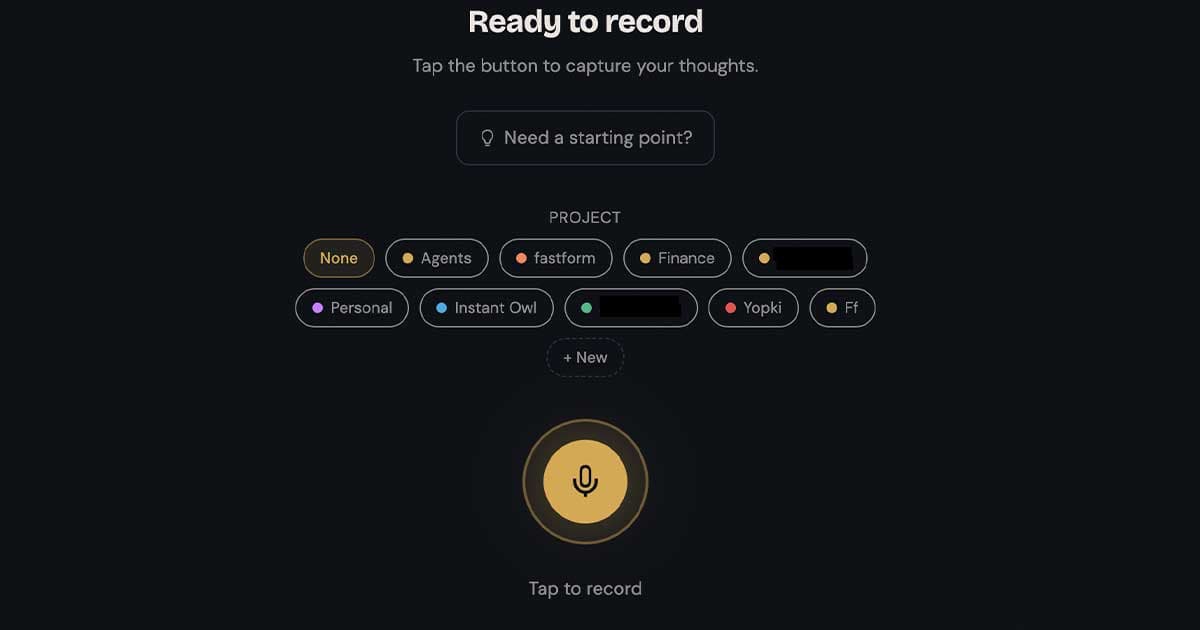
InstantOwl is for a different moment: working through an idea out loud before you know what you are going to write. Record a study note, a plan for an essay, or a brain dump of everything on your mind, pauses and backtracks included, and get back an organized document instead of a transcript to sort through yourself. InstantOwl is currently free to use.
If your dictation questions are really about iPhone, our full dictation on iPhone guide covers the command tables in full. For the Mac side of the same family, including the 30-second myth Apple's own guide debunks, see dictation on Mac.
For the wider field of dedicated dictation apps beyond what Apple ships, dictation software compares the field.
Related reading
- Dictation on iPhone: the full command tables, the Magic Keyboard shortcut, and the settings that matter on iPhone.
- Dictation on Mac: how to turn it on, the shortcut, and the 30-second silence myth debunked with Apple's own wording.
- Dictation software: how the wider category of dictation tools breaks down beyond Apple's built-in option.
Frequently asked questions
What is the keyboard shortcut for dictation on iPad?
With a Magic Keyboard for iPad or Smart Keyboard attached, the shortcut is Globe-D: press the Globe key (the Switch Keyboard key, bottom-left) and D together, per Apple's support guide. Command-D shows up in some search results and old advice, but that is not the current shortcut. You can also open Settings, General, Keyboard, Dictation Shortcut and set your own, such as double-tapping Control.
Does dictation on iPad work without an internet connection?
Often, yes. Apple's guide states dictation requests are processed on your device in many languages, so no internet connection is required, though dictating into a search box can still send that text to the search provider. Not every language is on the on-device list, so an unsupported language may still need a connection.
What voice commands work while dictating on iPad?
You can say punctuation by name (period, comma, question mark), say new line or new paragraph to format, say emoji names like heart emoji, and say select or delete followed by a phrase to edit. Apple's guide notes dictation automatically inserts commas, periods, and question marks in supported languages, and you can turn that off in Settings, General, Keyboard, Auto-Punctuation.
Can you use Apple Pencil with dictation on iPad?
Yes. Select any text with Apple Pencil or your finger, then start dictating, and your voice replaces the selected text instead of adding to it. Apple's iPad guide describes this directly: you can select text with touch or Apple Pencil and replace it with your voice, a trick that is not available the same way on iPhone or Mac.

Written by
Jim BreeseJim Breese is the founder of InstantOwl. He's spent 15 years building companies, from an Airbnb host community he founded and exited to growth leadership at venture-backed SaaS startups. He built InstantOwl because his best ideas kept arriving mid-walk, out of order, and half-finished.
Stop losing good ideas.
InstantOwl turns a rambling voice note into a clean, organized document in moments. Just talk. We'll organize it.
 Try InstantOwl free