Otter vs Fireflies: Exact Free Tiers, Real Prices, and How to Leave Each
By Jim Breese · · Updated

Otter vs Fireflies: which one should you pick?
Pick based on which limit actually hurts you, not on which brand you have heard of more. Otter's free plan caps what you can transcribe: 300 minutes a month, 30 minutes per conversation, 3 lifetime file imports, per otter.ai/pricing. Fireflies' free plan caps what you can keep: transcription and AI summaries are unlimited, but storage tops out at 400 minutes for the whole team, per fireflies.ai/pricing.
That single distinction, transcribe limit versus keep limit, is the actual decision most comparison pages skip. If you record a handful of short calls a month and rarely need to look back further than a week, Otter's minute cap will not bother you. If you record often but review notes within days of the meeting, Fireflies' unlimited transcription means you never hit a wall mid-recording, you just need a habit of exporting or reading older notes before the 400-minute team clock pushes them out of reach.
On raw quality, the two are close enough that most honest sources say so. The top-voted comparison on a Reddit thread about the two, at 4 points, put it directly: "Otter is on par with fireflies and there isn't much differentiation. This whole space is so overcrowded and right now there is no clear winner. If you find a tool that does what you need, then just stick with it."
A separate commenter who trialed both for three months and switched from Otter to Fireflies said the meeting notes "felt more accurate in Fireflies," and separately described Otter's AI "making up stuff on the fly" in one summary. That is a one-user report worth knowing, not a verdict on its own.
Shape matters more than the scoreboard here. Otter leans toward solo use: a cleaner live-transcript view and a genuinely useful free tier for occasional calls. Fireflies leans toward teams: shared transcripts, search across every past meeting, an API, and CRM integrations, all things a team needs and a solo user usually does not.
Can you trust the "Otter vs Fireflies" rankings already online?
Not without checking who wrote them. The two most visible comparison articles for this exact search are both written by companies that compete with Otter and Fireflies, and neither says so as plainly as it should.
Cotera's comparison is bylined "Ibby Syed, Founder, Cotera," a company in the same meeting-intelligence business, with no disclosure statement anywhere on the page and calls to action promoting Cotera's own agents. It prints accuracy figures down to a decimal, Fireflies at one number and Otter at a lower one, with no named source for either, then concedes on the same page that "the difference is statistical noise," which is a more honest sentence than the numbers above it.
Its own cost comparison mixes different tiers of each product, and it rounds both companies' Business plans to "around $29 a month," which erases a real gap: Otter Business is $30 a month, or $19.99 annually, while Fireflies Business is $29 a month, or $19 annually, per each company's own pricing page.
Avoma's comparison at least says the quiet part out loud: "Avoma competes with Otter and Fireflies in the meeting intelligence and conversation intelligence category," right in the article. Its own pricing numbers for Otter and Fireflies match what both companies publish today, which is rare on this search and worth crediting. Its verdict, unsurprisingly, adds a third door: Avoma for "structured notes, coaching insights, and revenue intelligence." Read that recommendation knowing it comes from a competitor with something to sell.
Neither site is lying, and disclosing a conflict of interest, as Avoma does, is a real point in its favor over Cotera's silence. But a founder-bylined page and a self-recommending competitor are exactly the kind of source worth double-checking against the vendors' own pricing pages, which is what the table below does.
Otter vs Fireflies pricing, verified today
Both companies publish full pricing on their own sites; the numbers below are pulled straight from otter.ai/pricing and fireflies.ai/pricing, read live on 2026-07-16.
| Plan | Otter | Fireflies |
|---|---|---|
| Free | 300 min/mo, 30 min/call cap, 3 lifetime imports | Unlimited transcription, 400 min team storage, 20 AI credits, 2 hr recording cap |
| Pro/mid tier | $16.99/mo, or $8.33/mo annual; 1,200 min/mo, 90 min cap, 10 imports/mo | $18/mo, or $10/mo annual; 8,000 min storage/seat, 20 AI credits, 2 hr cap |
| Business | $30/mo, or $19.99/mo annual; unlimited meetings, 4 hr cap, 3 concurrent | $29/mo, or $19/mo annual; unlimited storage, 30 AI credits, 3 hr cap |
| Enterprise | Custom, demo required | $39/mo, annual billing only; unlimited storage, 50 AI credits, 4 hr cap |
Both companies run the same annual-versus-monthly trap. Otter Pro is $8.33 a month billed annually but $16.99 a month billed monthly, more than double. Fireflies Pro is $10 a month billed annually but $18 a month billed monthly. If a comparison article quotes one flat number per plan without naming the billing cycle, as Cotera's "about $17" and "around $29" do, assume it flattened a real difference.
Neither vendor publishes independent, third-party benchmarks for transcription accuracy. Fireflies claims "95% Accurate" on its own homepage; Otter does not publish an accuracy figure at all. Treat both as marketing claims from the company being described, not as neutral test results.
How many languages do Otter and Fireflies actually support?
Fireflies states "100+ Languages" on its own homepage and pricing page, so that figure is at least a first-party claim you can attribute directly to Fireflies. Otter is a different story, and worth flagging plainly: Otter does not publish an official language count anywhere on its own site.
Comparison pages fill that gap with guesses, and the guesses do not agree with each other. Different competitor pages ranking themselves in this same search print different specific numbers for Otter, none of them citing an Otter source. When rival pages cannot agree on a basic spec, that disagreement is the tell: the number is folklore, copied from page to page, not a verified fact. If a language count for Otter matters to your decision, do not trust any specific figure until Otter itself publishes one.
How do you remove Otter or Fireflies from a meeting, and delete your account?
Both companies publish official removal and deletion steps, and the two processes differ in ways worth knowing before you commit to either tool.
To remove Otter mid-meeting, type "stop otter" in the Zoom, Google Meet, or Microsoft Teams chat. Per Otter's help center, this works for any participant, with no Otter account required, and removes every Notetaker immediately if more than one is present. To stop future auto-joins, go to Integrations, then Meetings, then "Default auto-join settings," and pick "Meetings I manually select."
To remove Fireflies mid-meeting, open the participant list on whichever platform you are using, find Fireflies Notetaker, and choose Remove (on Zoom, click More next to its name first). Per Fireflies' help center, you can also stop it from the live meeting banner on the Fireflies dashboard, and removing it before the 3-minute mark means no transcript or notes get created at all. To stop future auto-joins, switch the auto-record setting to "Only when I invite," or build a Recording Rule that blocks meetings by keyword, email, or domain.
Deleting an account is where the two diverge the most. Otter's delete option, per its account-deletion help article, lives under Account Settings, then General, then a confirmation with your password. It is instant and permanent: "Otter is not able to recover deleted accounts or conversations." The option is also hidden entirely if you belong to a workspace with 2 or more members, until an owner removes everyone else first.
Fireflies' deletion, per its own account-deletion article, runs through Settings, then Account, then a "Delete my account" confirmation. The account deactivates immediately, but Fireflies gives you a 30-day window to contact support and recover it before data is permanently erased. No workspace-owner maze is documented on Fireflies' side. On offboarding specifically, Fireflies is the more forgiving of the two: a real recovery window, and no hidden delete button behind a multi-member workspace.
What if you are not actually running meetings?
If the calendar-joining bot, the shared team transcripts, and the meeting recap are not actually what you need, both Otter and Fireflies are built for a job you do not have. A recurring pattern on Reddit backs this up: people search comparisons like this one wanting to capture their own thoughts, a phone call they want recorded and transcribed, or an idea on the walk to the car, and land on tools built entirely for other people's Zoom calls.
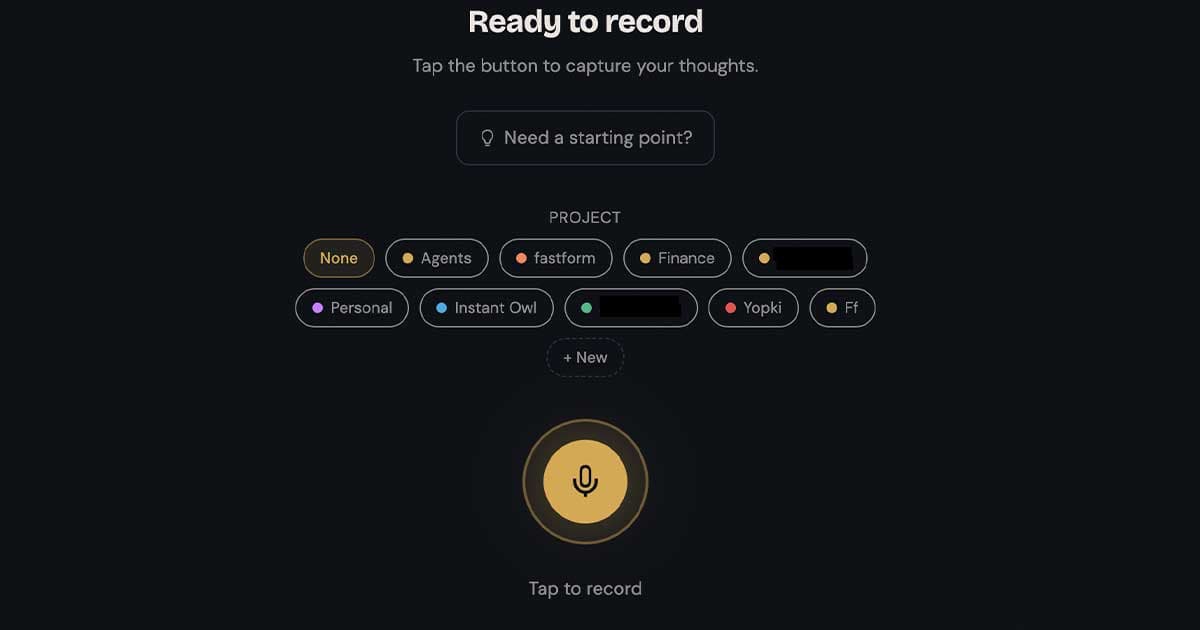
Full disclosure: InstantOwl is our product, and this is our blog. It does not compete with Otter or Fireflies on meeting transcription; it is built for the voice note you record about your own thinking, turning one recording into organized notes and tasks instead of a meeting transcript to sort through later. Our Otter review and Otter alternatives roundup cover the personal-capture side in more depth.
InstantOwl is currently free to use.
Frequently asked questions
Is Fireflies better than Otter?
Neither is better overall. The best Reddit comparison of the two, with 4 upvotes, put it plainly: "Otter is on par with fireflies and there isn't much differentiation... if you find a tool that does what you need, then just stick with it." Fireflies fits teams better, per both companies' own pricing pages; Otter fits solo, occasional use better.
Which is free, Otter or Fireflies?
Both have real free plans, but the limits differ. Otter's free tier caps what you can transcribe: 300 minutes a month, 30 minutes per call, 3 lifetime file imports, per otter.ai/pricing. Fireflies' free tier caps what you can keep: transcription and AI summaries are unlimited, but storage is capped at 400 minutes for the whole team, per fireflies.ai/pricing.
How do I remove Fireflies from a meeting?
Open the participant list on Zoom, Google Meet, or Microsoft Teams, find Fireflies Notetaker, and choose Remove, per Fireflies' help center. You can also click the stop icon on the live meeting banner in the Fireflies dashboard. If Fireflies is removed before 3 minutes have passed, no transcript or notes are created.
How do I stop Otter joining meetings?
Type "stop otter" in the meeting chat to remove it instantly from that call, per Otter's help center. To stop future auto-joins, go to Integrations, then Meetings, then "Default auto-join settings," and choose "Meetings I manually select" instead of joining everything.
Related reading
- Otter.ai: what it is and what it costs: the full pricing table, how to turn off auto-join, and how to delete your account.
- Otter.ai alternatives by what you actually need: Fathom, Fireflies, AudioPen, and more, sorted by job.
- Fireflies.ai review: pricing, the free-tier storage catch, and official offboarding steps in full.
- Otter vs Fathom: how Otter compares to the meeting notetaker with a genuinely unlimited free tier.
- InstantOwl: organized notes and tasks from one recording, currently free to use.
Frequently asked questions
Is Fireflies better than Otter?
Neither is better overall. The best Reddit comparison of the two, with 4 upvotes, put it plainly: 'Otter is on par with fireflies and there isn't much differentiation... if you find a tool that does what you need, then just stick with it.' Fireflies fits teams better, per both companies' own pricing pages; Otter fits solo, occasional use better.
Which is free, Otter or Fireflies?
Both have real free plans, but the limits differ. Otter's free tier caps what you can transcribe: 300 minutes a month, 30 minutes per call, 3 lifetime file imports, per otter.ai/pricing. Fireflies' free tier caps what you can keep: transcription and AI summaries are unlimited, but storage is capped at 400 minutes for the whole team, per fireflies.ai/pricing.
How do I remove Fireflies from a meeting?
Open the participant list on Zoom, Google Meet, or Microsoft Teams, find Fireflies Notetaker, and choose Remove, per Fireflies' help center. You can also click the stop icon on the live meeting banner in the Fireflies dashboard. If Fireflies is removed before 3 minutes have passed, no transcript or notes are created.
How do I stop Otter joining meetings?
Type 'stop otter' in the meeting chat to remove it instantly from that call, per Otter's help center. To stop future auto-joins, go to Integrations, then Meetings, then 'Default auto-join settings,' and choose 'Meetings I manually select' instead of joining everything.

Written by
Jim BreeseJim Breese is the founder of InstantOwl. He's spent 15 years building companies, from an Airbnb host community he founded and exited to growth leadership at venture-backed SaaS startups. He built InstantOwl because his best ideas kept arriving mid-walk, out of order, and half-finished.
Stop losing good ideas.
InstantOwl turns a rambling voice note into a clean, organized document in moments. Just talk. We'll organize it.
 Try InstantOwl free