AudioPen vs Superwhisper: When You Stop Talking, What Do You Get Back?
By Jim Breese ·

The short answer: two different jobs, one label
Superwhisper types a cleaned-up version of exactly what you said, wherever your cursor is. AudioPen takes the same ramble and hands back a finished piece of writing. That split is not a value judgment, it is a category difference, and even AudioPen's own comparison article agrees.
AudioPen's own comparison page frames the whole category with one question: "When you stop talking, what do you get back?" Its answer, in AudioPen's own words: "Wispr Flow gives you a clean version of exactly what you said. SuperWhisper gives you that too... AudioPen gives you something different: not just a tidy transcript, but a finished piece of writing."
Most people asking "AudioPen vs Superwhisper" are really asking which output they want, not which tool wins. If you want your own words, tidied up, at your cursor, that is Superwhisper. If you want a ramble turned into something you could hand to someone else to read, that is AudioPen. Pick by the job first, then check the details below.
Superwhisper, honestly
Superwhisper is system-wide dictation software: it types what you said, cleaned up, into whatever app you are using, wherever your cursor sits, per its own homepage. It runs local, offline-capable transcription by default on Apple Silicon, and its own privacy page says it does not train on your data.
Pricing, verified live: Superwhisper Pro costs $8.49 a month or $84.99 a year ("2 months free"), and a one-time Lifetime option costs $249.99, the "Top choice" tier on its own pricing table (Superwhisper). Every paid plan opens with a trial capped at 15 minutes of recording, and refunds are available within 30 days on any plan. Its free tier includes unlimited use of small AI models, so you can try the core dictation experience for nothing.
It runs on Mac, Windows, and iOS, with no Android app and no web version. That is a real gap if you switch devices often. It is also the tradeoff for how deep the local processing goes: nothing has to leave the machine to work.
Configuration is Superwhisper's whole personality. It ships predefined modes, a custom mode builder, multiple AI models, a meeting assistant, and desktop file transcription, per AudioPen's own comparison article, which still describes a competitor's feature set accurately. That flexibility is a feature for power users and friction for everyone else: you choose and download models, then build or tune modes before the app feels like yours.
Superwhisper places no cap on how long a single recording can run, unlike AudioPen's 15-minute limit. That freedom has a cost: some users on Superwhisper's own community forum report the app crashing mid-session and losing the entire recording, with one frustrated poster summing it up bluntly as not being a reliable recording application in its own right.
The honest cons come from people who use it daily. One reviewer who bought Superwhisper a year ago, believing it had no real competition, has since soured on it, citing cluttered redesigns and power features quietly removed. A separate review documented that Superwhisper saves recordings to disk by default with no built-in opt-out, and stores API keys in plain text rather than the Mac Keychain, worth knowing if you plan to use your own AI provider keys. It is also an indie, bootstrapped product, and its own public feedback board shows a long queue of feature requests still open.
AudioPen, honestly
AudioPen is thought-rewriting, not transcription: you ramble, and it hands back a finished piece of writing in a style you choose, saved to a synced notebook, per its own site. It is not trying to give you your exact words back. Rewriting is the entire premise.
AudioPen is never a subscription, and it says so directly on its own homepage: "No subscriptions. No auto-renewals. Pay once, use for the full period" (AudioPen). It sells three prepaid Prime passes instead: 3 months for $33, 1 year for $99 ("Most popular"), and 2 years for $159 ("Best value"), each charged once with nothing renewing behind your back (AudioPen's Prime page). Every pass, even the most expensive, caps individual recordings at 15 minutes.
AudioPen's free plan needs no credit card, but AudioPen has never published its exact free-tier limits. Users consistently report roughly 3 minutes per recording and about 10 saved notes before Prime becomes necessary. Treat that as a pattern other users have noticed, not an official spec, since AudioPen itself has never printed those numbers.
Platform coverage runs the opposite direction from Superwhisper. AudioPen ships voice typing on Mac, iPhone, and iPad, a notebook on web and Android, and notes-only support on Apple Watch, but has no Windows app at all, per its own comparison article.
Capture on the go is a real use case, and AudioPen supports a hands-free version of it: one AudioPen user, in an online community for the app, described starting a recording by simply saying "Hey Siri, start a recording in AudioPen" while driving, with a phone already unlocked. The same user reported one rough edge, Siri occasionally misfiring into an unrelated screen-recording prompt instead, a small but real friction point for walk-and-talk or drive-and-talk capture.
The honest cons: the 15-minute recording cap applies even to paying users, the free tier is tight enough that anyone talking to it daily will hit Prime quickly, and a rewrite can smooth over nuance a straight transcript would have kept.
One user in an online note-taking community praised AudioPen as "really great" but stopped using it after hitting a bug where the desktop app logged them out roughly every 10 minutes. One claim AudioPen's own comparison article makes, offline on-device transcription, has no confirmation anywhere on AudioPen's own pricing or product pages, so we are not repeating it here as fact.
The keep-both pattern
Real users hold both tools at once, for different jobs, more often than a single-winner comparison would suggest. One person, writing on Medium about a separate note-taking app, mentioned in passing that they use Superwhisper "for journaling because it's all offline" and separately bought AudioPen "with a lifetime deal," using each for a different kind of capture.
That AudioPen lifetime deal is worth a date stamp. It does not exist today. AudioPen currently sells only the prepaid Prime passes above, so treat that mention as a historical anecdote, not a current option.
There is no direct AudioPen-versus-Superwhisper thread on Reddit, and that absence is itself informative. The two tools live in different online communities entirely: Superwhisper shows up where dictation and keyboard-replacement power users gather, and AudioPen shows up in general note-taking communities. People rarely argue about which one wins because the two rarely compete for the same recording in the first place.
The third job neither one does
Both tools stop at text. Superwhisper hands you a transcript at your cursor. AudioPen hands you a rewritten note in a notebook. Neither one turns what you said into a task list, sorts it into a project, or lets you ask a question across everything you have recorded.
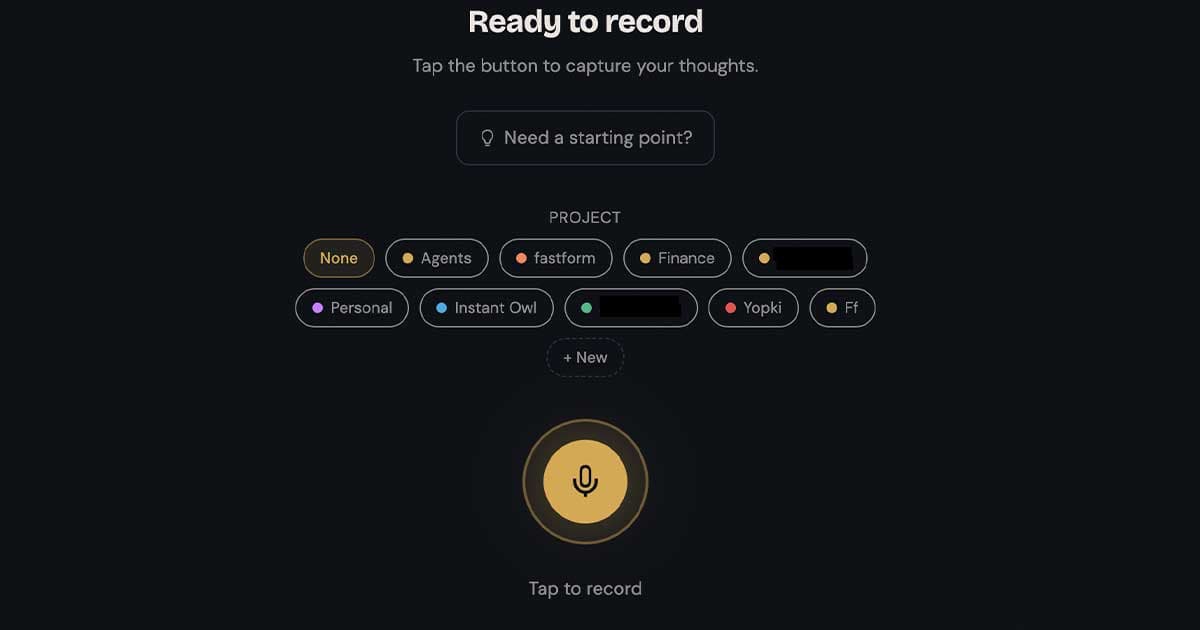
Full disclosure: InstantOwl is our product, and this blog belongs to it, so we have a stake in this comparison. With that said, InstantOwl's job is different from both tools above. You talk, and it organizes the ramble into notes and extracted tasks automatically, sorted into the project it belongs to. InstantOwl is currently free to use.
Think of it as a third row on the table AudioPen's own comparison started: Superwhisper gives you your words, cleaned up. AudioPen gives you your idea, rewritten. InstantOwl gives you your brain dump, organized. For the two tools this post covers in full, read our Superwhisper review and our AudioPen review.
Which should you pick?
If you write for a living, or dictate into other apps all day (email, code comments, Slack, a manuscript), pick Superwhisper. You want your own words back, accurately, at your cursor, and you are willing to spend a few minutes configuring modes to get there. Mac users who want that processing to stay fully offline get the strongest case for it.
If you think out loud and want the mess turned into something readable without editing it yourself, pick AudioPen. You are paying for the rewrite, not the transcript, and the prepaid-pass model means you are never stuck in a subscription you forgot about.
If what you actually want back is structure, not just clean prose, that is neither tool's job. For a third dictation-first comparison in this same category, see Wispr Flow vs Superwhisper, or start with the full dictation software roundup if you are still narrowing down the field.
Related reading
- Superwhisper review: full pricing, privacy, and platform details.
- AudioPen review: full pricing, style options, and where it stops.
- Wispr Flow vs Superwhisper: a third dictation-first comparison in the same category.
Frequently asked questions
Is Superwhisper free?
Yes, with limits. Superwhisper's free tier includes unlimited use of its small AI models, per its own homepage. Pro costs $8.49 a month or $84.99 a year, and a one-time $249.99 lifetime option skips the subscription entirely. Every paid trial is capped at 15 minutes of recording, and refunds are available within 30 days on any plan.
Is AudioPen a subscription?
No. AudioPen sells prepaid passes, not a subscription: 3 months for $33, 1 year for $99, and 2 years for $159, each paid once with no auto-renewal, per its own site: 'No subscriptions. No auto-renewals. Pay once, use for the full period.' There is no monthly plan and no lifetime plan today.
Can Superwhisper clean up my rambling?
A little, not the way AudioPen does. Superwhisper's modes can lightly reformat what you said, but the product is built to hand back your own words, cleaned up, not to rewrite a ramble into a finished piece of writing. AudioPen's own comparison of the two draws this exact line: Superwhisper gives you a clean version of what you said, AudioPen gives you something rewritten.
What is better than Superwhisper?
It depends on the job. For your own words back, cleaned up, at your cursor, Superwhisper is hard to beat, especially for offline, Mac-first use. For a ramble turned into a finished piece of writing, AudioPen is built for that instead. For the same ramble organized into notes and tasks rather than one document, that is what InstantOwl, a competitor, does, and it is currently free to use.

Written by
Jim BreeseJim Breese is the founder of InstantOwl. He's spent 15 years building companies, from an Airbnb host community he founded and exited to growth leadership at venture-backed SaaS startups. He built InstantOwl because his best ideas kept arriving mid-walk, out of order, and half-finished.
Stop losing good ideas.
InstantOwl turns a rambling voice note into a clean, organized document in moments. Just talk. We'll organize it.
 Try InstantOwl free